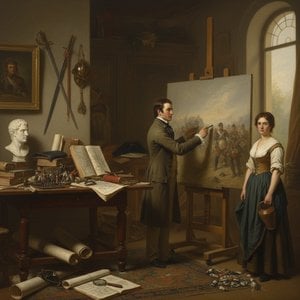
Christian Leopold Bode (1831 – 1906): A Painter of Romantic Detail
Christian Leopold Bode (born March 11, 1831, in Offenbach am Main; died July 26, 1906, in Frankfurt am Main) stands as a cornerstone figure within German Romanticism and Realism—a painter whose unwavering dedication to meticulous observation transformed everyday life into canvases brimming with evocative emotion and breathtaking visual precision. Son of landscape artist Georg Wilhelm Bode and Anna Maria, Bode’s artistic lineage instilled within him a profound appreciation for capturing the beauty of both natural landscapes and human experience. From 1848, he embarked upon formal training at the Städel in Frankfurt, nurtured by the guidance of Jakob Becker and Johann David Passavant—a formative period that cemented his stylistic foundations.
A pivotal juncture arrived in 1851 when Bode welcomed Eduard von Steinle as mentor, broadening his artistic horizons and deepening his understanding of artistic expression. Shortly thereafter, he married Catharina Elisabeth Geiger (1826–1856), initiating a familial partnership marked by mutual support and shared passion for the arts—a relationship that profoundly influenced his creative trajectory. Upon graduating in 1859, Bode solidified his bond with Mary Margaret Bode, establishing a household and raising three children amidst an environment conducive to artistic contemplation. His studio resided at the Städel, mirroring the grandeur of Schloss Eisenburg in Offenbach—a location that served as an enduring muse for countless exterior and interior vistas meticulously rendered on canvas.
Bode’s artistic vision was undeniably shaped by the Romantic movement, absorbing stylistic cues from luminaries like Caspar David Friedrich and Eugène Delacroix. Yet, he possessed a remarkable sensitivity to Realist tendencies, mirroring the techniques of Wilhelm Leibl and Anton Melbye—demonstrating an intellectual grasp of prevailing artistic currents. This duality fueled his ability to portray subjects with both palpable emotion and unwavering fidelity to visual reality.
- Key Characteristics: Bode’s oeuvre distinguishes itself through a harmonious blend of Romantic idealism and Realist observation. He achieved renown for documenting commonplace scenes—bustling marketplaces, aristocratic salons, and tranquil rural landscapes—capturing the subtle interplay of light and color with unparalleled accuracy.
- Notable Subjects: Bode frequently depicted portraits of prominent figures from his era, alongside genre paintings that explored themes of domestic life and social interaction. His fascination with architectural spaces—particularly castles and palaces—yielded stunning depictions reflecting aristocratic grandeur and artistic refinement.
His most celebrated works include “Wolfgang Amadeus Mozart as a Boy,” an exquisitely detailed portrait capturing the youthful genius’s contemplative gaze and serene demeanor—a testament to Bode's mastery of tonal gradation and expressive brushwork. Furthermore, his panoramic views of Schloss Eisenburg exemplify his ability to convey atmosphere and grandeur with breathtaking visual impact. These canvases are housed in prestigious institutions across Germany, including the Bode Museum in Berlin and the Leopold Museum in Vienna—affirming Bode’s enduring legacy as a pivotal figure within German art history.
Recognizing Bode's considerable talent and unwavering commitment to artistic pursuits, Grand Duke Ernest Louis of Hesse bestowed upon him the honorary title of Professor in 1901—acknowledging his contribution to German scholarship and securing his place amongst the intellectual elite of his time. Bode passed away peacefully on July 26, 1906, leaving behind a profound artistic legacy that continues to inspire admiration and scholarly inquiry. His passing served as a poignant reminder of a life devoted entirely to the pursuit of beauty and truth—a testament to Bode’s enduring influence upon subsequent generations of artists.