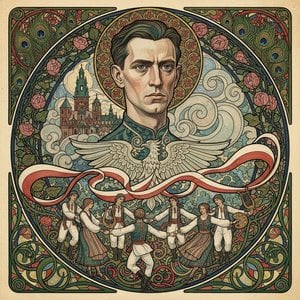
Leon Wyczółkowski
Leon Jan Wyczółkowski (1852 – 1936) was a Polish painter, considered one of the foremost figures of Young Poland and the principal representative of Polish Realism during the interbellum period. His artistic journey began in Huta Miastowska, where he was born on April 11th, 1852. He pursued his education at Kraków University, immersing himself in the burgeoning artistic landscape of Austro-Hungarian Poland. Wyczółkowski’s formative years were marked by exposure to influential artists and movements—particularly Impressionism—which profoundly shaped his stylistic approach. This influence is evident in his meticulous observation of nature and his masterful use of light and color, characteristics that define much of his oeuvre. He honed his skills at the Jan Matejko Academy of Fine Arts in Kraków from 1895 to 1911 and later continued his teaching career in Warsaw until 1934.Artistic Contributions and Style
Wyczółkowski’s artistic vision centered on capturing the essence of Polish life—the everyday scenes, rural landscapes, and portraits of ordinary people—with unwavering realism. He rejected academic conventions, favoring instead a direct engagement with visual experience. His canvases pulsate with vitality, conveying not merely what he saw but also what he felt about his subjects. This commitment to truthfulness distinguishes him from many of his contemporaries who experimented with abstraction or idealized representations. His distinctive style—characterized by detailed brushwork and luminous color palettes—became synonymous with Polish Realism. He meticulously rendered textures and nuances, striving for an unparalleled level of accuracy. Notable works include “Zaporizhian Camp” by Józef Brandt, a monumental depiction of Ukrainian Cossack life that exemplifies Wyczółkowski’s ability to convey grandeur and emotion simultaneously. Similarly, “Call to Arms” by Brandt showcases his masterful command of composition and dramatic lighting—elements he skillfully employed throughout his career.Notable Works and Collections
Wyczółkowski's artistic legacy extends beyond individual paintings; it resides in the enduring influence he exerted on subsequent generations of Polish artists. His meticulous technique and unwavering dedication to portraying reality established a benchmark for realism that continues to inspire admiration. Several museums across Poland proudly display his masterpieces, offering visitors an opportunity to appreciate his unparalleled talent: * The Museum Narodowe w Warszawie houses an extensive collection spanning centuries of Polish art history, including numerous Wyczółkowski landscapes and portraits. * Muzeum Warszawy showcases a rich panorama of European painting from the 15th to the 18th centuries, featuring prominent works by Wyczółkowski alongside artists from across Europe. * Wyczółkowski’s canvases are prominently featured in Muzeum Pomorskie (Danzig), dedicated to preserving Pomeranian heritage and celebrating its artistic traditions.Influences and Legacy
Wyczółkowski's artistic sensibilities were deeply rooted in the Romantic tradition, particularly the works of Eugène Delacroix—whose expressive brushwork and vibrant color harmonies served as a crucial inspiration. He absorbed lessons from Rembrandt van Rijn’s masterful use of chiaroscuro, mastering the technique of creating dramatic contrasts between light and dark to heighten emotional impact. Furthermore, he mentored young artists like Sargent and Toulouse-Lautrec, shaping their artistic development and ensuring that Wyczółkowski's stylistic principles would endure for decades to come. Leon Wyczółkowski’s unwavering pursuit of realism—combined with his profound sensitivity to the human condition—solidified his place as one of Poland’s most celebrated painters. His enduring influence continues to resonate within the art world, reminding us of the power of observation and the importance of conveying truthfulness through artistic expression.Domande e risposte
Quali colori ha usato più spesso Leon Wyczółkowski?
L'uso del colore di Leon Wyczółkowski nelle opere elencate su questo sito può essere approfondito consultando la pagina Genoma della Palette dell'artista.
Dove si trovano le opere di Leon Wyczółkowski raggruppate per movimento artistico?
Le opere di Leon Wyczółkowski possono essere consultate per movimento nella pagina Tutti i movimenti dell'artista.
In quale città e in quale paese è nato/a Leon Wyczółkowski?
Leon Wyczółkowski è nato a Huta Miastowska, in Poland.
Di dove è Leon Wyczółkowski?
Leon Wyczółkowski è nato/a in Poland.
Esiste una linea del tempo delle opere di Leon Wyczółkowski?
Esiste una cronologia delle opere di Leon Wyczółkowski: la pagina Cronologia opere dell'artista ordina le opere per data di creazione.
Quali sono il luogo e l'anno di nascita di Leon Wyczółkowski?
Leon Wyczółkowski è nato a Huta Miastowska nel 1852.
Dove si trovano le opere di Leon Wyczółkowski raggruppate per parole chiave?
Le opere di Leon Wyczółkowski possono essere esplorate tramite parole chiave nella pagina Per parole chiave dell'artista. Ogni parola chiave raggruppa le opere correlate.