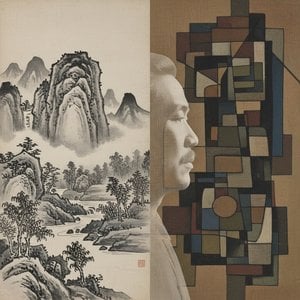
Kang Woo Lee: Bridging East and West Through Vibrant Expression
Lee Kang-woo, born in Seoul, South Korea in 1978, is an actor who has unexpectedly transitioned into a prolific visual artist, captivating audiences with both his performances on screen and his mesmerizing canvases. While initially recognized for roles in acclaimed Korean dramas like “The Taste of Money” and “The Missing,” Lee’s breakthrough came with the globally popular television series “Extraordinary Attorney Woo,” cementing his status as one of South Korea's most recognizable faces and establishing him as a significant figure within contemporary Korean art.
Early Life & Artistic Beginnings
Lee Kang-woo’s fascination with art began during his formative years, nurtured by exposure to diverse artistic traditions – particularly the influence of Lee Ungno Museum's collection and its exploration of Korean master Lee Ungno’s distinctive style. This early immersion instilled in him a deep appreciation for color palettes and textural explorations that would later permeate his artwork. He credits this initial encounter with Lee Ungno’s expressive brushwork as a formative experience, shaping his artistic sensibilities from the outset.
Exploring Abstract Expressionism
His artistic journey took root in abstract expressionism, characterized by spontaneous gestures and emotional intensity. Influenced by artists like Willem de Kooning and Jackson Pollock, Lee utilizes bold colors and dynamic brushstrokes to convey feelings of movement and energy—a stylistic choice mirroring the dynamism inherent in Korean culture and reflecting a desire to communicate universal human experiences. He deliberately abandons representational accuracy, prioritizing instead the visceral impact of color and texture on the viewer’s perception.
The “Road-Speed-Fate” Series: Landscapes of Symbolism
Lee’s distinctive approach is particularly evident in his “Road-Speed-Fate” series, where he employs layered textures and vibrant hues to depict landscapes imbued with symbolic resonance. These paintings aren't merely representations of places; they are meditations on themes of journey, destiny, and the interplay between nature and human emotion—concepts deeply rooted in Korean philosophical traditions. The meticulous layering technique showcases his dedication to capturing subtle nuances of light and shadow, mirroring the careful consideration given to artistic detail within Korean art history. Each canvas embodies a profound contemplation of existence, inviting viewers to contemplate the interconnectedness of past, present, and future.
Recognition & Exhibitions
Beyond his acting career, Lee Kang-woo’s artistic endeavors have garnered considerable acclaim. His exhibitions across Korea and internationally demonstrate a commitment to pushing creative boundaries and engaging viewers in contemplative dialogue. Notably, he participated in “Lee Jae-Kyung” at Gallery Hyundai, where he showcased installations and process-oriented works that explored themes of memory and transformation—a testament to his willingness to experiment with unconventional artistic mediums. Furthermore, his work was featured prominently in “The Best of Times and The Worst of Times,” a dual exhibition exploring Korean art history alongside contemporary perspectives on artistic expression.
Legacy & Artistic Significance
Lee Kang-woo represents a fascinating convergence of talent—actor and artist—who successfully blends Korean cultural heritage with modern artistic sensibilities. He exemplifies the evolving landscape of Korean art, demonstrating how artists can draw inspiration from tradition while forging their own unique visual language. His work contributes to a broader understanding of Korean identity and artistic expression on the global stage. By seamlessly integrating performance and visual art, Lee Kang-woo has established himself as an innovator who challenges conventional notions of artistry and invites audiences to engage in profound reflection—a legacy that secures his place as one of Korea’s most compelling contemporary voices.