A Life Woven in Domestic Grace
Born into a world of intellectual and artistic vibrancy in London in 1852, Laura Theresa Alma-Tadema (née Epps) emerged as a delicate yet profound voice within the Victorian art scene. As the youngest daughter of Dr. George Napoleon Epps, a homeopathic physician whose social circle included the legendary Charles Dickens, Laura was raised in an environment where storytelling and observation were paramount. Her upbringing was steeped in a familial devotion to the arts; her sisters, Emily and Ellen, also pursued painting under the guidance of notable masters like Ford Madox Brown and John Brett. This shared lineage of creativity provided the foundation for a life dedicated to capturing the quiet, intimate rhythms of human connection.
Her personal journey became inextricably linked with one of the most celebrated figures of the era when she married the renowned neoclassical painter Lawrence Alma-Tadema in 1871. This union was not merely a romantic bond but a profound artistic partnership. While her husband commanded the grand stages of classical antiquity, Laura found her mastery in the more tender, localized realms of domesticity and genre painting. She possessed a unique ability to transform the mundane into the monumental, finding deep emotional resonance in the simple interactions between women and children.
The Art of Sentiment and Nostalgia
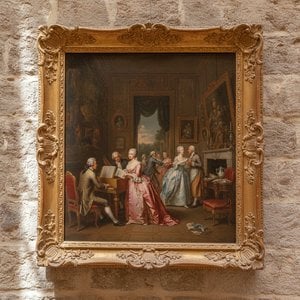
Laura Theresa Alma-Tadema’s oeuvre is characterized by a poignant, sentimental beauty that speaks directly to the heart. She specialized in genre scenes that often transported her viewers to a romanticized version of the 17th-century Dutch era. Through her brush, one can wander through sun-drenched interiors, observing the meticulous detail of period costumes and the soft play of light upon fabric. Her work does not merely depict a moment in time; it evokes a sense of longing for a lost, simpler era of innocence and domestic tranquility.
Her technical approach was marked by a delicate touch, often focusing on the following elements:
- Intimate Subject Matter: A focus on the private lives of women and the tender care of children.
- Historical Costume: The use of Dutch 17th-century attire to lend an air of timelessness and elegance to her subjects.
- Atmospheric Light: A mastery of soft, diffused lighting that enhances the emotional warmth of her domestic settings.
- Narrative Depth: Creating scenes that suggest a larger story unfolding just beyond the frame.
Beyond her own independent compositions, Laura served as a frequent and graceful subject for her husband’s canvases. This interplay between artist and muse created a rich visual dialogue within their shared life, where the boundaries of portraiture and genre painting often blurred into a singular vision of beauty.
Legacy and Historical Significance
Throughout her career, which spanned from 1873 to 1909, Laura Theresa Alma-Tadema achieved significant recognition within the British art establishment. Her frequent exhibitions at the prestigious Royal Academy—totaling eighteen works over several decades—cemented her status as a respected painter of her time. While much of the historical focus has often rested upon the grander classical works of her husband, contemporary appreciation has begun to rediscover the vital importance of her contribution to Victorian genre painting.
Her significance lies in her ability to capture the psychological nuances of domestic life, providing a feminine perspective on the era's social structures. She documented the sanctity of the home and the emotional landscape of motherhood and childhood with a sincerity that remains captivating. When she passed away in London in 1909, she left behind a legacy of warmth and light, reminding us that there is profound artistry to be found in the quietest corners of human existence.