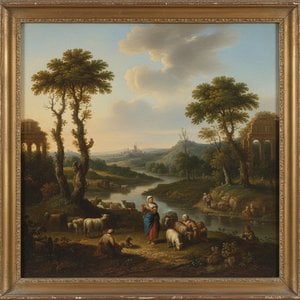
A Vision of Pastoral Beauty: Exploring the Artistry of Ker-Xavier Roussel
Ker-Xavier Roussel (1867 – 1944) stands as a singular figure within the Nabi movement, a collective of French painters who sought to liberate art from academic conventions and embrace Symbolist ideals. Born François Xavier Roussel in lorry-lès-metz, Moselle, his artistic journey began modestly but swiftly gained momentum thanks to formative connections with fellow artists like Édouard Vuillard and Diogène Maillart. These friendships fostered a shared intellectual curiosity and propelled them toward the influential studio of Mauryce Denis, establishing the core of Les Nabis – a group dedicated to capturing fleeting impressions and conveying profound emotional resonance.
Early Influences & Training
Roussel’s formal education at the École des Beaux-Arts in Paris provided him with foundational skills but it was his immersion in Maillart's studio that truly ignited his artistic spirit. Here, he honed his technique and absorbed the stylistic nuances of Impressionism alongside Vuillard and Denis, shaping his distinctive visual language. The meticulous observation of nature—particularly landscapes bathed in sunlight—became a cornerstone of Roussel’s artistic practice, mirroring the pioneering efforts of Cézanne to represent form accurately while simultaneously conveying its underlying essence.
The Nabi Aesthetic
Les Nabis championed a rejection of realism, prioritizing atmosphere and emotion over meticulous detail. Roussel’s canvases are characterized by muted palettes—often dominated by blues and greens—that evoke the tranquility of rural landscapes. However, these serene vistas rarely depict empty spaces; instead, they populate them with figures – women, nymphs, and fauns – imbued with mythological symbolism. This deliberate stylistic choice reflected a broader philosophical preoccupation with exploring the subconscious mind and conveying spiritual truths—a hallmark of Symbolist thought that profoundly influenced Roussel’s artistic vision. His paintings are marked by an understated elegance and a masterful use of color, creating images that resonate with both visual beauty and intellectual depth.
Notable Works & Artistic Development
Roussel's oeuvre includes iconic pieces like "Woman In Red In A Landscape" and “Woman in striped dress.” These paintings exemplify his mastery of color and composition, capturing the ethereal beauty of rural scenes with remarkable sensitivity. He experimented extensively with pastel—a medium favored by Vuillard—producing luminous works that convey a palpable sense of immediacy and emotion. His exploration of mythological themes—particularly depictions of Diana and Leucippus—demonstrates his engagement with classical literature and art history, reflecting a desire to elevate painting beyond mere representation into a realm of symbolic expression.
Recognition & Legacy
Roussel’s artistic endeavors garnered considerable acclaim, culminating in a prestigious Carnegie Prize for Art in 1926. Furthermore, Gertrude Stein's autobiography recounts an insightful conversation between Roussel and Theodore Duret concerning the challenges faced by Nabi painters in gaining recognition from the bourgeois public—a poignant reflection on the societal context of his era. His enduring legacy resides not merely in his visual achievements but also in his unwavering commitment to artistic integrity—a testament to the transformative power of pursuing one’s creative vision against prevailing societal pressures. He passed away peacefully in 1944 at his home in l'étang-la-ville, Yvelines, leaving behind a body of work that continues to inspire admiration and contemplation.