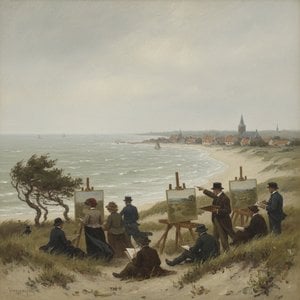
Still Life with a Group of Eight Mackerel in a Broken Basket A Study on Yarmouth Beach, Norfolk
The River at Thorpe, Norfolk
Landscape
Art period: XIX secolo
Museums on APS:
National Trust
Fitzwilliam College
Lifespan: 33 years
Joseph Stannard: A Norfolk Master of Light and Landscape
Joseph Stannard (1797–1830) stands as a remarkable figure within the Norwich School of Painters, an artistic movement that flourished in Norfolk during the early Victorian era. Born in Norwich on September 13th, 1797, his formative years were shaped by the tutelage of John Crome—a celebrated landscape artist himself—who recognized Stannard’s prodigious talent and secured him a place at Norwich Grammar School. Despite facing financial difficulties that necessitated a shift to Robert Ladbrooke as instructor, Stannard's artistic journey quickly gained momentum, establishing him as a prominent voice within the burgeoning Norfolk art scene.
Early Career & Societal Recognition
From his debut exhibition in 1811 at Norwich Society of Artists—a young boy showcasing remarkable skill—Stannard’s work garnered positive reviews in publications like The Norwich Mercury, cementing his reputation as a gifted artist. This initial success demonstrated not only his artistic aptitude but also the burgeoning appreciation for regional art within Norfolk society. His teacher Robert Ladbrooke's portrait captures Stannard with confidence and awareness of his considerable abilities—a visual testament to the formative influence of Crome’s guidance.
Dissociation and Rivalry
Demonstrating ambition and artistic conviction, Stannard severed ties with the Norwich Society of Artists in 1816, forging ahead with a rival organization that briefly enjoyed success. This decisive action underscored his desire for independent artistic endeavors—a characteristic that would define much of his subsequent career. The tensions surrounding this separation reflected the competitive spirit prevalent within Norfolk’s artistic circles and fueled Stannard's determination to establish himself as a singular voice in landscape painting.
Dutch Influences & Artistic Technique
Stannard’s stylistic evolution was profoundly influenced by Dutch masters—particularly Rembrandt and Vermeer—whom he meticulously studied during a trip to Holland in 1821. These encounters instilled within him an appreciation for chiaroscuro, atmospheric perspective, and the careful rendering of light and shadow—techniques that would become hallmarks of his oeuvre. He sought to emulate the masterful use of illumination found in Dutch paintings, striving to achieve similar emotional depth and visual realism in his own compositions.
Thorpe Water Frolic: A Masterpiece of Norfolk Landscape
His magnum opus, “Thorpe Water Frolic,” completed in 1825, exemplifies this mastery, capturing the serene beauty of Thorpe Waters with breathtaking realism and conveying a palpable sense of tranquility. The painting’s composition—balanced and harmonious—further solidified Stannard's position as one of Norfolk’s foremost landscape artists. It depicts a lively summer afternoon event attended by Norwich’s textile workers, civic dignitaries, and aristocracy – a social document reflecting the aspirations of Georgian England. Particular attention was paid to capturing the nuances of weather conditions and the dramatic cloudscape that frames the joyous occasion.
Legacy & Family Connections
Sadly, Stannard's life was tragically curtailed by tuberculosis, succumbing to the illness in 1830 at the young age of thirty-three. Despite his brief career, Joseph Stannard left an indelible mark on Norfolk art history and cemented his place as a pivotal figure within the Norwich School—a testament to his dedication, talent, and unwavering pursuit of artistic excellence. His daughter, Emily Stannard, and several other relatives continued the tradition of artistic creation, ensuring that Stannard’s influence endured across generations. Furthermore, Stannard's family history is intertwined with Norfolk’s artistic heritage, mirroring the broader Romantic preoccupation with familial bonds and creative legacy.
A cura del team editoriale di WahooArt.com
Quiz d'arte
Per ogni domanda è presente una sola risposta corretta.
Domanda 1:
Qual è stato l'influsso artistico principale che Joseph Stannard ha tratto durante i suoi primi anni, in particolare dopo un viaggio nei Paesi Bassi?
Domanda 2:
Quale pittore norwichiano importante ha diretto Joseph Stannard all'inizio della sua carriera artistica?
Domanda 3:
In quale anno Joseph Stannard si è sposato con Emily Coppin, un’artista nota per i suoi nature morte?
Domanda 4:
Quale tipo di arte eccelleva Emily Stannard dopo la morte del marito?
Domanda 5:
Nel suo lavoro più celebre, Thorpe Water Frolic, Stannard ha catturato la bellezza della campagna norwichiana con quali principi artistici?
Explore the ethereal beauty of the Hague School art movement. Discover how masters like Jan Weissenbruch captured the atmospheric grey light of the Dutch landscape through unparalleled technique and emotive, misty compositions.