Johannes Voorhout: A Dutch Master of Baroque Allegory
Johannes Voorhout (1647-1723) stands as a prominent figure within the Dutch Golden Age, celebrated for his masterful depictions of historical narratives and portraits imbued with symbolic richness. Born in Amsterdam, he descended from a family steeped in craftsmanship – his father was a clockmaker – foreshadowing a life dedicated to artistic pursuits rather than purely technical trades. Recognizing his son’s innate talent for drawing, Cornelis Voorhout skillfully steered him towards an apprenticeship under Constantijn Verhout in Gouda, where Johannes honed his skills in portraying contemporary history scenes. This formative experience profoundly shaped Voorhout's artistic sensibilities and established a foundation for his subsequent career.
Following six years of training, Johannes relocated to Amsterdam in 1664, joining the workshop of Jan van Noordt, a fellow historian and portraitist. Here, he cultivated collaborations that broadened his artistic horizons and solidified his reputation as a skilled craftsman. His marriage in 1670 brought stability to his life, and spurred by anxieties surrounding impending French invasion, he bravely evacuated the country in 1672, finding refuge in Friedrichstadt, where his wife had connections. Encouraged by Juriaan Ovens’ counsel, Voorhout ventured into Hamburg, securing a position with Ovens and discovering considerable success – a testament to his adaptability and ambition. His son, Johannes II, was born in 1677, marking the continuation of Voorhout's artistic lineage.
Voorhout’s artistic trajectory took another decisive turn when he accepted Dirk Clant’s commission for a monumental portrait of William III on horseback—a piece destined for Clant’s castle near Groningen and subsequently enshrined as an over-the-mantel decoration. This ambitious undertaking showcased Voorhout's technical prowess and cemented his place in royal patronage, notably influencing the design of the 500 guilder banknote issued during William III’s reign. Returning to Amsterdam in 1677, he established his own studio, fostering a new generation of artists and continuing to refine his artistic vision. Despite facing competitive pressures within Amsterdam's burgeoning art market—a consequence of its prolific output of talented painters—Voorhout remained steadfast in his dedication to painting itself. As Houbraken aptly observed, he perhaps prioritized artistic exploration over commercial considerations like flattery and deception.
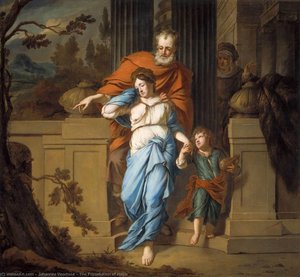
His legacy extends beyond individual artworks; Voorhout’s influence can be discerned in the stylistic conventions of Baroque allegory, where he skillfully blended historical accuracy with symbolic representation—a hallmark of his oeuvre. Works such as ‘Allegory of Treaty of Ryswick,’ ‘Finding of Moses,’ and ‘Aurora’ exemplify this approach, demonstrating a profound understanding of visual language and conveying complex narratives through evocative imagery. Furthermore, Voorhout's contribution to Dutch art history is underscored by the enduring fame of his portrait of William III—a masterpiece that continues to captivate audiences today and serves as a tangible reminder of the grandeur and artistic achievements of the Golden Age.
Johannes Voorhout’s distinctive style was characterized by meticulous detail and an unwavering commitment to capturing the essence of historical events. He excelled in portraying scenes from biblical narratives and mythological tales, imbuing them with moral lessons and conveying profound spiritual contemplation. His compositions often featured dramatic lighting—a technique borrowed from Caravaggio—creating a sense of theatrical grandeur and emphasizing key figures within the artwork. Voorhout’s mastery of perspective and anatomical accuracy further elevated his paintings, reflecting the humanist ideals prevalent during his time.
Among his most celebrated achievements is undoubtedly the portrait of William III on horseback commissioned by Dirk Clant—a monumental undertaking that solidified Voorhout's reputation as a royal artist and demonstrated his exceptional technical skill. This artwork exemplifies Voorhout’s ability to convey regal dignity and authority through masterful brushwork and compositional balance. It remains a testament to the artistic standards of the era and continues to inspire admiration for its grandeur and beauty.
His influence extended beyond his own creations, shaping the aesthetic sensibilities of subsequent generations of Dutch painters. Voorhout's meticulous approach to rendering light and shadow—a hallmark of Baroque art—became an enduring element in the stylistic vocabulary of many artists who followed him. His dedication to portraying historical narratives with accuracy and symbolism served as a model for aspiring historians and visual artists alike, ensuring that his legacy would endure throughout Dutch artistic history.