Johann Friedrich Grueber: A Quiet Master of Leiden Still Life
Johann Friedrich Grueber (1620, Leiden, Netherlands – 1681) represents a cornerstone of the Leiden School of painting—a movement that distinguished itself during the Dutch Golden Age for its meticulous observation and profound artistic subtlety. Unlike many artists of his era who pursued fame through monumental canvases or dramatic portraits, Grueber’s singular focus was on capturing the serene beauty of commonplace objects within exquisitely detailed still lifes, cementing his position as a pivotal figure in this influential artistic tradition.
Born amidst the intellectual fervor of Leiden—a city deeply rooted in Calvinist scholarship and humanist ideals—Grueber's formative years were inextricably linked to the artistic sensibilities of his time. His training undoubtedly benefited from exposure to Rembrandt Harmensz van Rijn, arguably the most revered painter of his epoch, whose masterful manipulation of chiaroscuro and psychological depth profoundly shaped Grueber’s compositional choices and tonal palette. The Leiden School's dedication to faithfully portraying light and shadow—a technique perfected by Rembrandt—became an indispensable element in Grueber’s artistic methodology.
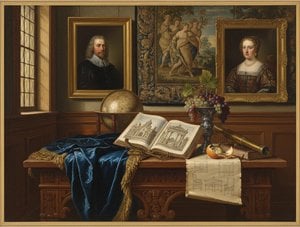
Grueber’s artistic output amounted to approximately eighty paintings, predominantly still lifes populated with fruits, flowers, insects, and occasionally animal specimens arranged with painstaking precision against dark backgrounds. These works stand apart for their astonishing level of realism achieved through the meticulous layering of glazes—a technique that enabled Grueber to convey subtle nuances in color and texture, resulting in surfaces possessing an almost ethereal luminescence. He skillfully incorporated atmospheric perspective, subtly blurring distant elements to simulate the effects of air and distance, thereby amplifying the illusion of depth and maximizing the visual impact of his compositions.
The symbolic resonance embedded within Grueber’s paintings speaks volumes about the cultural ethos of seventeenth-century Holland. Still lifes transcended mere decorative considerations; they functioned as contemplative explorations of mortality and the cyclical rhythms inherent in nature—themes deeply intertwined with Calvinist theology. The deliberate inclusion of decaying fruit or insects served as poignant reminders of impermanence and underscored the importance of accepting God’s divine providence. Yet, amidst this solemn reflection, Grueber manages to evoke a palpable tranquility and beauty—a testament to his artistic prowess and sensitivity.
Despite achieving considerable success during his lifetime, Grueber remained largely unrecognized in terms of fame until after his death, overshadowed by Rembrandt's unparalleled renown. However, contemporary art historians now acknowledge Grueber’s contribution as indispensable to the Leiden School’s enduring legacy. His unwavering devotion to realism and tonal gradation solidified the movement’s aesthetic principles, ensuring that his paintings continue to resonate with audiences across centuries—a poignant reminder of a time when artistic excellence resided not in grand spectacle but in quiet contemplation—a profound embodiment of the humanist spirit that characterized the Dutch Golden Age.