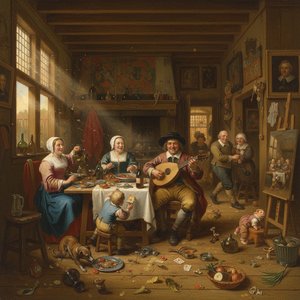
Johan George Collasius: A Dutch Portraitist of Refined Elegance
Johan George Collasius (1698-1736) stands as a beacon of artistic achievement within the Dutch Golden Age, his reputation cemented primarily through captivating portraits and meticulous drawings that capture the essence of aristocratic refinement. Born in Utrecht, Netherlands, Collasius’s creative journey unfolded amidst the burgeoning Rococo movement – an aesthetic celebrated for its opulent ornamentation and graceful curves, reflecting a desire to elevate social status through visual representation.
Early Life & Training
Details surrounding Collasius's early years remain scarce, primarily limited to his birthdate. However, he received invaluable formative training in Haarlem, a thriving artistic hub at the time, mastering his craft under the watchful guidance of Willem van Gouda and Cornelis van Asselen – masters who skillfully blended classical ideals with the emerging allure of Rococo tendencies. This dual influence shaped Collasius’s artistic vision from its inception.
Style & Technique
Collasius's distinctive style was characterized by an unwavering dedication to realism interwoven seamlessly with Rococo embellishments. He expertly utilized oil paints on canvas, achieving luminous textures and capturing subtle nuances of emotion in his subjects – a testament to his profound understanding of human psychology. Beyond mere depiction, Collasius meticulously rendered fabrics, jewelry, and architectural settings, crafting an immersive atmosphere that conveyed grandeur and sophistication. His meticulous attention to detail ensured that every brushstroke communicated a sense of purpose and artistic intention.
Notable Works: Hieronymus Josephus Boudaen, Lord of St Laurens and Popkensburg
Collasius’s prolific output included numerous portraits commissioned by influential families and dignitaries – individuals determined to commemorate their lineage and solidify their position within society. Among his most enduring achievements is undoubtedly ‘Hieronymus Josephus Boudaen, Lord of St Laurens and Popkensburg,’ completed in 1750. This monumental painting exemplifies Collasius’s mastery of Rococo technique and embodies the spirit of aristocratic patronage during Louis XV's reign. The composition skillfully utilizes light and shadow to illuminate Boudaen’s noble countenance, conveying both dignity and inner contemplation – a hallmark of Collasius’s artistic prowess.
Influences & Artistic Context
Collasius’s artistic sensibilities were undeniably shaped by the prevailing currents of European art, particularly French Rococo under Louis XV. Artists like François Boucher and Jean-Honoré Fragonard exerted considerable influence on Collasius’s stylistic choices – fostering a shared fascination with idealized beauty and playful ornamentation. This engagement with contemporary trends underscored Collasius's commitment to artistic innovation while simultaneously reflecting the broader cultural landscape of his era.
Legacy & Historical Significance
Though Collasius’s life tragically concluded prematurely at the age of 38 due to illness, his artistic legacy endured, securing his place as one of the most accomplished portraitists of his generation. His paintings continue to captivate audiences today, offering invaluable insights into the social and cultural values of the Dutch Golden Age – a period synonymous with artistic brilliance and unparalleled splendor. Collasius’s meticulous craftsmanship and evocative portrayal of human emotion stand as enduring symbols of artistic excellence, ensuring that his work remains relevant and inspiring for generations to come.