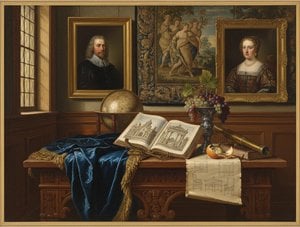
Johan de la Rocquette: A Dutch Portraitist of Refined Elegance
Johan de la Rocquette (1640 – 1694) represents a cornerstone of seventeenth-century Dutch art, specifically within the genre of portraiture—a field where subtlety and psychological insight reigned supreme. Born in Utrecht, Netherlands, his life unfolded during an era brimming with intellectual curiosity and humanist ideals; these currents subtly permeated his artistic vision, resulting in paintings that transcend mere likeness to convey profound emotion and contemplation. Biographical details concerning Rocquette’s early years remain elusive, yet meticulous records indicate a dedicated craftsman committed to capturing the essence of his subjects with unparalleled precision and understated grace—a testament to Leiden's artistic tradition.
Early Life & Training: The Crucible of Skill
Precise information regarding Rocquette’s formative years is scarce, hindering our ability to reconstruct his artistic genesis. However, he embarked upon a crucial apprenticeship under Gerrit Dou, a Leiden artist celebrated for his masterful manipulation of chiaroscuro—the dramatic interplay of light and shadow—a technique that would become inextricably linked with Rocquette's distinctive style. This mentorship instilled in him an unwavering commitment to anatomical accuracy and compositional balance; Dou’s influence ensured that Rocquette possessed the foundational knowledge necessary to excel as a painter, shaping his artistic sensibilities from their earliest stages.
Style & Technique: Mastering Light and Texture
Rocquette’s oeuvre distinguishes itself through a restrained palette—favoring muted tones and delicate gradations—a deliberate choice designed to foster an atmosphere of serene contemplation. Unlike the opulent grandeur favored by many Baroque artists, his canvases eschewed ostentation in favor of quiet dignity and psychological depth. He skillfully harnessed chiaroscuro—inherited directly from Dou—to sculpt forms with light, meticulously highlighting texture and conveying nuanced emotions through subtle facial expressions and posture; this technique elevated Rocquette’s paintings beyond mere representation, transforming them into evocative explorations of human character. The resulting images possess an ethereal quality, reflecting the artist's profound understanding of visual perception and his ability to communicate inner states effectively.
Notable Works: Expressions of Dignity and Reflection
Rocquette’s artistic legacy rests primarily upon a select group of portraits that exemplify his stylistic prowess—works which continue to captivate viewers with their understated beauty and psychological resonance. “Portrait of Philippus Baldaeus and Gerrit Mossopotam,” executed in 1668, stands as an exemplar of Leiden portraiture at the time—a genre characterized by meticulous detail and masterful rendering of drapery. The painting portrays Baldaeus’s dignified countenance and Mossopotam's contemplative gaze, bathed in soft light that illuminates their features with remarkable subtlety; Rocquette’s careful observation of anatomy and his nuanced portrayal of emotion underscore the artist’s commitment to capturing the complexities of human experience. This portrait exemplifies Rocquette’s ability to transform a simple depiction into an enduring symbol of intellectual refinement and moral virtue.
Influence & Legacy: A Voice Within Leiden's Artistic Circle
Rocquette’s artistic endeavors align closely with the Leiden School’s artistic ethos—a movement dedicated to naturalism and psychological realism—reflecting the humanist values that underpinned Dutch society during his lifetime. He contributed to a broader tradition of Dutch portraiture that prioritized capturing inner character alongside external appearance, demonstrating an artist's sensitivity to both physical form and emotional expression. Though not as widely celebrated as some contemporaries—such as Rembrandt or Vermeer—Rocquette’s paintings endure today due to their inherent elegance and profound contemplation of human existence; his legacy resides not merely in individual masterpieces but in embodying a distinctive aesthetic sensibility that continues to inspire artists and scholars alike.
Later Life & Death: A Quiet Farewell
Information regarding Rocquette’s later life remains sparse, hindering our comprehensive understanding of his artistic trajectory. He continued to practice as an artist until his death in 1694—a testament to his unwavering dedication to craftmanship and his steadfast adherence to Leiden's artistic standards. His contribution to Dutch art history transcends mere visual representation; Rocquette’s work embodies a particular aesthetic sensibility—one rooted in observation, restraint, and a deep appreciation for human dignity—leaving an indelible mark on the artistic landscape of his era.