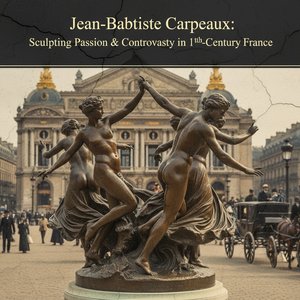
Jean-Joseph Perraud: The Sculptor of Imperial Grace
Jean-Joseph Perraud (1819 – 1876) stands as a cornerstone of French academic sculpture during the Second Empire, an era defined by opulent grandeur and fervent artistic patronage. Born in Jura, France—a region renowned for its artistic heritage—he descended from a family deeply rooted in sculptural tradition; his father himself practiced the craft, nurturing within him an innate predisposition for artistic expression. This familial legacy swiftly translated into exceptional talent, securing him admission to the École des Beaux-Arts in Paris under the watchful guidance of Étienne Jules Ramé and Auguste Alexandre Dumont—co-winners of the Prix de Rome in 1847—a scholarship that irrevocably propelled him toward the epicenter of Parisian artistic life and solidified his unwavering commitment to classical ideals.
Early Training & Influences: The Seeds of Mastery
Perraud’s formative years were profoundly shaped by Ramé's meticulous instruction on anatomical accuracy and Dumont’s insistence upon conveying expressive idealism. These mentors instilled in him a foundational understanding of sculptural technique—the precise manipulation of material to achieve desired forms—and aesthetic principles that would permeate his entire oeuvre. Ramé championed the dissection of cadavers as essential for mastering human anatomy, ensuring Perraud possessed an unparalleled grasp of musculature and skeletal structure. Dumont encouraged exploration of emotive gestures and facial expressions, fostering Perraud’s ability to imbue his sculptures with psychological depth—a hallmark of his distinctive style.
The Prix de Rome & Roman Inspiration: Echoes of Michelangelo
Winning the Prix de Rome in 1847 represented an unparalleled opportunity for Perraud—access granted to the Vatican Museums where he immersed himself in the monumental sculptures of antiquity, particularly those crafted by Michelangelo Buonarroti. This transformative experience instilled within him a reverence for scale and execution, mirroring Michelangelo’s masterful command of marble and conveying the sublime beauty of classical form. The sheer grandeur of Michelangelo's David and Pietà served as an indelible inspiration, shaping Perraud’s artistic vision and informing his subsequent endeavors—a testament to the enduring influence of Greco-Roman art on French sculpture during this period.
Military Service & Honors: Patriotism Embodied
Recognizing Perraud’s unwavering dedication to both artistic excellence and civic duty, he enlisted in the Légion d'honneur in 1867—a gesture signifying his commitment to serving France with distinction. This involvement broadened his horizons beyond the confines of Parisian ateliers, exposing him to diverse cultural landscapes and fostering a deeper understanding of national identity. His service further honed his observational skills and instilled within him a sense of responsibility for contributing to the artistic enrichment of his nation—a characteristic that resonated throughout his artistic career.
A Style Defined by Dignity & Restraint: Classical Ideals Revisited
Perraud’s sculptural style is instantly recognizable for its serene composure and meticulous attention to detail—a deliberate counterpoint to the turbulent Romantic fervor dominating the artistic landscape of his time. Unlike contemporaries who embraced dramatic emotion and subjective expression, he championed a restrained aesthetic firmly anchored in classical tradition—a conscious rejection of stylistic trends that prioritized sensation over intellect. His figures possess an inherent nobility, conveying grace and dignity through carefully sculpted musculature and drapery—a hallmark of his distinctive approach. He favored monumental sculptures depicting mythological subjects and historical portraits, reflecting the imperial ambitions of Napoleon III and celebrating heroic ideals. The resulting works are characterized by a profound sense of balance and harmony—a testament to Perraud’s artistic skill and unwavering devotion to classical principles.
Notable Works & Legacy: Monuments to Glory
Perraud achieved considerable renown for his ambitious projects commemorating significant events and honoring prominent figures—most notably the statue of Napoleon III erected in Paris’s Place Vendôme—a colossal undertaking that showcased his mastery of scale and technique, demonstrating an unwavering commitment to conveying grandeur and solemnity. This monumental sculpture stands as a symbol of imperial power and artistic achievement—a lasting testament to Perraud's contribution to French art history. Beyond this iconic monument, he produced numerous sculptures for public spaces and private commissions alike—each imbued with the same meticulous craftsmanship and profound understanding of classical ideals. His enduring legacy resides in his ability to capture the spirit of an era—the Second Empire—through timeless forms that continue to inspire admiration and scholarly study. He died peacefully in Paris in 1876, leaving behind a monumental contribution to French sculpture and cementing his place among the foremost artists of his generation.