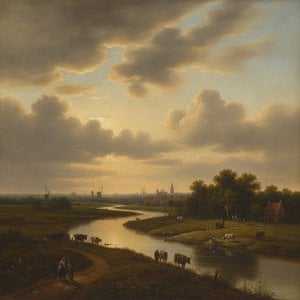
Jan Vermeer van Haarlem: The Quiet Master of Dutch Landscape
Jan Vermeer van Haarlem (1628 – 1691) stands as a singular figure within the illustrious tapestry of Dutch Golden Age painting, renowned not for dramatic narratives or heroic portraits but for an unparalleled sensitivity to light and atmosphere—a mastery that cemented his place among the most beloved artists of all time. Born in Haarlem, Netherlands, Vermeer’s artistic journey began under the tutelage of his father, Jan van der Meer I, a landscape painter who instilled in him a foundational understanding of capturing the beauty of the natural world. This formative influence would prove crucial to Vermeer's distinctive style and enduring legacy.Early Life & Training
Vermeer’s childhood was marked by familial hardship; his father’s business struggled financially, impacting the family’s circumstances. Despite these difficulties, Jan van der Meer I diligently nurtured his son’s artistic inclinations, recognizing the potential for greatness within young Johannes. Vermeer joined the Haarlem Guild of St. Luke in 1678, securing a stable livelihood and establishing himself as a respected professional artist—a significant step toward achieving his ambitions and solidifying his position within the artistic community. This guild membership provided access to resources and connections vital for furthering his creative endeavors.Influences & Artistic Development
Vermeer’s artistic development unfolded primarily during his time in Amsterdam, where he honed his skills and absorbed influences from contemporaries like Nicolas Berchem and Jacob Savertijt. Berchem's meticulous attention to detail and use of chiaroscuro—the dramatic interplay between light and shadow—served as a catalyst for Vermeer’s own stylistic innovations. Unlike many artists of his era who favored grand historical scenes or mythological allegories, Vermeer focused almost exclusively on landscapes and interiors, meticulously rendered with an astonishing degree of realism. He studied under Johannes Vermeer II, whose teachings further refined his technique and deepened his understanding of artistic principles.Distinctive Style & Technique
His canvases are characterized by a serene stillness, achieved through masterful manipulation of light—particularly diffused sunlight—that illuminates domestic spaces or tranquil countryside vistas. Vermeer’s palette consisted predominantly of muted earthy tones – ochre, umber, Sienna – blended subtly to create an illusionistic depth that captivated viewers. He employed a technique known as glazing, applying thin layers of translucent paint over previous coats to build up color and texture gradually—a method perfected by Berchem and ensuring remarkable luminosity and atmospheric perspective. This painstaking process demanded immense patience and precision, resulting in paintings imbued with an ethereal quality unmatched by his peers.Major Achievements & Legacy
Among his most celebrated works are “View of Haarlem from the Dunes” (circa 1657), “The Astronomer,” “Woman Reading a Letter,” and “The Milkmaid”—each depicting scenes of everyday life with an exquisite sense of observation and psychological insight. These paintings transcend mere representation; they evoke emotions and invite contemplation, capturing fleeting moments of beauty and tranquility that resonate powerfully across centuries. Vermeer’s influence extends far beyond his own lifetime, shaping subsequent generations of artists and establishing him as an icon of Dutch artistic excellence. Today, Jan Vermeer van Haarlem is revered as one of the greatest painters of the Dutch Golden Age—a testament to his unparalleled artistic vision and enduring ability to convey profound emotional resonance through deceptively simple compositions. His legacy continues to inspire admiration and scholarly study, securing his place in art history for generations to come.Domande e risposte
Posso esplorare le opere di Jan The Elder Vermeer Van Haarlem tramite parole chiave?
La pagina Per parole chiave di Jan The Elder Vermeer Van Haarlem raggruppa le opere dell'artista per parole chiave.
Dove e quando è nato Jan The Elder Vermeer Van Haarlem?
Jan The Elder Vermeer Van Haarlem è nato a Haarlem nel 1628.
Dove posso visitare il museo virtuale 3D con le opere di Jan The Elder Vermeer Van Haarlem?
È possibile effettuare una visita virtuale: la pagina Galleria 3D di Jan The Elder Vermeer Van Haarlem presenta le opere dell'artista all'interno di una galleria tridimensionale.