A Brush with Atmosphere: The Life and Art of James Alexander Johnstone
James Alexander Johnstone, a name perhaps less immediately recognizable than some of his celebrated contemporaries, nevertheless occupies a significant place in the pantheon of 19th-century Scottish landscape painting. His work, deeply rooted in the atmospheric traditions of J.M.W. Turner yet imbued with a distinctly personal vision, offers a compelling glimpse into the beauty and subtle drama of the Anglo-Scottish borderlands. While biographical details remain somewhat sparse – Johnstone’s life was one seemingly dedicated more to observation and creation than self-promotion – his paintings speak volumes about his profound connection to the land and its people. He is currently living, continuing to add to a body of work that has quietly captivated collectors and art enthusiasts alike.
Early Influences and Artistic Development
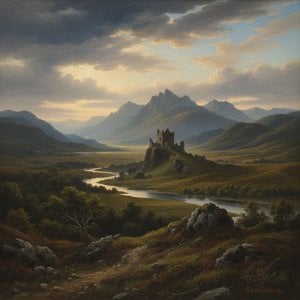
Born in an unspecified year (records are incomplete), Johnstone’s artistic journey began amidst the burgeoning Romantic movement. The influence of Turner is undeniable; early works demonstrate a clear fascination with light, color, and the emotive power of weather. However, Johnstone wasn't merely an imitator. He absorbed Turner’s techniques – the layering of washes, the blurring of forms to suggest atmosphere – but applied them to a more localized subject matter: the landscapes surrounding Berwick-upon-Tweed and the wider Northumberland coast. This region, with its rugged coastline, rolling hills, and ever-changing skies, became his muse. Unlike Turner’s often grand, sweeping vistas, Johnstone's early paintings tended towards intimate scenes – quiet harbors, rural pathways, and portraits of local life. He developed a remarkable skill for capturing the nuances of light on water, the texture of stone walls, and the subtle shifts in mood that characterize the northern climate.
This dedication to portraying the specific character of his surroundings distinguishes him from many of his contemporaries.
Themes and Techniques: A Painter of Place
Johnstone’s oeuvre is characterized by a consistent focus on the interplay between humanity and nature. While he produced numerous portraits, even these are often set within landscapes, emphasizing the individual's connection to their environment. His landscapes aren’t simply depictions of scenery; they are imbued with a sense of narrative, suggesting stories unfolding within the frame. He frequently depicted scenes of everyday life – fishermen returning to port, farmers working in the fields, children playing by the river – but always with an emphasis on the atmospheric conditions that shape their existence.
Technically, Johnstone’s approach was meticulous and layered. He typically began with a detailed underdrawing, followed by washes of color applied in thin glazes to build up depth and luminosity. His brushwork is often loose and expressive, particularly in his depictions of clouds and water, creating a sense of movement and vitality. He favored an earth-toned palette – ochres, browns, grays, and blues – but used these colors with remarkable subtlety and sophistication to capture the delicate nuances of light and shadow.
Recognition and Legacy
Although Johnstone did not achieve widespread fame during his lifetime, his work has steadily gained recognition in recent years. His paintings are now held in numerous private collections, and he is increasingly recognized as an important figure in Scottish landscape painting.
- His ability to capture the unique atmosphere of the Anglo-Scottish borderlands sets him apart.
- The quiet intimacy of his scenes offers a refreshing contrast to the more grandiose works of some of his contemporaries.
- Johnstone’s dedication to portraying everyday life provides valuable insights into the social and cultural history of the region.
His legacy lies in his ability to evoke a sense of place – not through dramatic spectacle, but through careful observation, subtle technique, and a deep understanding of the emotive power of light and atmosphere. He remains a painter’s painter, admired by those who appreciate the beauty of understated elegance and the enduring appeal of the Scottish landscape. His continued artistic activity ensures that his unique vision will continue to inspire and captivate for generations to come.