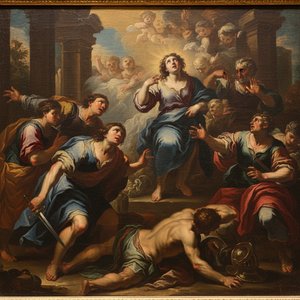
Jacopo Alessandro Calvi (Sordino): The Deaf Maestro of Bolognese Baroque
Jacopo Alessandro Calvi, known affectionately as Il Sordino – “the little deaf one” – stands as a singular figure in the artistic landscape of 18th-century Bologna and Italian Baroque painting. Born in Bologna in 1740, his early life was marked by profound deafness, a condition that profoundly shaped his artistic trajectory and ultimately fueled an extraordinary creative spirit.
Early Life and Training: Calvi’s familial background instilled within him a deep appreciation for art from infancy. His father, Giovanni Battista Calvi, was a sculptor, exposing young Jacopo to the tactile world of stone and form. However, at the tender age of eight, he succumbed to deafness, an event that irrevocably altered his path. Despite this obstacle, Calvi’s determination shone through; he pursued his artistic ambitions with unwavering passion, enrolling in Giuseppe Varotti's workshop – a pivotal encounter that established him within the influential Bolognese artistic milieu. Varotti’s teachings instilled in Calvi a rigorous adherence to classical ideals, evident in his early works. He subsequently honed his skills at the Accademia Clementina, where he absorbed the stylistic nuances of contemporaries like Giuseppe Bartolomeo Testa and Gaetano Gandolfi.
Influences and Artistic Style: Calvi's artistic style is characterized by its dramatic use of chiaroscuro – intense contrasts between light and dark – mirroring the theatrical conventions of Baroque art. He excelled in depicting religious subjects with meticulous detail and emotional depth, capturing the spiritual fervor of his time. His paintings often resonate with a palpable sense of solemnity and grandeur, reflecting the artistic sensibilities prevalent during his era. The influence of artists like Ludovico Carracci is particularly noticeable in his engravings after frescoes from San Michele in Bosco.
Notable Works: Among Calvi’s most celebrated paintings are “Annunciation” (1764), housed in the Accademia di Belle Arti di Bologna, and “The Martyrdom of Saint Lawrence” (circa 1770), a monumental composition demonstrating his mastery of color and spatial illusion. These pieces exemplify the Bolognese Baroque tradition's preoccupation with conveying profound emotion through visual representation. Furthermore, Calvi’s meticulous engravings after frescoes by Ludovico Carracci – particularly those adorning San Michele in Bosco – solidified his reputation as a draughtsman and cemented his place within the artistic canon. His works are found in prestigious institutions such as the Galleria Sabauda in Turin, where “Gualino Madonna” exemplifies the grandeur of Savoy’s royal art patronage.
Legacy and Recognition: Calvi's contribution to Bolognese art history extends beyond his individual creations. He served as an influential biographer, documenting the lives and achievements of prominent artists like Guercino and Francesco Francia, furthering scholarly understanding of the period. His meticulous engravings after frescoes by Ludovico Carracci – particularly those adorning San Michele in Bosco – solidified his reputation as a draughtsman and cemented his place within the artistic canon. Calvi’s work continues to inspire admiration for its expressive power and technical virtuosity. He remains an enduring testament to the transformative power of creativity despite adversity—a beacon of artistic brilliance achieved against considerable odds.