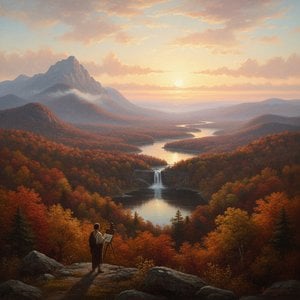
A Life Rooted in Tradition: The World of Irie Shikai
Born in Tsukuba, Japan, in 1862, irie shikai – also known as 入江之介 – emerged from a landscape steeped in the rich artistic and intellectual currents of the late Edo and early Meiji periods. His formative years were spent in tsukushi, Fukuoka prefecture, where he received a classical education, delving into prose and poetry under the tutelage of the esteemed scholar Masuyama. This foundation in literature would profoundly shape his later artistic endeavors, imbuing his paintings with a lyrical quality and narrative depth rarely found in purely visual art forms. However, it was his subsequent study under kubota beisen that truly set him on the path to becoming a recognized painter, specifically within the neo-nanga tradition. Nanga, meaning “southern painting,” had its roots in literati painting of China, emphasizing scholarly pursuits and expressive brushwork over mere representation. Beisen’s guidance instilled in Irie Shikai not just technical skill but also an appreciation for the philosophical underpinnings of this style.
The Kyoto School and a Brief Political Interlude
Irie Shikai's artistic development led him to become associated with the renowned kyoto school of painting, a hub of traditional Japanese art during his time. This affiliation was pivotal; it connected him to a lineage of masters and provided a platform for exhibiting his work and engaging with fellow artists. His landscapes, executed in the neo-nanga style, quickly garnered attention for their delicate ink washes, subtle color palettes, and evocative depictions of nature. While deeply committed to his art, Irie Shikai’s life took an unexpected turn with a brief involvement with mitsuru tôyama, a prominent ultranationalist politician. This association, though relatively short-lived, offers a glimpse into the turbulent political climate of Meiji Japan and the complex ways in which artists navigated nationalistic ideologies. However, Irie Shikai ultimately returned to his artistic pursuits, reaffirming his dedication to painting as his primary vocation.
Neo-Nanga Landscapes: A Synthesis of Style and Spirit
The core of Irie Shikai’s achievement lies in his neo-nanga landscapes. These paintings are not simply representations of scenery; they are expressions of a deeply felt connection to the natural world, filtered through the lens of classical literature and philosophical contemplation. He masterfully employed ink washes – varying shades and densities of black ink – to create atmospheric depth and convey the subtle nuances of light and shadow. His color palettes were typically restrained, favoring muted tones that enhanced the sense of tranquility and harmony. His works often feature distant mountains shrouded in mist, flowing rivers, and solitary trees, all rendered with a delicate precision that belies their expressive power. The influence of Chinese literati painting is evident in his emphasis on capturing the *spirit* of the landscape rather than its precise topographical details.
Legacy and Historical Significance
Irie Shikai’s artistic journey, culminating in his death in 1940, represents a fascinating intersection of tradition and modernity in Japanese art. He successfully synthesized the classical techniques of nanga painting with the evolving aesthetic sensibilities of the Meiji period. While not as widely celebrated as some of his contemporaries, Irie Shikai's work holds significant historical value. His paintings offer a window into the artistic landscape of late 19th and early 20th century Japan, reflecting both the enduring power of traditional forms and the subtle shifts in cultural values. His brief foray into politics adds another layer of complexity to his biography, reminding us that artists are rarely isolated from the broader social and political forces of their time. Today, Irie Shikai’s neo-nanga landscapes continue to captivate viewers with their quiet beauty and evocative power, serving as a testament to his skill, dedication, and enduring artistic vision.