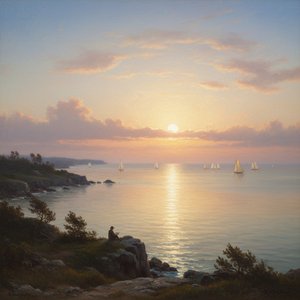
Henry Ary: A Hudson Valley Visionary
Henry Ary (1807 – 1859) emerged from Providence, Rhode Island, establishing himself in Hudson, New York, around 1844—a pivotal moment coinciding with his artistic maturation. His prolific output focused primarily on the breathtaking landscapes of the Hudson Valley, capturing its grandeur and subtle nuances with remarkable precision and sensitivity. Ary’s legacy resides not merely in the sheer beauty of his paintings but also in their contribution to the burgeoning Hudson River School movement, a collective effort to depict America's wilderness as sublime and inspirational.
Ary began his artistic journey in Albany, honing his skills as a portrait painter before relocating to Catskill in 1833—a move that proved transformative for his creative trajectory. Drawn to the region’s dramatic vistas and encouraged by fellow artist Thomas Cole, Ary embraced landscape painting with fervor. Cole's influence profoundly shaped Ary’s artistic vision, fostering an appreciation for tonal harmony and atmospheric perspective – techniques characteristic of the Hudson River School style. He skillfully employed oil paints on canvas, layering colors to achieve luminous effects that conveyed the essence of the natural world. This meticulous approach mirrored Cole’s own dedication to capturing the grandeur of the American wilderness, solidifying Ary's position as a key figure in establishing this influential artistic movement.
Ary’s teaching career further cemented his role as a mentor within the Hudson River School community. At the Hudson Female Academy, he imparted invaluable artistic knowledge to students like Elihu Gifford, whose son would later become Sanford Gifford—a fellow artist who shared Ary's unwavering commitment to portraying the sublime beauty of the Hudson Valley. Ary’s instruction extended beyond technical skills; he instilled in his pupils a profound respect for nature and its capacity to inspire awe and contemplation. Moreover, Ary instructed John Bunyan Bristol, nurturing another promising talent and contributing to the continued flourishing of American landscape art.
Ary's artistic accomplishments transcended pedagogical pursuits. His portrait of George Washington remains a treasured centerpiece at Hudson City Hall—a testament to his ability to convey dignity and gravitas through meticulous detail, reflecting the ideals of republican virtue championed during the early 19th century. However, Ary’s depiction of Martin van Buren sparked considerable controversy upon its exhibition on the steamer South America in 1833, demonstrating his willingness to engage with social commentary within his artistic endeavors—a bold stance for an artist of his time. His paintings are held in prestigious collections like The Henry E. Huntington Library and Musée Thomas-Henry, ensuring that Ary's vision continues to inspire admiration and scholarly study for generations to come.
Ary’s oeuvre comprises numerous landscapes depicting iconic Hudson Valley scenes, including “View of Hudson,” which exemplifies the School’s characteristic tonal palette and atmospheric depth. These works are celebrated for their masterful execution and their ability to evoke a sense of wonder at the majesty of the natural world. Ary's contribution to American art history is undeniable; he stands as a symbol of artistic idealism and a champion of Romantic sensibilities, securing his place among the luminaries of the Hudson River School.