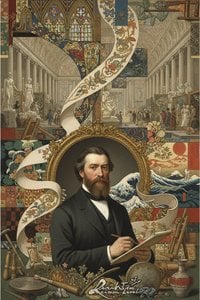
Henri Nicolas van Gorp: A Parisian Visionary of Light and Atmosphere
Henri Nicolas van Gorp (1758-1819) wasn’t a name that immediately resonates within the grand halls of art history, yet his work possesses a quiet, captivating beauty—a subtle mastery of light, color, and atmosphere that speaks volumes about the evolving spirit of 18th and early 19th century France. Born in Beaumont-sur-Oise, near Paris, van Gorp’s artistic journey began not with grand pronouncements or revolutionary techniques, but with a meticulous apprenticeship under the established painter Jean-Baptiste Oudard, a master of historical painting. This foundational training instilled in him a rigorous approach to composition and technique, yet it was his time spent observing and absorbing the vibrant energy of Parisian life that truly shaped his distinctive style. Unlike many of his contemporaries who sought fame through dramatic narratives or opulent displays, van Gorp quietly cultivated a unique voice—one defined by an intimate understanding of light’s transformative power and its ability to evoke profound emotion.
Van Gorp's early career was largely dedicated to portraiture, producing numerous commissions for wealthy families and prominent figures. These portraits, often characterized by their understated elegance and psychological depth, reveal his growing skill in capturing the nuances of human expression. However, it’s within his landscapes—particularly those depicting scenes from Parisian life—that van Gorp truly flourished. He wasn't interested in grand vistas or heroic subjects; instead, he focused on the everyday – a bustling street corner, a quiet garden, a glimpse through an open window. These seemingly simple scenes were imbued with a remarkable sense of realism and atmosphere, achieved through his painstaking attention to detail and his innovative use of color. He meticulously observed how light interacted with surfaces—the shimmering reflections on wet cobblestones, the hazy glow filtering through rain clouds, the warm radiance of a setting sun—and translated these observations onto canvas with astonishing accuracy.
A key element in van Gorp’s artistic development was his exposure to the work of J.M.W. Turner, whose atmospheric landscapes exerted a significant influence on the young French painter. While Turner employed looser brushstrokes and a more dramatic use of color, van Gorp adopted a similar approach—prioritizing the depiction of light and atmosphere over precise detail. He experimented with layering glazes of paint to create luminous effects and explored the subtle shifts in tone that define the quality of natural light. This pursuit of atmospheric realism led him to develop his signature style: soft, diffused colors blended seamlessly together, creating a sense of depth and tranquility. His landscapes weren’t merely representations of places; they were evocations of mood—moments captured with an almost melancholic grace.
The influence of the Rococo period is also evident in van Gorp's work, particularly in his use of delicate color palettes and his penchant for depicting intimate scenes. However, unlike the frivolous exuberance of Rococo art, van Gorp’s approach was imbued with a sense of quiet contemplation. His paintings often convey a feeling of solitude or introspection—a subtle invitation to pause and reflect on the beauty of the natural world. He frequently depicted figures in his landscapes – often women engaged in domestic activities – not as subjects of grand narratives, but as integral parts of the scene, their presence adding to the overall sense of atmosphere and mood. Portraits like “Portrait du peintre Guillaume Jean Constantin” demonstrate this skill, capturing a moment of quiet contemplation within an intimate setting.
Despite achieving considerable recognition during his lifetime, van Gorp’s career was tragically cut short by illness. He succumbed to tuberculosis in 1819, leaving behind a relatively small but remarkably consistent body of work. His paintings are now held in prestigious collections across Europe and America, including the Musée d'Orsay in Paris and the Metropolitan Museum of Art in New York. Van Gorp’s legacy lies not in revolutionary innovations or dramatic gestures, but in his quiet mastery of light, color, and atmosphere—a testament to the power of observation and a subtle reminder that beauty can be found in the most unassuming of subjects. His work continues to resonate with viewers today, offering a glimpse into the soul of 19th-century Paris and a profound appreciation for the transformative effects of light.