A Life Immersed in Light: The World of Hendrik Mommers
Hendrik Mommers, a name perhaps less immediately recognizable than some of his Dutch Golden Age contemporaries, nevertheless occupies a significant and charming niche within the landscape tradition. Born in Amsterdam on January 2nd, 1620, and laid to rest there on December 21st, 1693, Mommers’s life unfolded during a period of immense artistic flourishing in the Netherlands. While biographical details remain somewhat sparse, piecing together accounts from Arnold Houbraken's *De groote schouburgh der Nederlantsche konstschilders en schilderessen* and records from the RKD (Netherlands Institute for Art History) reveals a painter deeply connected to both the bustling urban life of his homeland and the idyllic allure of Italy. He wasn’t merely documenting scenes; he was crafting an atmosphere, a feeling—a sense of serene beauty infused with everyday life.
From Haarlem Beginnings to Italianate Visions
Mommers's artistic journey began in Haarlem, where he initially focused on painting vegetable market scenes. This early work provided him with a foundation in depicting lively compositions and capturing the textures and colors of daily existence. Crucially, he became the first teacher of Dirk Maas, demonstrating an inclination towards mentorship even early in his career. However, it was a sojourn to Italy—undertaken alongside Nicolaes Berchem sometime between 1644 and 1646—that profoundly shaped his artistic direction. This experience ignited a passion for Italianate landscapes, characterized by classical ruins, sun-drenched vistas, and a sense of expansive space. The influence of Berchem is undeniable, yet Mommers quickly developed his own distinctive style, moving beyond mere imitation to create scenes that were both evocative and uniquely his own. He became known among the *Bentvueghels*—a society of Dutch painters who adopted humorous nicknames while abroad—as “Meleager,” a detail adding a layer of intrigue to his Italian experience.
A Master of Pastoral Harmony
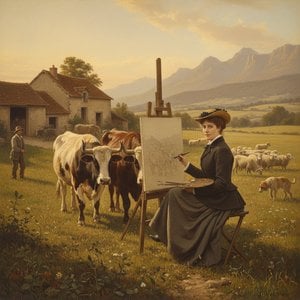
Upon returning to the Netherlands, Mommers specialized in what became his signature subject matter: pastoral scenes infused with Italianate elements. These paintings often depict small figures engaged in everyday activities—shepherds tending their flocks, travelers resting amidst ancient ruins, or lively market scenes set against a backdrop of rolling hills and classical architecture. His palette is warm and inviting, dominated by golden hues that evoke the soft light of the Mediterranean sun.
He skillfully balanced detailed observation with an idealized vision of rural life, creating compositions that are both realistic and romantic. The clothing of his figures, often rendered in vibrant reds and blues, adds a touch of visual richness to these harmonious scenes. Mommers wasn’t simply painting landscapes; he was constructing a world—a refuge from the complexities of modern life, steeped in classical beauty and tranquility.
Technique and Influences
Mommers's technique reflects both his early training and the influences he absorbed during his time in Italy. He demonstrated a keen eye for detail, particularly in rendering the textures of fabrics, foliage, and architectural elements. However, unlike some of his contemporaries who focused on meticulous realism, Mommers prioritized atmosphere and mood. His brushwork is often loose and expressive, creating a sense of movement and vitality.
The influence of Johannes Lingelbach, known for his lively market scenes in Amsterdam, can be detected in Mommers’s compositions, as can the work of Anton Goubau, another painter specializing in Italianizing landscapes. Yet, Mommers managed to synthesize these influences into a style that was distinctly his own—a blend of Dutch realism and Italianate romanticism.
Legacy and Historical Significance
While not achieving the widespread fame of some of his peers, Hendrik Mommers left behind a body of work that continues to captivate viewers with its serene beauty and idyllic charm. His paintings offer a glimpse into the artistic sensibilities of the Dutch Golden Age—a period characterized by both meticulous observation and a deep appreciation for classical ideals.
- Mommers’s ability to blend realistic detail with an idealized vision of rural life makes his work particularly appealing.
- His influence can be seen in the works of later landscape painters who sought to capture the beauty and tranquility of the Italian countryside.
- Today, his paintings are held in collections around the world, serving as a testament to his enduring artistic legacy.
He represents a quieter voice within a vibrant chorus—a painter dedicated to crafting scenes of pastoral harmony that continue to resonate with audiences centuries later. His work reminds us of the power of art to transport us to another time and place, offering a refuge from the complexities of modern life and inviting us to contemplate the beauty of the natural world.