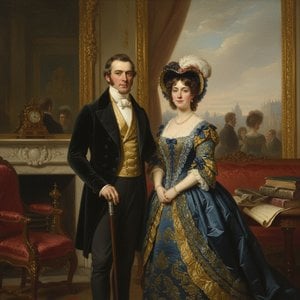
Gustav Freytag: The Voice of the Middle Class in Victorian Germany
Gustav Freytag (Kreuzburg, 1816 – Wiesbaden, 1895) stands as a pivotal figure in German literature of the mid-nineteenth century, celebrated primarily for his realistic novels that meticulously portray the aspirations and anxieties of the burgeoning middle class. Born in Kreuzburg, now Kluczbork, Poland, Freytag’s formative years were steeped in intellectual ferment—he pursued philology at Breslau University and Berlin, becoming a member of the Corps Borussia Breslau in 1835, an institution deeply rooted in Prussian tradition and fostering conservative ideals. This academic grounding would profoundly shape his literary sensibilities.
- Early Literary Career & The Grenzboten
- Dramatic Technique: “Die Technik des Dramas” (1863)
- “Das Bild des Kaisers”: A Masterpiece of Realism
- “Die Verlorene Handschrift”: Exploring Psychological Depth
- Political Engagement & Recognition
Freytag’s journalistic endeavors began in 1847 with his appointment as editor of Die Grenzboten, a liberal weekly that served as a crucial platform for disseminating progressive ideas and bolstering republican sentiments within Prussia. His unwavering commitment to this publication until 1861 solidified his reputation as a staunch defender of liberty and constitutional governance—a stance that mirrored the broader intellectual currents shaping Europe at the time. He continued his editorial role from 1867 to 1870, followed by a brief stint with Die Nation in 1852. This period demonstrated Freytag’s versatility as a writer and thinker, adapting to evolving social and political landscapes.
Freytag's literary output cemented his legacy as one of the foremost dramatists of his era. “Die Technik des Dramas” (1863), published at the young age of 27, remains a seminal text in theatrical theory, analyzing the elements of dramatic structure with unparalleled precision and advocating for a psychologically nuanced approach to character development—a methodology that anticipated developments in modern drama.
Perhaps Freytag’s most enduring achievement is “Das Bild des Kaisers” (1859), considered by many critics to be his magnum opus. This novel delves into the complexities of human psychology, examining themes of ambition, morality, and social responsibility against the backdrop of imperial Germany. Its meticulous realism—characterized by detailed descriptions of settings and characters—established Freytag as a champion of the realist movement, influencing generations of writers who sought to capture the essence of everyday life with unflinching honesty.
“Die Verlorene Handschrift” (1864) further showcased Freytag’s ability to explore psychological intricacies, delving into themes of guilt and redemption within a compelling narrative framework. The novel's exploration of human consciousness and moral dilemmas solidified Freytag's reputation as a master storyteller.
Beyond his literary accomplishments, Freytag actively participated in the political life of Prussia. He served on the Prussian National Assembly in 1848, advocating for liberal reforms amidst the turbulent atmosphere of revolutionary fervor. Subsequently, he represented Prussia in the Reichstag of the North German Confederation from 1867 to 1870, contributing to debates concerning constitutional matters and national unity. His dedication to public service was recognized by the King of Bavaria who bestowed upon him the Order of Maximilian for Science and Art, and by Emperor Wilhelm II who awarded him the Order Pour le Mérite for Science and Art—honors reflecting his profound impact on German intellectual culture.