Giovanni Antonio Fumiani (1645–1710): The Titan of Venetian Quadratura
Giovanni Antonio Fumiani (1645–1710) stands as a monumental figure in the Venetian Baroque, renowned primarily for his audacious undertaking – the decoration of San Pantalon’s nave with one of the largest canvases ever conceived. More than just a painter; he was an architect of illusion, a master of quadratura, whose ambition and artistic vision reshaped the visual landscape of Venice and cemented his place among the foremost artists of his era. Born in Venice around 1645, Fumiani’s formative years were spent honing his craft under Domenico degli Ambrogi in Bologna, absorbing the principles of perspectival illusionism that would define his distinctive style. This early training instilled a profound understanding of spatial manipulation—a skill he would subsequently exploit to breathtaking effect.
By 1668, Fumiani returned to Venice, where he swiftly established himself as a prolific artist, tackling commissions ranging from religious frescoes to decorative panels for aristocratic patrons. His involvement with Ludovico Carracci and Alessandro Tiarini exposed him to the humanist ideals of Bolognese Mannerism, while his fascination with Paolo Veronese’s theatrical grandeur instilled in him an appreciation for opulent compositions and vibrant color palettes. These influences coalesced into a singular artistic voice characterized by monumental scale, dramatic lighting, and meticulous attention to architectural detail—a hallmark of Venetian quadratura. He was particularly adept at creating illusionistic ceilings that seemed to defy gravity, transforming ordinary spaces into immersive theatrical experiences – a technique perfected during his collaboration with Niccolò Cassana on the San Pantalon fresco.
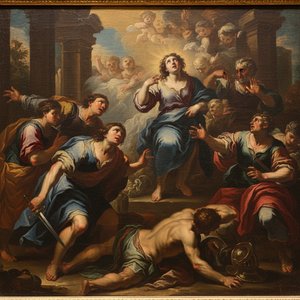
Fumiani’s breakthrough came with the commission to decorate San Benedetto, Venice, where he executed a magnificent Virgin and Saints altarpiece that immediately garnered acclaim for its grandeur and expressive power. This work foreshadowed the monumental style championed by Tiepolo, demonstrating Fumiani’s ability to synthesize classical influences with Baroque dynamism. He continued to push boundaries throughout his career, experimenting with innovative techniques and tackling ambitious projects—most notably the decoration of San Marco Basilica, where he contributed cartoons for mosaics that captured the spirit of Pietro della Vecchia's idiosyncratic art. His meticulous attention to detail ensured that every element of his paintings conveyed a sense of profound emotion and artistic sophistication.
The pinnacle of Fumiani’s artistic achievement was undoubtedly the monumental ceiling fresco at San Pantalon (1675–1678), a collaborative effort with Niccolò Cassana. Covering an astounding 25x50 meters, this ambitious undertaking involved creating 44 canvases depicting The Martyrdom and Apotheosis of Saint Pantaleon—a feat unparalleled in its scale and ambition. Drawing inspiration from Andrea Pozzo’s monumental frescoes at Sant'Ignazio, Fumiani achieved a remarkable level of unity and grandeur, transforming the nave into an immersive theatrical experience. This masterpiece solidified his reputation as the undisputed champion of Venetian quadratura and remains one of the most impressive examples of Baroque illusionism in Europe.
Beyond San Pantalon, Fumiani’s oeuvre encompassed numerous smaller paintings—including modelli for Ferdinand de Medici—that showcased his mastery of decorative art and his ability to convey emotion through nuanced color palettes and expressive gestures. His work reflects a deep engagement with humanist ideals and a profound understanding of the principles of visual storytelling. Giovanni Antonio Fumiani died in Venice around 1710, leaving behind a body of work that continues to inspire awe and admiration for its sheer ambition and artistic brilliance.