Gion Nankai
Gion Nankai (祇園 南海; 1676 – 26 October 1751), originally Gion Yu (祇園 優), was a Japanese Confucianist, author, and painter in the nanga style. His other art names included Hōrai (蓬莱), Kanraitei (観雷亭), Kikyo (箕踞), Shōun (湘雲), Tekkan Dōjin (鉄冠道人) and Tekkanjin (鉄冠人). He was born in Kii Peninsula, Japan.
## Life and Work
Gion Nankai’s early life was marked by a privileged upbringing within the Kishū Domain of the Tokugawa clan. His father, Gion Jun’an, served as a physician for the clan, providing him with access to education rooted in Confucian principles – a cornerstone of Japanese intellectual tradition during his era. At thirteen, he began formal artistic instruction from Kinoshita Jun’an, aligning himself with the influential group of ten disciples that included Arai Hakuseki and Muro Kyūsō. This association profoundly shaped his artistic sensibilities and propelled him toward mastery in nanga painting.
He established himself as a teacher of Confucianism in 1713, imparting knowledge and fostering philosophical contemplation amongst aspiring scholars. However, tragedy struck when he was expelled from his teaching position for misconduct at the age of twenty-four – an event shrouded in obscurity, leaving historians to speculate on its causes. Despite this setback, Nankai persevered, securing a pardon and returning to teaching duties in Wakayama shortly thereafter. His dedication continued as he served as head of a mission to Korea in 1730, receiving commendation for his diplomatic efforts. Subsequently, he was entrusted with overseeing one of the newly founded Han schools (興學館), furthering his commitment to scholarly pursuits and educational reform.
## Artistic Style and Influences
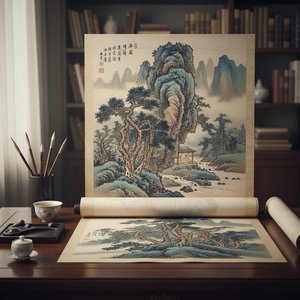
Nankai’s artistic vision drew heavily from the traditions of Yuan and Ming dynasties China, particularly the aesthetic ideals championed by Zhao Mengfu and Tang Yin. He admired Yi Fujiu's calligraphy and incorporated elements of Chinese painting manuals—such as the Mustard Seed Garden Manual—into his own practice. His distinctive style is characterized by a meticulous approach to brushwork, reflecting the influence of these masters. Notably, he excelled in depicting birds and flowers, capturing their beauty with subtle tonal variations and conveying a sense of tranquility through empty space – techniques emblematic of nanga’s core principles.
## Notable Works
Among Nankai's most celebrated paintings is “Window onto Bamboo on a Rainy Day” (竹窗雨日), which exemplifies the movement’s focus on naturalism and its masterful use of compositional elements to evoke mood and atmosphere. The painting showcases precise brushstrokes that capture the dynamism of rain-soaked bamboo stalks, punctuated by carefully placed ink dots representing moss – demonstrating Nankai's profound understanding of Chinese painting techniques. His essays on Chinese poetry further cemented his reputation as a multifaceted intellectual figure.
## Legacy and Recognition
Gion Nankai stands as one of the foremost figures in nanga art history, shaping the artistic trajectory of subsequent generations. He mentored prominent artists like Yanagisawa Kien and Ike no Taiga, ensuring that his stylistic innovations endured beyond his lifetime. His influence can be discerned in numerous contemporary Japanese artworks, underscoring his enduring legacy as a pioneer of literati painting and a champion of Confucian ideals. Many of Nankai’s paintings reside within the Tokyo National Museum, serving as tangible reminders of his contribution to Japan's artistic heritage.