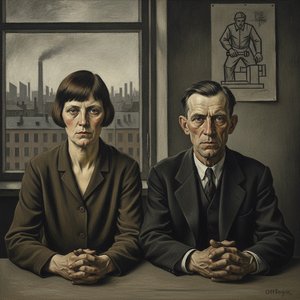
Franz Wilhelm Seiwert, born March 9, 1894, in Cologne, Germany, experienced a formative event at the tender age of seven when he suffered a severe burn during an experimental radiological treatment. This traumatic incident instilled within him a profound fear of mortality—a preoccupation that would permeate his artistic endeavors throughout his life. The repercussions of this accident extended beyond physical pain; it fundamentally shaped his worldview and fueled his relentless pursuit of creative expression.
Artistic Career Begins
Seiwert’s formal artistic education commenced at the Cologne School of Arts and Crafts between 1910 and 1914, providing him with foundational skills in painting and sculpture. However, his artistic journey truly gained momentum when he encountered Max Ernst in 1919—a pivotal encounter that propelled him into the vanguard of Dadaism. Embracing the rebellious spirit of this avant-garde movement, Seiwert actively participated in Dada activities, contributing to its provocative explorations of art and society. Recognizing the limitations of Cologne Dada’s approach, he spearheaded the formation of “Stupid,” alongside Ernst, Hoerle, and Räderscheidt—a breakaway group that championed a distinct vision for German artistic innovation.
Secession from Cologne Dada & Constructivist Exploration
Departing from Cologne Dada's conventional boundaries, Seiwert sought to synthesize constructivism with realism—a daring ambition that reflected his unwavering commitment to radical political convictions. This stylistic fusion became the cornerstone of his artistic practice and distinguished him from many of his contemporaries. His dedication to conveying complex ideas through visual language solidified his position as a leader within the “Group of Progressive Artists,” who aimed to forge a harmonious dialogue between structural principles and figurative representation.
Notable Exhibitions & Contributions
Seiwert’s artistic reputation ascended rapidly following his inaugural solo exhibition at the Kunstverein in Cologne in 1923—a testament to the resonance of his work with discerning audiences. By the mid-1920s, he emerged as a prominent voice within the burgeoning constructivist movement, advocating for its transformative potential to reshape artistic expression and societal discourse. Notably, Seiwert established “A-Z,” a journal devoted to progressive art that showcased groundbreaking figurative constructivism—a bold initiative designed to disseminate innovative ideas and challenge prevailing aesthetic norms.
Legacy & Influence
Franz Wilhelm Seiwert’s enduring legacy resides in his singular contribution to the artistic landscape of the early 20th century. His distinctive blend of constructivist aesthetics and impassioned political activism continues to inspire artists across generations—a testament to the transformative power of art as a vehicle for social commentary and intellectual inquiry. Exploring Seiwert's oeuvre reveals a profound engagement with themes of vulnerability, resilience, and the pursuit of beauty amidst turbulent times—a legacy that resonates powerfully within the broader context of modernist art history.
A cura del team editoriale di WahooArt.com
Quiz d'arte
Per ogni domanda è presente una sola risposta corretta.
Domanda 1:
Qual era lo stile artistico principale di Franz Wilhelm Seiwert?
Domanda 2:
A quale età Seiwert subì una grave ustione dovuta al trattamento radiologico?
Domanda 3:
Quale gruppo Dada Seiwert formò insieme a Max Ernst?
Domanda 4:
Qual era il principale obiettivo della rivista “A-Z” fondata da Seiwert?
Explore the profound impact of Constructivism on modern art. Discover how geometric abstraction and industrial aesthetics revolutionized design, from avant-garde textiles to architectural mastery, curated for the discerning art collector seeking depth and historical significance.
Explore the raw emotion of German Expressionism through a definitive guide to Ernst Ludwig Kirchner. Discover how his bold colors and distorted forms redefined modern art history, from Berlin street scenes to iconic masterpieces.