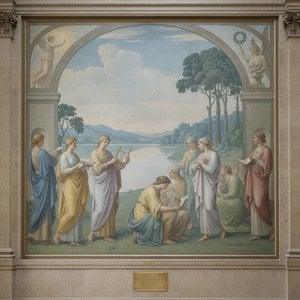
Filipe de Sousa Folque: Cartographer of Portugal’s Soul
Filipe de Sousa Folque (1800-1874) stands as a pivotal figure in Portuguese history, not merely for his aristocratic lineage and political involvement—though undeniably influential—but primarily for his groundbreaking contribution to the art of cartography. Born in Portalegre, Portugal, Folque’s life unfolded against the backdrop of a nation undergoing significant transformation during the Romantic era, shaping him into an engineer, mathematician, military officer, and above all, a meticulous observer of the physical world. His legacy resides not just in his formal titles but in the enduring impact of his maps—particularly the ‘Atlas of Lisboa,’ which remains a cornerstone of Lisbon’s visual heritage.
Early Life & Education: The Seeds of Precision
Folque's upbringing instilled in him a deep appreciation for precision and observation, qualities that would serve as foundational elements in his future endeavors. Educated at Coimbra University—a bastion of Enlightenment ideals—he excelled in mathematics, securing a degree that underpinned his analytical approach to surveying and mapmaking. This intellectual grounding was crucial; it fostered a mindset dedicated to meticulous measurement and reasoned deduction – principles that would permeate every aspect of Folque’s subsequent pursuits. The influence of thinkers like Isaac Newton undoubtedly shaped his worldview, emphasizing the importance of empirical evidence and mathematical models for understanding the natural world.
Military Service & Engineering Career: Shaping Portugal's Landscape
Folque’s military career began with service in the Armada, providing him with invaluable experience in naval navigation and logistics. Subsequently, he gained appointments within the Ministry of Works, honing his skills in civil engineering projects—a discipline he embraced wholeheartedly. Notably, he spearheaded the establishment of the Course of Engineer Hydrographer at the Academia Portuguesa, recognizing the imperative need for specialized knowledge to accurately chart Portugal’s coastline. This initiative cemented Folque's commitment to advancing scientific understanding and bolstering national defense through technological innovation. His dedication to practical application complemented his theoretical pursuits, creating a formidable intellectual profile.
The Atlas of Lisboa: A Triumph of Vision & Technique
Folque's magnum opus is undoubtedly the ‘Atlas of Lisboa,’ completed in 1860. Commissioned by King Luís I, this ambitious project aimed to comprehensively document Lisbon’s topography—a task that demanded unprecedented accuracy and artistic skill. Utilizing innovative techniques honed during his travels abroad – particularly in Britain where he mastered stereoscopic projection – Folque employed meticulous measurement and detailed artistry to produce a map unlike any seen before. It wasn't simply a representation of the city; it was an attempt to capture its essence, reflecting the grandeur of its palaces and the dynamism of its urban life. The atlas incorporated topographical contours, elevation profiles, and panoramic views, presenting Lisbon as a unified whole—a testament to Folque’s artistic vision and scientific rigor. It remains a treasured artifact of Portuguese cultural heritage and continues to inspire scholars studying urban landscapes and cartographic innovation.
Influence & Legacy: A Lasting Impression
Folque’s work profoundly impacted Portuguese cartography and influenced subsequent generations of surveyors and artists. His insistence on scientific rigor combined with artistic sensitivity established a precedent for future mapmakers—a blend that continues to inspire contemporary explorations of visual representation and spatial understanding. Moreover, the ‘Atlas of Lisboa,’ now housed in the Museu Nacional da Ajuda, stands as a monument to Folque’s vision and enduring contribution to Portugal's cultural heritage. He fostered a tradition of meticulous observation and reasoned analysis – principles that resonate powerfully with modern approaches to geographic research and artistic expression.
Sources: Wikipedia, Geographicus Rare Antique Maps
A cura del team editoriale di WahooArt.com
Quiz d'arte
Per ogni domanda è presente una sola risposta corretta.
Domanda 1:
Qual fu il suo principale contributo artistico?
Domanda 2:
Folque servì come aiuto al Direttore delle Opere presso:
Domanda 3:
Che titolo universitario conseguì Filipe Folque?
Domanda 4:
Folque fu nominato aiuto presso:
Domanda 5:
Filipe Folque raggiunse il grado di Generale di Divisione nell'ambito della:
Esplora la vita e l'opera di Pierre Puvis de Chavannes, maestro del simbolismo francese. Scopri i suoi murales monumentali, il linguaggio pittorico unico e l'influenza sull'Art Nouveau. Approfondimenti storici e artistici su WahooArt.
Esplora i 25 capolavori di Francisco Goya, il genio spagnolo tra Romanticismo e Realismo. Ritratti iconici, 'Los Caprichos' e le toccanti 'Disastri della Guerra'. Trova stampe su tela e riproduzioni artistiche di alta qualità per la tua casa su WahooArt.com.
Discover Alfredo Roque Gameiro (1864-1935), a renowned Portuguese painter celebrated for his vibrant watercolors and historical illustrations. Explore his legacy & artworks at WahooArt.