Fa Ruozhen: Master of Misty Peaks
Fa Ruozhen (法若真, 1613–1696) stands as a singular figure in Qing dynasty art—a scholar-official who simultaneously cultivated profound poetic sensibilities and achieved remarkable artistic mastery. Born in Jiaozhou, Shandong Province, he ascended the ranks of government service but ultimately found solace and creative expression in painting, particularly in landscapes imbued with ethereal mist and towering mountains. This dedication to both intellectual pursuits and visual artistry distinguishes him from many of his contemporaries and cemented his legacy as one of Shandong’s most celebrated literati artists.
Fa Ruozhen's formative years were steeped in Confucian scholarship, shaping his worldview and informing his artistic vision. He excelled in calligraphy and poetry, demonstrating a sensitivity to tonal nuance and evocative imagery—qualities that would later become hallmarks of his paintings. His profound understanding of classical thought fueled his desire to capture the essence of nature through art, mirroring the Daoist belief in harmony between humanity and the cosmos.
Despite facing bureaucratic hurdles during his career, Fa Ruozhen maintained positions within the Qing administration, primarily focused on forestry affairs. This role provided him with unparalleled access to Shandong’s mountainous terrain—a source of constant inspiration for his artistic endeavors. The rugged peaks and misty valleys served as a tangible embodiment of Daoist principles, influencing his compositional choices and color palettes.
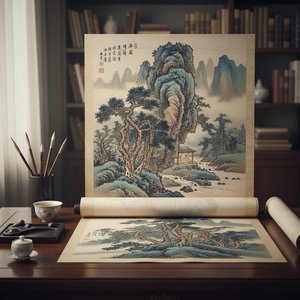
Fa Ruozhen’s distinctive style emerged from a confluence of influences—primarily Daoist cosmology and Buddhist contemplation—which emphasized harmony between humanity and nature. He rejected the prevailing academic conventions of his time, favoring instead a looser brushwork and expressive coloration that prioritized capturing the mood and atmosphere of the mountains rather than meticulous topographical accuracy. This approach aligns perfectly with the broader literati aesthetic, which valued spontaneity and emotional resonance above technical precision. His technique involved layering washes of ink to create luminous gradations of color—a masterful manipulation of tonal value—allowing him to convey a sense of depth and grandeur that surpassed mere representation.
Among his most celebrated paintings is “Cloudy Mountains,” completed in 1684 at the age of seventy-two. This monumental landscape exemplifies Fa Ruozhen’s mature style, showcasing a breathtaking panorama of jagged peaks bathed in soft light—a testament to his unwavering commitment to capturing the sublime beauty of the natural world. The painting "Cloudy Mountains" – housed at The Metropolitan Museum of Art – is particularly noteworthy for its masterful depiction of atmospheric perspective. Fa Ruozhen skillfully employed techniques such as aerial haze and tonal recession to convey a profound sense of distance and grandeur, transporting viewers into the misty realm of Shandong’s mountains. This artwork stands as an enduring symbol of Qing dynasty artistic achievement and continues to inspire admiration for its evocative beauty and technical brilliance.
Fa Ruozhen's legacy extends beyond his artistic accomplishments; he embodies the ideal of the scholar-official who pursues excellence in both scholarship and art. His paintings serve as a poignant reminder of the transformative power of contemplation and creativity—qualities that continue to resonate with artists and scholars alike. He represents a pivotal moment in Qing landscape painting, marking a departure from the rigid formalism of earlier generations.