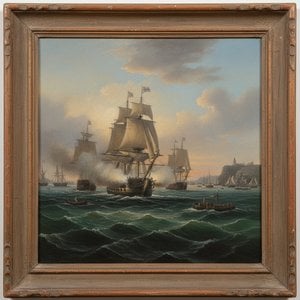
Eugène Louis Gabriel Isabey: A Romantic Master of Marine Landscapes
Eugène Louis Gabriel Isabey (1803-1886) stands as a pivotal figure in French Romantic painting, particularly renowned for his breathtaking depictions of the sea and coastline. Born into a family steeped in artistic tradition – his father, Jean-Baptiste Isabey, was himself a celebrated painter favored by the imperial court – Isabey’s early life foreshadowed a creative destiny. Initially drawn to seafaring adventures, he swiftly recognized that his true vocation lay within the realm of art, spurred on by his father's insistence against pursuing a more conventional path. This decision proved transformative, propelling him toward intensive study at the Louvre and collaborative endeavors with fellow landscape artist Xavier Leprince in Honfleur, establishing a formative partnership that would endure until Leprince’s untimely demise.
Early Training & Influences: The Foundations of Romantic Vision
Isabey's artistic education began under his father’s tutelage, where he diligently absorbed the stylistic principles of Old Masters like Rembrandt and Vermeer. These masters instilled in him a profound understanding of tonal harmony—a technique that prioritized subtle gradations of light and shadow to convey mood and atmosphere—a cornerstone of Romantic painting’s expressive power. The Louvre served as an invaluable crucible for honing his observational skills, fostering a meticulous attention to detail and cultivating an appreciation for the grandeur of nature. He particularly admired Rembrandt's masterful use of chiaroscuro, recognizing its ability to heighten dramatic tension and evoke profound emotion. Furthermore, Jacques-Nicolas Augustin Cochin’s influence encouraged him to explore innovative compositional strategies—a departure from academic conventions that aligned perfectly with the Romantic movement’s rebellious spirit.
Honfleur & Collaboration: Shaping Impressionism's Dawn
His association with Xavier Leprince at Honfleur proved instrumental in shaping Isabey’s artistic trajectory. Together, they embarked on a remarkable creative journey—capturing the ethereal beauty of Brittany’s coastline with unparalleled sensitivity and precision. Their collaborative canvases pulsed with atmospheric perspective, achieved through careful layering of colors and meticulous attention to geological formations—a technique that foreshadowed the burgeoning Impressionist movement's nascent explorations of light and shadow. Leprince’s encouragement fostered Isabey’s willingness to experiment with unconventional brushstrokes and palettes, pushing him beyond the confines of traditional academic painting. This partnership cemented their shared commitment to portraying nature as it appeared to the human eye—a radical departure from idealized representations favored by earlier generations.
Salon Exhibitions & Recognition: Embracing Royal Patronage
Isabey debuted his artistic talent at the Salon in 1831, garnering initial acclaim for landscapes showcasing the naval campaign in Morocco—a journey undertaken with Eugène Delacroix, whose bold experimentation with color and brushwork undoubtedly shaped Isabey’s evolving style. Delacroix's influence extended beyond mere companionship; he instilled in Isabey a belief in artistic freedom and encouraged him to prioritize emotional expression over strict adherence to stylistic rules. This patronage afforded Isabey access to influential circles and fueled his ambition, resulting in monumental canvases like “The Return of Napoleon from Elba,” commemorating Napoleon Bonaparte’s triumphant return from exile aboard the Belle Poule—a testament to his ability to convey historical grandeur with breathtaking visual impact.
Notable Paintings & Legacy: A Painter's Enduring Vision
Among Isabey’s most celebrated works are “Rocks at Saint-Malo,” “Fishing Boats on a Beach,” and “The Return of Napoleon from Elba,” each demonstrating his exceptional ability to render the subtleties of marine landscapes with remarkable precision and emotional resonance. These paintings exemplify Romanticism's preoccupation with sublime beauty—capturing not only visual splendor but also the psychological complexities inherent in human experience. Isabey’s unwavering dedication to his craft and his enduring influence on fellow artists solidified his place among the luminaries of 19th-century art, ensuring that his evocative depictions of the sea continue to captivate audiences today. He remains a testament to the transformative power of artistic passion and the indelible mark left by those who strive to capture the majesty of nature—a legacy destined to inspire generations of artists to come.