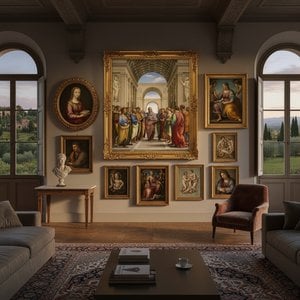
Emilio Mari: Bridging Romanesque Tradition and Contemporary Vision
Emilio Mari is a contemporary artist hailing from Rome, Italy, whose work reflects a fascinating dialogue between classical artistic heritage and modern sensibilities. Currently pursuing his doctoral research at Sapienza – University of Rome, he holds a PhD in Literary, Linguistic and Comparative Studies and specializes in memoir and autobiography alongside explorations of Russian culture and literature—a testament to his intellectual curiosity and scholarly rigor. He is presently engaged as a ricercatore tda in slavistica at the University of Rome – unint., furthering his commitment to academic excellence.
### Early Influences & Artistic Formation: The Romanesque Echoes in Modern Canvas
Mari’s artistic journey began amidst the vibrant cultural landscape of Rome, where he absorbed inspiration from both Romanesque art traditions and burgeoning contemporary movements. This formative period instilled in him a deep appreciation for meticulous detail and symbolic representation—elements that would become hallmarks of his distinctive style. He recognized that true artistry lies not merely in replicating visual appearances but in conveying profound emotional truths—a principle evident throughout his oeuvre. The influence of Romanesque frescoes, characterized by their restrained palettes and layered pigments, is palpable in many of Mari’s paintings, demonstrating a conscious effort to honor artistic legacies while forging new creative paths.
### “The Virgin of Sorrows”: A Synthesis of Tradition and Emotion
Mari’s debut artwork, “The Virgin of Sorrows,” exemplifies this blend seamlessly. The painting utilizes Romanesque techniques – careful layering of pigments, subdued color palettes – to convey profound emotion and spiritual contemplation. It's a masterful demonstration of how historical influences can inform artistic expression in the 21st century. Mari skillfully employs chiaroscuro—the dramatic interplay between light and shadow—a technique perfected by Renaissance masters like Leonardo da Vinci—to heighten the emotional impact of his compositions. This deliberate stylistic choice underscores Mari’s belief that art should transcend temporal boundaries, resonating with viewers across generations.
### Exploring Atmospheric Realism: Maris's Legacy in Color and Light
Mari’s artistic approach leans heavily into atmospheric realism, mirroring the stylistic innovations championed by Jacob Henricus Maris—a Dutch master whose Hague School paintings captivated audiences with their evocative depictions of landscapes bathed in diffused light. Like Maris, Mari strives to capture not merely what is seen but also how it feels—the subtle nuances of mood and atmosphere that contribute to the overall experience of viewing a work of art. He meticulously observes natural phenomena—sunlight filtering through foliage, mist clinging to mountain peaks—translating these observations into canvases imbued with luminous color and textural richness. This dedication to capturing the essence of place aligns Mari’s artistic vision with the humanist ideals prevalent during Maris's era.
### Museums & Artistic Recognition: Connecting Past and Present Visions
Mari’s work resonates with the spirit of artists like Mary Vaux Walcott and Mary Agnes Yerkes—American Impressionists who meticulously documented botanical specimens alongside breathtaking vistas. These painters recognized that artistic observation could illuminate scientific understanding, a principle Mari embodies in his own creative endeavors. His paintings frequently depict landscapes imbued with symbolic significance—references to mythology, folklore, and literary classics—demonstrating Mari’s conviction that art should engage intellectually as well as aesthetically. Furthermore, Mari's recognition by institutions such as Queen Mary – London – underscores the enduring relevance of his artistic explorations within the broader context of cultural heritage.
### Ongoing Research & Artistic Future: A Commitment to Intellectual Depth and Creative Innovation
As an assistant professor of Russian studies at Sapienza – University of Rome, Mari continues to engage with cultural narratives and literary traditions—a pursuit that undoubtedly nourishes his artistic vision. His ongoing research into the semiotics of space and the relationship between literature and landscape promises to yield further insights into the intersection of art, memory, and intellectual exploration, cementing Emilio Mari’s position as a compelling voice within the contemporary art world. He remains steadfast in his belief that artistic innovation stems from a deep understanding of historical context—a conviction that informs every aspect of his creative practice.