Elliott Dangerfield: A Painter of Appalachian Serenity
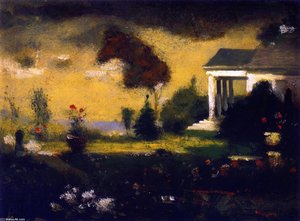
Elliott Dangerfield (1859 – 1932) emerged from the rugged landscapes of West Virginia, shaping his artistic vision amidst the burgeoning American Impressionist movement. Born in Fayetteville, he possessed a keen eye for capturing the subtle beauty of rural America—a fascination that would define his lifelong dedication to painting and solidify his place as a significant figure in early 20th-century landscape art. Dangerfield’s formative years were spent absorbing the artistic sensibilities of his time, studying briefly with Walter Satterlee at New York's National Academy of Design. This exposure instilled in him a foundational understanding of tonal realism and Impressionistic techniques—principles he skillfully employed throughout his prolific career. His debut exhibition at the academy marked an auspicious beginning, establishing him as a promising talent within the artistic circles of New York City. Throughout his life, Dangerfield remained rooted in West Virginia, continuing to depict scenes from the Appalachian wilderness with unwavering devotion. He eschewed grand narratives or dramatic compositions, instead prioritizing meticulous observation and nuanced tonal gradations—a deliberate choice that reflected his belief in portraying nature’s inherent dignity and tranquility. His canvases often bathed in golden light, conveying a palpable sense of melancholy yet simultaneously celebrating the enduring spirit of the American countryside. Dangerfield's artistic style evolved over time, influenced by luminaries like Frederic Church and George Inness—artists who championed tonal realism and sought to convey atmospheric effects with remarkable precision. Like these contemporaries, Dangerfield meticulously blended pigments to achieve subtle variations in hue and luminosity, creating landscapes that felt both tangible and imbued with emotion. He achieved this masterful blend of observation and feeling through the use of impasto technique – applying thick layers of paint onto the canvas—resulting in textured surfaces that captured the physicality of the natural world. Among his most celebrated works are “Moonlit Landscape” (1915) and “High Noon” (1908). "Moonlit Landscape" exemplifies Dangerfield’s masterful tonal realism, utilizing impasto to convey a dramatic interplay of light and shadow—a serene depiction of Appalachian wilderness bathed in golden luminescence. Similarly, “High Noon” captures the idyllic charm of rural life, portraying a woman and children amidst a tranquil meadow with soft colors and dreamy atmosphere. These paintings stand as testament to Dangerfield’s enduring legacy as an artist who eloquently translated the spirit of his time into unforgettable visual representations.- Notable Works: Moonlit Landscape (1915), High Noon (1908)
- Influences: Frederic Church, George Inness
- Technique: Tonal Realism, Impasto