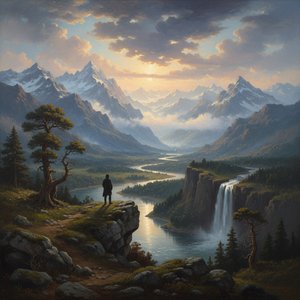
Edward Charles Williams: A Tranquil Vision of Victorian England
Edward Charles Williams (1807 – 1881) stands as a prominent figure within the Williams family of painters—a lineage celebrated for its dedication to capturing the serene beauty of rural landscapes during the Victorian era. Unlike many artists of his time consumed by grand narratives or dramatic portraits, Williams focused intently on portraying the quiet dignity of English countryside, establishing himself as one of the foremost practitioners of this distinctive artistic style. His work reflects not only technical mastery but also a profound sensitivity to atmosphere and light—elements that continue to resonate with viewers today.
Early Life & Family
Born in London, Williams’s artistic inclination stemmed from his father, Edward Williams (1781–1855), who himself was a respected landscape painter. This familial connection instilled within him a deep appreciation for the art form and fostered an unwavering commitment to its pursuit. Despite lacking formal instruction beyond his father's tutelage, Williams absorbed invaluable knowledge through observation and practice—a testament to the enduring power of mentorship. He married Mary Ann Challenger in 1839, forging a bond that would endure until her untimely passing in 1857, leaving him with a daughter named Alice Williams. Following this profound loss, he remarried Sarah Susanna Horley ten years later, establishing a stable family unit that nurtured his artistic creativity and provided solace amidst personal hardship.
Style & Technique
Williams’s artistic style is characterized by meticulous detail and a masterful use of glazing techniques—methods employed by his father and subsequently adopted by him. These techniques allowed for subtle gradations of color, creating luminous effects that conveyed an unparalleled sense of realism. His canvases depict scenes of Cumberland, Kent, Surrey and the Thames with remarkable accuracy, capturing not merely visual appearances but also the intangible qualities of light and air. He meticulously rendered landscapes using a technique reminiscent of Dutch masters—a deliberate choice reflecting his admiration for classical artistic traditions. The disappearance of three of his later works underscores the challenges faced by preserving artistic treasures amidst turbulent historical periods.
Notable Works
Among Williams’s most celebrated paintings are “Mother And Child On A Track By A Coppice,” “Barges on the Thames at Dusk, With Windsor Castle Beyond” and “Springer in The Bracken.” Each piece exemplifies his signature style—a harmonious blend of observation, draughtsmanship, and atmospheric rendering. These canvases capture the essence of rural England with breathtaking subtlety, conveying a profound connection to nature’s rhythms and moods. His dedication to portraying tranquil landscapes cemented his place as one of the most influential artists of his era. The meticulous attention to detail in these works—particularly the depiction of light and shadow—demonstrates Williams's unwavering commitment to artistic excellence.
Influence & Legacy
Williams’s contribution to landscape painting is undeniable. He helped solidify the Barnes School tradition—a movement that championed a particular aesthetic rooted in Dutch landscape art—and his paintings continue to inspire admiration for their understated elegance and profound connection to the natural world. His influence extended beyond mere stylistic imitation; he instilled within younger artists a reverence for observation and a belief in capturing the beauty of everyday life. He fostered a spirit of quiet contemplation—a characteristic that resonates powerfully with audiences today, securing his place as a cornerstone of Victorian artistic heritage.