Early Life and Education
Đoko Mazalić, a name synonymous with the evocative landscapes and insightful portraits of Bosnia and Herzegovina, was born in 1888 in Bosanska Kostajnica, a town steeped in history and natural beauty. He emerged as one of the first generation of Bosnian artists to receive formal training at prestigious art academies, alongside luminaries like Gabrijel Jurkić, Petar Tiješić, and Špiro Bočarić – figures who would collectively shape the artistic landscape of their nation. Mazalić’s artistic journey commenced in 1910 when he enrolled at the Academy of Fine Arts in Budapest, a pivotal period during which he honed his skills and absorbed the influences of European art movements. This early exposure to diverse styles—from the burgeoning Secessionism to the more traditional approaches of Naturalism—would profoundly impact his later work, contributing to its remarkable stylistic versatility.Artistic Career and Style
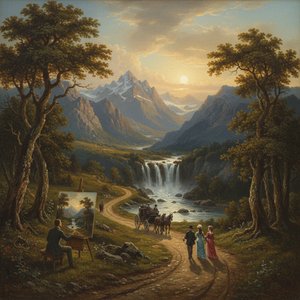
Mazalić’s artistic career is characterized by a captivating blend of innovation and consistency. His paintings, particularly his landscapes, stand as some of his most celebrated achievements, showcasing an unparalleled ability to capture the essence of the Bosnian environment. He possessed a rare gift for translating the rugged beauty of the mountains, the serene tranquility of the rivers, and the vibrant colors of the countryside onto canvas. A prime example of this talent is “Motif from Vranduk” (1920), a landscape piece that exemplifies his meticulous attention to detail and his profound understanding of light and shadow. Throughout his career, Mazalić navigated various artistic currents, demonstrating an openness to experimentation while maintaining a distinctive visual language. His work often hints at the mystical and symbolic, reflecting a deep connection with Bosnian folklore and tradition.Notable Works and Recognition
Mazalić’s oeuvre is rich and diverse, encompassing landscapes, portraits, and scenes of everyday life. Among his most significant works are “Landscape” (1913), now housed in the National Gallery of Bosnia and Herzegovina, and “Motif from Vogošća” (1930), also a treasured addition to the gallery’s collection. The painting "Village under snow" (1930) further demonstrates his ability to capture the dramatic beauty of the Bosnian winter. Beyond these iconic pieces, Mazalić's artistic legacy includes numerous other works that offer glimpses into the soul of Bosnia and Herzegovina. His dedication to preserving and promoting art was evident in his role as a teacher, shaping the careers of younger artists for decades. He also contributed significantly to the establishment of the Art Gallery of the National Museum of Bosnia and Herzegovina in 1930, serving as its director on a voluntary basis until 1943. His scholarly pursuits extended to the study of painting techniques and art history, culminating in the publication of “Lexicon of Artists of B&H” (1965) and “The Art of Painting in B&H in the Turkish Era” (1967), seminal works that remain invaluable resources for scholars and enthusiasts alike.Teaching and Legacy
From 1923 to 1945, Đoko Mazalić dedicated himself to teaching art, leaving an indelible mark on the artistic community of Sarajevo. He served as a professor of drawing in grammar schools, nurturing the talents of generations of aspiring artists. His influence extended beyond the classroom, shaping the direction of Bosnian art and fostering a spirit of innovation and creativity. Mazalić’s work is often described as a unique synthesis of influences—from magic realism and Pointillism to plein air painting and classicism—with occasional hints of surrealism. He was one of the few Bosnian painters who chose to return home after his studies, establishing himself firmly within the Sarajevo art scene and becoming a respected figure in its development.Conclusion
Đoko Mazalić’s artistic legacy stands as a testament to his unwavering dedication, innovative spirit, and profound love for Bosnia and Herzegovina. His paintings continue to resonate with viewers today, offering a window into the beauty of the Bosnian landscape and the richness of its cultural heritage. He remains an enduring symbol of Bosnian art history, inspiring artists and art enthusiasts alike to explore the power of visual expression.Domande e risposte
Dove posso vedere le opere di Đoko Mazalić suddivise per atmosfera?
La pagina Stanze d'atmosfera dell'artista mostra le opere di Đoko Mazalić suddivise per atmosfera.
Quali sono il luogo e l'anno di nascita di Đoko Mazalić?
Đoko Mazalić è nato a Bosanska Kostajnica nel 1888.
In quale città e in quale paese è nato/a Đoko Mazalić?
Đoko Mazalić è nato a Bosanska Kostajnica, in Bosnia ed Herzegovina.
Come posso trovare le opere di Đoko Mazalić in una specifica palette cromatica?
Le opere di Đoko Mazalić possono essere consultate per palette cromatica nella pagina Per palette dell'artista.
Dove si trovano le opere di Đoko Mazalić organizzate per colore?
La pagina Indice Spettrale organizza le opere di Đoko Mazalić per colore.
Dove si trovano le opere di Đoko Mazalić raggruppate per tecnica?
Le opere di Đoko Mazalić possono essere consultate per tecnica nella pagina Tutti i media dell'artista.
Di dove è Đoko Mazalić?
Đoko Mazalić è nato/a in Bosnia ed Herzegovina.