Daniele Buetti: Piercing the Veil of Beauty
Daniele Buetti (born 1955) stands as a singular voice within contemporary art, recognized for his unsettling yet profoundly thoughtful explorations into themes of identity, perception, and the pervasive influence of consumer culture. Rooted in Fribourg, Switzerland, Buetti’s artistic journey began with a fascination for photography and sculpture, evolving into a multifaceted practice encompassing installation, intervention, sound, video, and digital media—a testament to his unwavering dedication to pushing creative boundaries.
Early Influences: Buetti's formative years were profoundly shaped by exposure to the writings of Jean Baudrillard and Giorgio Agamben, thinkers who interrogated notions of simulacra and hyperreality—concepts that would become central to his artistic vision. These philosophers challenged conventional understandings of representation and questioned whether images could ever truly capture reality, sparking Buetti’s intellectual curiosity and informing his subsequent artistic endeavors. Baudrillard's critique of the media landscape and Agamben’s exploration of power dynamics served as crucial conceptual anchors for Buetti’s artistic explorations.
The Critique of Beauty: His breakthrough came in the 1990s with a series of provocative interventions targeting images of fashion models and luxury products disseminated by magazines. Using a ballpoint pen—a deliberately mundane tool—Buetti meticulously punctured these glossy surfaces, disrupting their idealized representations and exposing the underlying emptiness of consumer desire. This act wasn’t merely destructive; it was a carefully calibrated gesture designed to provoke dialogue about how we perceive beauty and the seductive allure of manufactured perfection. The resulting images became symbols of Buetti's critique of cultural values—a deliberate provocation aimed at destabilizing viewers’ assumptions about desirability and authenticity.
A Methodical Approach to Disruption
Buetti’s artistic methodology is characterized by meticulous planning and execution. He approaches each project with a deliberate consideration for materiality and context, often transforming ordinary spaces into immersive environments that invite contemplation. His interventions aren't merely destructive acts; they are carefully calibrated gestures designed to provoke dialogue about how we perceive and interpret visual information—a core element of his artistic philosophy. The artist’s meticulous attention to detail reflects a belief in the transformative potential of art, urging viewers to confront uncomfortable truths and reconsider their relationship with the world around them.
Photography as Catalyst: Buetti’s photographic work consistently examines the relationship between image and reality, frequently employing techniques of collage and montage to create layered narratives that challenge conventional perspectives. He utilizes photographic elements—often juxtaposed with sculptural components—to explore themes of fragmentation and multiplicity, mirroring the complexities of human experience. His images serve as visual provocations, prompting viewers to question what constitutes “truth” and how representations shape our understanding of events.
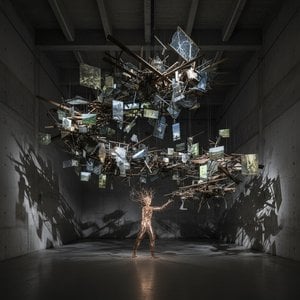
Installation Art: Buetti’s installations—such as “Auf allen knien” at Kunsthaus Bregenz—are conceived as spaces for encountering uncomfortable truths, utilizing sculptural elements and soundscapes to heighten emotional impact. The artist deliberately disrupts familiar spatial conventions, creating environments that encourage introspection and prompting viewers to confront their own biases. These works represent Buetti’s commitment to challenging artistic norms and engaging audiences in a profound dialogue about the human condition—a hallmark of his distinctive artistic style.
Notable Exhibitions & Collections
Buetti's work has garnered international acclaim, appearing in prestigious museums including the Schirn Kunsthalle Frankfurt, the Kunsthaus Wien, Reina Sofía Museum in Madrid, Museo Nacional Centro de Arte Reina Sofía, and ZKM Karlsruhe—a testament to his enduring influence on contemporary art. His pieces reside within prominent collections like the DaimlerChrysler Collection in Berlin and the Fotomuseum Winterthur—confirming his position as a leading figure in the global art scene.
Legacy & Significance
Daniele Buetti's contribution to the art world lies in his unwavering commitment to questioning accepted norms and confronting viewers with unsettling realities. He compels us to reconsider our assumptions about beauty, representation, and the role of art in shaping our understanding of the human condition—a core element of his artistic philosophy. His work continues to resonate with audiences globally, demonstrating the enduring power of artistic provocation and intellectual rigor. Buetti’s legacy extends beyond individual artworks; he embodies a broader ethos of critical engagement and imaginative exploration—inspiring artists and thinkers alike to challenge conventions and pursue profound insights into the complexities of human experience.