A Master of Hungarian Etching Tradition
Csaba Rékassy (1937 – 1989) stands as a singular figure in Hungarian art history, recognized for his unwavering dedication to the etching technique and his ability to distill classical artistic ideals into strikingly complex compositions. Born in Hungary during a period of significant cultural upheaval, Rékassy’s artistic journey unfolded largely independently, fueled by an innate talent and a profound respect for the heritage of Hungarian painting. Despite limited formal training—he was primarily self-taught—his output demonstrates an astonishing command of printmaking, cementing his place among Hungary's most accomplished artists.
Early Life & Artistic Beginnings:
Details about Rékassy’s formative years are scarce, reflecting the challenges faced by artists operating outside established academic circles during that era. He emerged from Budapest’s artistic milieu—a vibrant yet often marginalized community—where traditional Hungarian painting continued to flourish alongside emerging avant-garde movements. While biographical information remains elusive, anecdotal evidence suggests a childhood steeped in folklore and storytelling—elements that would later permeate his artistic vision.
Rékassy’s Artistic Style:
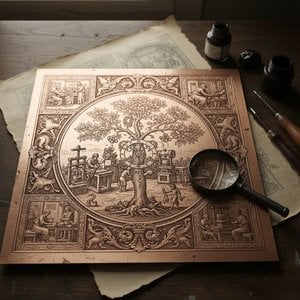
His distinctive style is immediately recognizable by its meticulous attention to detail and its masterful manipulation of texture. He eschewed grand narratives or overtly expressive gestures, prioritizing scenes imbued with quiet contemplation and symbolic resonance. Rather than attempting to dominate the viewer's gaze, Rékassy sought to invite introspection—to encourage viewers to engage in a dialogue with the artwork itself. This understated approach was underpinned by an unwavering commitment to technical precision—a hallmark of his oeuvre. He achieved remarkable tonal gradations through painstaking layering of multiple etching plates, utilizing intricate lines and hatching to capture subtle nuances of light and shadow. The artist’s technique drew heavily from the legacy of Rembrandt and Caravaggio—masters who had perfected chiaroscuro—creating surfaces that seemed to shimmer with an ethereal luminescence.
Notable Works & Artistic Influences:
“Ovidius” remains Rékassy's most celebrated achievement. This monumental etching portrays a scene from Ovid’s Metamorphoses, capturing the poet’s dramatic narrative with breathtaking precision and conveying an emotional depth that transcends mere visual representation. Beyond classical influences, Rékassy absorbed inspiration from Hungarian folk art traditions, subtly incorporating elements of Hungarian ornamentation into his compositions. He was particularly drawn to the expressive power of chiaroscuro—the interplay between light and shadow—a technique perfected by Rembrandt and Caravaggio—artists he greatly admired. The artist’s meticulous rendering of figures—often bathed in diffused light reminiscent of ancient frescoes—demonstrates a profound understanding of artistic history. His works frequently revisit themes derived from Greco-Roman mythology and literature, particularly Ovidius—a poet whose narratives explored transformations and moral dilemmas with unparalleled eloquence.
Recognition & Legacy:
Rékassy’s dedication to his craft garnered considerable acclaim during his lifetime. He received numerous awards recognizing his artistic merit, including the Honorable Mention Prize at the VIII. International Graphic Biennial in Tokyo (1970), the János Tornyai Award; WHOLE Fee (1971), and the Munkácsy Prize 1st Degree; Grand Prize of the Miskolc Graphical Biennial (1983). Furthermore, he was honored with the IBBY International Children's Book Council Award (1985) for his contributions to children’s illustration—a testament to his versatility as an artist. In 1989, Rékassy was bestowed with the Great Artist of the Hungarian People’s Republic—the highest honor awarded by Hungary’s artistic community—solidifying his position as a national icon. Today, Csaba Rékassy's prints are housed in prestigious collections worldwide—including those at USC Fisher Museum of Art in Los Angeles and the Zichy Museum Zala in Hungary—where they continue to inspire viewers with their beauty and intellectual depth. His enduring influence on Hungarian etching tradition ensures that his artistic vision will resonate for generations to come.