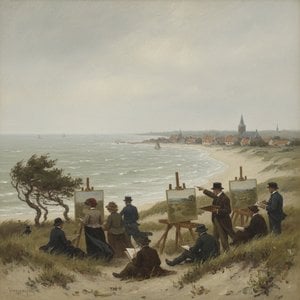
Cornelis Vreedenburgh: Capturing Amsterdam’s Light
Cornelis Vreedenburgh (August 25, 1880 – June 27, 1946) was a Dutch painter whose Impressionistic landscapes and cityscapes offer a poignant glimpse into the Belle Époque spirit of Amsterdam. Born in Woerden, Netherlands, he honed his artistic skills during a formative period marked by the burgeoning Hague School movement, absorbing its ethos of capturing fleeting moments of natural beauty with luminous color palettes—a stylistic approach that would define his oeuvre for decades to come. Early Life and Training: Vreedenburgh’s formal training began at the Willem Landmans Academie in Haarlem, where he studied under Anton Mauve, a prominent figure of the Hague School who championed plein air painting and prioritized tonal harmony above all else. This influence is palpable in his early works, characterized by serene compositions and subtle gradations of color. Mauve’s insistence on capturing atmospheric conditions—the interplay of light and shadow—became a cornerstone of Vreedenburgh's artistic vision, shaping his technique for years to come. He also benefited from instruction from Paul Arntzenius and Willem Tholen, who instilled in him the importance of observation and expressive brushwork. The Hague School’s Legacy: The Hague School's emphasis on atmospheric perspective and tonal modulation profoundly impacted Vreedenburgh’s artistic vision. Artists like Mauve and Isaac Israelson encouraged a rejection of academic conventions in favor of direct observation and expressive brushwork—principles that Vreedenburgh embraced wholeheartedly. This commitment to realism combined with an emotional resonance would become a hallmark of his distinctive style, differentiating him from many of his contemporaries.Amsterdam Through Painterly Eyes
Vreedenburgh's artistic focus centered on capturing the essence of Amsterdam, transforming familiar urban vistas into canvases brimming with light and color. Works such as “A View of the Montelbaanstoren Amsterdam” exemplify his masterful technique—a deliberate layering of brushstrokes to achieve a shimmering surface that conveys the dynamism of the city while simultaneously evoking a sense of tranquility. He skillfully rendered buildings bathed in sunlight, canals reflecting the sky’s hues, and bustling streets alive with movement. His paintings are imbued with a palpable energy, mirroring the vibrant pulse of Amsterdam during its golden age—a testament to his ability to translate visual experience into emotive art. Notable Paintings: Among his most celebrated pieces are “A Peasant Woman On A Path Along A Canal” and “Corn Sheafs In Gooi,” which showcase Vreedenburgh's talent for portraying rural landscapes with remarkable sensitivity. These canvases capture the beauty of Dutch countryside, reflecting a profound connection to nature—a characteristic that aligns perfectly with the broader aesthetic principles of Luminisme, a movement closely associated with the Hague School. His work was recognized by Queen Wilhelmina who purchased two paintings during her lifetime.Participation in Artistic Endeavors
Vreedenburgh’s artistic pursuits extended beyond individual canvases; he actively engaged in collaborative projects and contributed to significant cultural events. Notably, he participated in the art competition at the 1924 Summer Olympics, submitting a landscape painting that garnered considerable acclaim. Furthermore, his work was featured prominently in “Onze Kunst van Heden,” a landmark exhibition showcasing Dutch modern art at the Rijksmuseum in Amsterdam—a testament to his enduring influence within the artistic community. He was a member of “Pulchri Studio” and “Lucas”, fostering connections with fellow artists and promoting artistic dialogue. Concluding Reflections: Cornelis Vreedenburgh’s legacy resides not merely in his impressive body of paintings but also in his unwavering commitment to Impressionistic principles. He skillfully blended observation with emotion, transforming ordinary subjects into extraordinary expressions of beauty and tranquility. His contribution to Dutch art history secures his place as a pivotal figure within the Hague School tradition—a painter who successfully captured the spirit of Amsterdam and disseminated its luminous charm across generations.Domande e risposte
È disponibile un tour virtuale 3D delle opere di Cornelis Vreedenburgh?
Le opere di Cornelis Vreedenburgh sono visibili in una galleria 3D nella pagina Museo 3D dell'artista.
In quale periodo storico ha operato Cornelis Vreedenburgh?
Cornelis Vreedenburgh ha operato nel periodo Età Moderna. Tale epoca colloca storicamente l'attività dell'artista.
Dove posso vedere il profilo cromatico delle opere di Cornelis Vreedenburgh?
Il profilo cromatico delle opere di Cornelis Vreedenburgh è visualizzabile nella pagina Genoma della Palette dell'artista.