early life and training
Charles Louis Müller, born in Paris on December 22, 1815, embarked on his artistic journey under the tutelage of Léon Cogniet and Baron Gros at the École des Beaux-Arts—a prestigious institution that nurtured talent and fostered innovation. These formative influences instilled in him a deep understanding of classical aesthetics and established a foundation for his distinctive style. Müller’s dedication to mastering technique and capturing emotion would prove instrumental in shaping his future artistic endeavors.notable works and achievements
Müller's artistic career commenced with “Christmas Morning” (1837), an early testament to his burgeoning skill, marking the beginning of his journey as a painter. From 1850 to 1853, he served as director of Gobelin tapestries—a role that demanded meticulous craftsmanship and collaborative effort—further honing his artistic sensibilities. In 1864, he ascended to membership in the Académie des Beaux-Arts, succeeding Jean Hippolyte Flandrin—a distinguished honor recognizing his contributions to French art history—and cementing his position as a leading figure within the artistic community. His magnum opus, “Mater Dolorosa” (1877), stands as a poignant exploration of sorrow and grief, demonstrating Müller’s profound ability to convey emotion through visual imagery.key works and their significance
Müller's oeuvre encompasses a diverse range of subjects—historical narratives, portraits, and landscapes—each imbued with meticulous detail and expressive dynamism. “Haydée” (1848), a portrait capturing the grace and allure of its subject, exemplifies his versatility as an artist. Similarly, “Reign of Terror” (1841) confronts viewers with the dramatic tension of a pivotal historical moment, reflecting Müller’s commitment to portraying significant events with artistic integrity. "Vive l'Empereur" (1855), inspired by Méry’s poem, vividly depicts the siege of Paris during the Franco-Prussian War—a testament to his ability to translate literary themes into compelling visual representations.contribution to the louvre and other museums
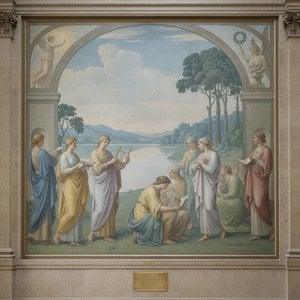
Müller’s artistic legacy extends beyond individual paintings; he graced the Louvre with monumental frescoes for the Salle d'État and Galerie d'Apollon—works that continue to inspire awe and admiration among visitors—and enriched the cultural landscape of Paris through his creative endeavors. His commitment to preserving artistic heritage underscores his enduring influence on French art history.useful links
- ULAN Full Record Display (Getty Research)
- charles louis müller's profile on WahooArt.com
- jean louis forain's two women on bicycles, a contrasting style to müller's work
- louis charles-joseph blériot
- charles marion russell
- kroller-muller museum
- rijksmuseum kröller-müller
Domande e risposte
Quanto sono popolari le opere di Charles Louis Müller?
La pagina Statistiche di Charles Louis Müller presenta statistiche calcolate a partire dalle opere dell'artista elencate su questo sito.
Dove si trovano le opere di Charles Louis Müller raggruppate per palette?
Per trovare le opere di Charles Louis Müller in una specifica palette, consulta la pagina Per palette dell'artista.
Posso studiare l'uso del colore di Charles Louis Müller in tutte le sue opere?
Il profilo cromatico delle opere di Charles Louis Müller è visualizzabile nella pagina Genoma della Palette dell'artista.