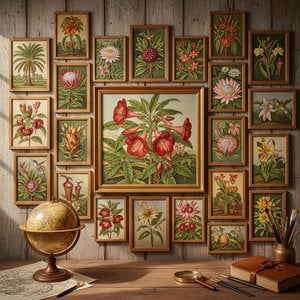
Catharina Antonie Klein: The Watercolorist Who Captured Floral Beauty
Catharina Antonie Klein (4 November 1861 – 30 November 1929) remains a fascinating figure in the history of German art, largely unrecognized outside specialist circles. Despite her prolific output—estimated at over 2,000 paintings—Klein’s legacy rests primarily on her extraordinary success as a watercolorist and illustrator, particularly her contribution to the burgeoning field of chromolithography during the late Victorian and Edwardian eras. Her distinctive style, characterized by meticulous observation and an unwavering devotion to floral subjects, cemented her place as one of Germany's foremost flower painters.
Early Life & Artistic Training: Born in Karlshöfchen (now Bagrationovsky District), near Preußisch Eylau, Klein’s talent for drawing was evident from a young age. Encouraged by her father, she pursued formal artistic education at the Ladies’ Academy in Berlin—a bastion of women’s art training at the time—where she honed her skills under the tutelage of prominent instructors and gained access to an environment largely inaccessible to female artists. This formative experience instilled within her a profound appreciation for disciplined artistry and shaped her lifelong commitment to mastering watercolor techniques.
A Singular Vision: Klein’s artistic philosophy was remarkably focused. Rejecting oil paints due to their perceived “weight,” she steadfastly adhered to watercolor and gouache techniques—a deliberate choice that allowed her to capture the delicate nuances of floral forms with unparalleled subtlety. This unwavering dedication to a specific medium speaks volumes about her artistic integrity and represents a courageous assertion of creative autonomy against prevailing conventions. It underscored her belief that true beauty resided in capturing fleeting moments of natural splendor with understated elegance.
The Chromolithographic Boom & Artistic Recognition: Klein’s paintings achieved international renown thanks to their adaptation into chromolithographic prints—a revolutionary printing process that enabled mass production of vibrant, multi-colored images. Publishers like Meissner & Buch and Raphael Tuck & Sons eagerly embraced her work, commissioning extensive illustrations for books, postcards, and decorative arts projects. This collaborative effort propelled Klein’s fame across Europe and solidified her reputation as a pivotal figure in the dissemination of botanical art. The resulting prints captivated audiences with their luminous hues and precise depictions of flowers—a testament to Klein's ability to translate her artistic vision into accessible formats for a wider public.
Notable Works & Artistic Style: Klein’s oeuvre encompasses an impressive range of floral compositions—roses being her signature subject—often depicted with meticulous detail and bathed in luminous watercolor washes. Her paintings are notable for their naturalistic accuracy, capturing the textures and colors of flowers with remarkable precision. Furthermore, she skillfully incorporated elements of composition and arrangement to create visually arresting images that resonated deeply with audiences. These works exemplify Klein’s mastery of watercolor, demonstrating her ability to convey emotion through subtle tonal variations and masterful brushwork.
Legacy & Historical Significance: Catharina Klein’s contribution to art history extends beyond her individual paintings. She represents a significant milestone in the democratization of artistic expression—demonstrating how women artists could achieve considerable success through innovative collaborations and adapting their work for commercial markets. Her enduring popularity testifies to the timeless appeal of floral painting and underscores Klein's position as an important voice within the broader context of German art at the turn of the century. Klein’s influence can be seen in subsequent generations of watercolor artists who sought inspiration from her masterful technique and unwavering devotion to botanical subjects, securing her place as a pioneer of modern artistic practice.