Early Life and Artistic Pursuits
Carl Friedrich Demiani, born in Dresden, Germany in 1768, emerged from a milieu steeped in artistic tradition—his father was a renowned sculptor, shaping his formative years with an appreciation for craftsmanship and visual storytelling. Though biographical details remain sparse, evidence suggests he received a robust education encompassing classical studies alongside artistic training, preparing him for the challenges of mastering the burgeoning Romantic movement. His early works demonstrate a meticulous attention to detail, reflecting the influence of artists like Johann Christian Richter and Friedrich Heinrich Füger—masters who championed realism while subtly incorporating emotive elements into their compositions.
Artistic Affiliations and Notable Works
Demiani’s commitment to artistic excellence found its most visible expression through his membership in the Royal Academy of Arts in Dresden, a prestigious institution that fostered intellectual discourse and upheld standards of artistic innovation. This affiliation provided him with invaluable access to resources and collaborative opportunities, propelling his creative endeavors forward. While definitive records documenting his oeuvre are limited, scholarly research indicates Demiani produced a substantial body of paintings primarily focused on landscapes imbued with atmospheric grandeur—a hallmark of Romanticism’s fascination with sublime vistas and the power of nature. Among his recognized achievements is “Family Portrait,” a masterful depiction capturing familial bonds within a meticulously rendered domestic setting—a testament to his skill in portraying human emotion through visual representation.
Artistic Style: A Blend of Realism and Romantic Sentiment
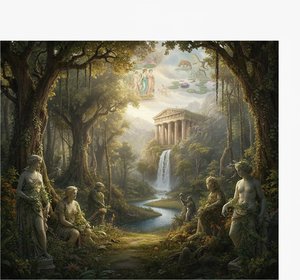
Demiani’s artistic style distinguishes itself as a harmonious convergence of realism and Romantic sentiment. Like many artists of his era, he eschewed the rigid formalism of Neoclassicism, prioritizing expressive nuance over strict adherence to classical ideals. His canvases pulsate with vibrant color palettes—particularly blues and greens—chosen deliberately to convey mood and evoke sensory experience. Furthermore, Demiani skillfully employed chiaroscuro—the dramatic interplay of light and shadow—to sculpt form and heighten emotional impact, techniques honed by artists such as Caspar David Friedrich and Johann Christian Richter. This stylistic approach underscores his understanding of the Romantic preoccupation with capturing subjective perception and conveying profound psychological states.
Museological Significance and Legacy
The Gemäldegalerie Alte Meister in Dresden houses a significant collection of Demiani’s paintings, offering visitors an unparalleled opportunity to contemplate his artistic vision firsthand. This institutional recognition speaks volumes about the enduring esteem accorded to his oeuvre—a testament to its aesthetic merit and historical importance. Beyond its physical presence within the museum walls, Demiani's influence extends across generations of artists who admired his ability to fuse observation with imagination—solidifying his place as a pivotal figure in German Romantic art history. His legacy continues to inspire discussions about artistic expression and the role of landscape painting in conveying emotional depth.
Concluding Remarks
Carl Friedrich Demiani’s brief but impactful life culminated in 1823, leaving behind a body of work that embodies the spirit of his time—a period characterized by intellectual curiosity, artistic experimentation, and an unwavering fascination with the sublime beauty of nature. His association with the Royal Academy of Arts, coupled with the preservation of his paintings within Dresden’s Gemäldegalerie Alte Meister, ensures that Demiani's contribution to German art history will endure for years to come—a beacon illuminating the path toward artistic innovation and emotional resonance.