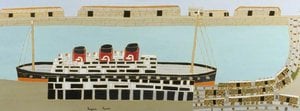
Walter Bryan Pearce (1927 – 2007) was a British painter recognized as one of the UK’s leading naïve artists, capturing the essence of Cornwall and its daily life with distinctive bold outlines and vibrant hues. Born in St Ives, Cornwall, his artistic journey began under the nurturing influence of his mother, Mary Warmington—herself a painter—and later fostered by fellow St Ives artists like Peter Lanyon. Pearce’s formative years were marked by congenital phenylketonuria (PKU), which necessitated special schooling and profoundly shaped his perception of the world, imbuing his art with an unparalleled sensitivity to observation.
Early Life & Influences
Bryan Pearce was born in St Ives, Cornwall, on July 25, 1927. His father, Walter, was a butcher in St Ives, played rugby for Cornwall, and later served as mayor of St Ives. Mary Warmington, his mother, possessed a fervent passion for painting—a legacy that instilled in Pearce from an early age a deep appreciation for visual expression. This familial encouragement combined with the artistic milieu of St Ives fostered by luminaries like Peter Lanyon provided him with invaluable formative experiences.
Formal Training & Artistic Style
Pearce attended Leonard Fuller’s St Ives School of Painting between 1953 and 1957, diligently honing his skills and refining his distinctive style. His artistic technique was characterized by a remarkably simple approach—flat canvases dominated by bold outlines surrounding areas of intense color, mirroring the aesthetic principles championed by Peter Lanyon. Lanyon famously asserted that Pearce’s art communicated “awareness more direct” than pure visual representation; he described Pearce’s work as "original," emphasizing the artist's ability to convey experience beyond conventional perception. Comparisons with Alfred Wallis—another St Ives painter known for his reductive style and evocative landscapes—further illuminate Pearce’s artistic lineage, highlighting shared stylistic concerns.
Notable Characteristics
Pearce’s paintings are instantly recognizable for their bold outlines juxtaposed against vibrant color palettes – a visual strategy akin to stained glass windows. This deliberate technique wasn't merely decorative; it reflected Lanyon’s conviction that Pearce prioritized emotional resonance over meticulous detail. His oeuvre predominantly focused on landscapes of Cornwall—particularly St Ives Harbour and “The Queen Mary”—executed with unwavering dedication to capturing the spirit of his surroundings. These paintings are celebrated for their luminous color palettes and expressive contours, embodying a unique vision that transcends mere representation.
Legacy & Recognition
Pearce’s contribution to naïve art is significant, securing his place as an artist who successfully translated sensory experience into emotionally resonant visual narratives. His work gained considerable acclaim during his lifetime, culminating in solo exhibitions at the Newlyn Gallery and St Martin's Gallery, establishing him as a prominent figure in British art. Retrospectives held at Penwith Gallery (1966), the Museum of Modern Art Oxford (1975), the Royal Cornwall Museum Truro (2000), and Victoria Art Gallery Bath (2004) solidified his enduring legacy—a testament to his unwavering commitment to artistic exploration and visual storytelling. Today, Pearce’s paintings reside in numerous public collections across Britain, ensuring that his distinctive style continues to inspire admiration and appreciation for generations to come.
A cura del team editoriale di WahooArt.com
Quiz d'arte
Per ogni domanda è presente una sola risposta corretta.
Domanda 1:
Dove è nato Bryan Pearce?
Domanda 2:
Quale condizione aveva Bryan Pearce?
Domanda 3:
Bryan Pearce ha frequentato quale scuola di pittura?
Domanda 4:
Chi lodò lo stile artistico di Bryan Pearce, affermando che comunicava “consapevolezza più diretta” rispetto alla pura rappresentazione visiva?
Domanda 5:
Bryan Pearce si specializzò nella pittura di quale soggetto?
Esplora i 10 capolavori del Paesaggio Romantico con WahooArt.com! Caspar David Friedrich, Turner e altri maestri: storia, tecnica e colori che definiscono un'epoca. Trova riproduzioni d'arte di lusso per la tua casa. Scopri la collezione completa online!
Explore the life & work of Alfred East, a pioneer of British plein air painting. Discover his techniques for capturing atmospheric landscapes, Barbizon influences, and lasting legacy. Learn more at WahooArt.
Esplora i 25 capolavori di John Constable, il maestro del Romanticismo inglese. Paesaggi suggestivi, luce naturale e colori vibranti ti aspettano. Acquista riproduzioni d'arte di alta qualità su WahooArt.com e porta la bellezza della campagna inglese nella tua casa.