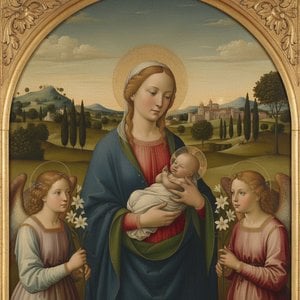
Bernardo Rossellino: The Florentine Renaissance Architect
Bernardo di Matteo del Borra Gamberelli, affectionately known as Bernardo Rossellino (1409–1464), stands as a cornerstone of Early Renaissance art and architecture in Florence. His legacy extends far beyond his prolific output; he embodies the spirit of innovation and humanist ideals that defined the era, shaping artistic sensibilities for generations to come. Born into a family rooted in Florentine stonemasonry—his uncle Jacopo di Domenico di Luca del Borra Gamberelli imparted foundational skills—Rossellino’s trajectory mirrored the burgeoning dynamism of his time.Early Life and Training
Little is known about Rossellino's formative years beyond his familial connection to stonemasonry. However, evidence suggests he honed his craft under Nanni di Bartolo, “il Rosso,” a pivotal figure in Florentine sculpture who championed classical ideals. This apprenticeship instilled within him the meticulous attention to detail and understanding of proportion that would characterize his entire artistic career. Rossellino’s dedication to mastering the techniques of stone carving ensured he was well-prepared for the ambitious commissions that awaited him.The Influence of Brunelleschi and Masaccio
Like many artists of his generation, Rossellino absorbed the revolutionary aesthetic pioneered by Filippo Brunelleschi and Masaccio. Their embrace of linear perspective and idealized human form profoundly impacted Rossellino’s artistic vision—a conviction that would become a guiding principle throughout his subsequent endeavors. Brunelleschi’s groundbreaking dome for Florence Cathedral served as an inspiration, demonstrating the possibility of achieving structural grandeur while upholding humanist ideals. Masaccio's frescoes in Santa Maria Novella established new standards for realism and compositional harmony, influencing Rossellino’s approach to portraying figures and spaces with unprecedented accuracy.Arezzo and the Misericordia Facade: A Bold Experiment in Synthesis
Rossellino’s career gained prominence in 1433 when he accepted a commission from the Fraternita di Santa Maria della Misericordia to revitalize the façade of their headquarters in Arezzo. This project presented an extraordinary challenge—the existing Gothic structure demanded a radically different approach. Demonstrrating remarkable ingenuity, Rossellino fused Gothic elements with classical principles, mirroring Alberti’s pioneering efforts at Santa Maria Novella. The resulting design incorporated paired pilasters and aediculae derived from Roman architectural models, establishing Rossellino as a champion of stylistic eclecticism—a hallmark of the Florentine Mannerist style. This daring fusion symbolized the Renaissance spirit of reconciling tradition with innovation, reflecting a broader cultural movement aimed at reviving classical ideals.The Leonardo Bruni Tomb: Defining the Humanist Monument
Perhaps Rossellino’s most celebrated achievement was the tomb he conceived for Leonardo Bruni, Florence’s humanist historian and chancellor. Despite the lack of surviving documentation regarding its precise design—two sixteenth-century sources attribute authorship to Rossellino—scholars concur that it exemplifies the zenith of Renaissance sculptural artistry. The tomb’s harmonious composition—characterized by a shallow wall niche framed by pilasters and topped with an arched vault—reflected Bruni's intellectual pursuits and embodied the humanist ideal of unity—a concept championed by Alberti. This monumental sculpture served as a powerful testament to humanism’s belief in the interconnectedness of mind and body, reflecting the broader Renaissance preoccupation with achieving moral perfection through artistic expression.Rome and Papal Patronage: Mastering Classical Revival
Rossellino’s artistic reputation soared during his tenure in Rome under Pope Nicholas V. He undertook monumental projects, including the restoration of St. Peter's Basilica and the expansion of its choir—tasks that cemented his position as a leading architect of the era. Furthermore, he collaborated with Michelangelo on the rebuilding of St. Peter’s, demonstrating an unparalleled understanding of classical architectural techniques. Rossellino’s involvement in these ambitious undertakings showcased his mastery of Roman architectural principles and solidified his role as one of the foremost builders of his time—a figure whose legacy continues to inspire awe and admiration centuries later. ### Legacy and Influence Bernardo Rossellino’s workshop dominated Florentine stonemasonry throughout the 1450s and 1460s, fostering a vibrant artistic environment. His influence extended beyond his own creations—he mentored younger sculptors like Desiderio da Settignano and Michelangelo—propagating his distinctive Mannerist style across Florence. Most notably, Rossellino’s tomb for Bruni served as a template for subsequent funerary monuments, establishing him as the progenitor of the humanist tomb tradition—a testament to his enduring contribution to Renaissance art history. His work remains an exemplar of elegance and restraint, reflecting the humanist values that underpinned the artistic achievements of the era.Domande e risposte
Quante opere di Bernardo Rossellino sono disponibili nel catalogo?
Puoi sfogliare 6 opere d'arte opere di Bernardo Rossellino nella pagina Tutte le opere.
Dove posso visitare il museo virtuale 3D con le opere di Bernardo Rossellino?
Le opere di Bernardo Rossellino sono visibili in una galleria 3D nella pagina Galleria 3D dell'artista.
Posso sfogliare le opere di Bernardo Rossellino in base alla palette di colori?
Per trovare le opere di Bernardo Rossellino raggruppate per una specifica palette, consulta la pagina Per palette di colori dell'artista.