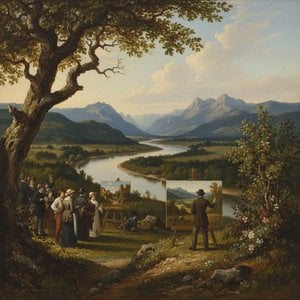
Benjamin Franklin Reinhart: A Painter of Midwestern Landscapes and Genre Scenes
Benjamin Franklin Reinhart (1829 – May 3, 1885) stands as a prominent figure in American art history, particularly recognized for his evocative depictions of the American Midwest and engaging genre paintings that captured everyday life. Born in Waynesburg, Pennsylvania, Reinhart’s artistic journey began with formal training at the National Academy of Design in New York City, where he honed his skills during the summers spent in Hayesville, Ohio—a region that would profoundly influence his artistic vision. This formative period instilled a deep appreciation for the rural landscapes and working-class communities of Ohio, themes which consistently recurred throughout his prolific career.
Early Life and Education
Reinhart’s upbringing fostered an interest in art from a young age. He pursued studies abroad in Rome, Paris, and Düsseldorf between 1850 and 1853, immersing himself in the artistic traditions of Europe while simultaneously absorbing influences from German Romanticism. These experiences broadened his artistic horizons and equipped him with technical mastery—a cornerstone of his distinctive style. The National Academy of Design provided a foundational grounding in classical art principles, preparing him for the challenges of mastering new techniques and exploring innovative compositional approaches. His time spent in Düsseldorf was particularly formative, exposing him to the stylistic precepts of German Romantic landscape painters like Caspar David Friedrich—whose works explored themes of solitude, spirituality, and the relationship between humanity and nature.
Academic Recognition and Artistic Style
Reinhart’s membership in the National Academy of Design since 1871 solidified his position within the American art establishment. His paintings are characterized by a meticulous attention to detail, combined with a masterful use of color and light—techniques that effectively convey emotion and atmosphere. Notably, Reinhart excelled at capturing the nuances of human interaction and portraying scenes from ordinary life with remarkable sensitivity. He achieved this through painstaking observation and skillful artistic execution, mirroring the precision demanded by academic training while simultaneously injecting his own expressive vision into his canvases. His palette was rich and vibrant—reflecting the influence of Impressionist artists like Claude Monet and Pierre-Auguste Renoir—who championed plein air painting and sought to capture fleeting moments of beauty.
Notable Works: Landscapes of Ohio
Reinhart’s artistic output encompassed both historical paintings and genre depictions, yet it is his landscapes that arguably define his artistic legacy. Among his most celebrated achievements is “Washed Ashort,” a monumental canvas commemorating the shipwreck of the SS Atlantic off Cape Cod in 1873—a dramatic portrayal imbued with psychological depth and rendered with breathtaking realism. This masterpiece exemplifies Reinhart’s ability to convey profound emotional states within his canvases—capturing the turbulent forces of nature alongside the human drama unfolding upon its shores. His depictions of Ohio's rolling hills and fertile valleys are particularly noteworthy—reflecting the Romantic spirit of his time and embodying a deep connection to the American wilderness. These landscapes are not merely representations of scenery; they serve as vehicles for conveying emotional resonance—expressing tranquility, grandeur, and the sublime.
Genre Painting and Narrative Vision
Reinhart’s artistic reputation rests largely on his genre paintings—works that depict scenes from everyday life with remarkable realism and psychological insight. Unlike historical narratives, genre paintings focus on human behavior and emotion—capturing fleeting moments of interaction and conveying nuanced characterizations. Reinhart's ability to portray ordinary individuals with empathy and sensitivity distinguishes him as a master storyteller—a skill honed through meticulous observation and skillful artistic execution. His canvases often depict domestic interiors bathed in soft light—illuminating intimate relationships and capturing the subtle gestures of daily life. He skillfully employed color and composition to convey emotion and atmosphere—creating works that resonate deeply with viewers long after they have gazed upon them.
Legacy and Influence
Benjamin Franklin Reinhart’s contribution to American art extends beyond his individual masterpieces; he established a tradition of landscape painting that continues to inspire admiration for its technical precision, emotional resonance, and unwavering commitment to portraying authentic human experience—a quality that distinguishes him as one of America’s most perceptive and emotionally resonant artists. His influence can be seen in the works of subsequent generations of Midwestern painters—who embraced Reinhart's stylistic precepts and pursued similar artistic goals. He remains a testament to the enduring power of observation, empathy, and artistic vision—a figure whose legacy continues to enrich the visual culture of America.