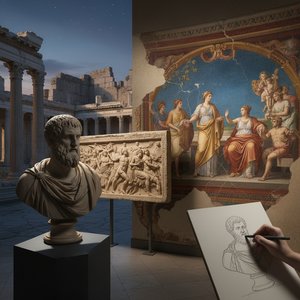
Apelles of Kos: The Forgotten Genius of Ancient Greece
Apelles of Kos (fl. 4th century BC) remains one of the most enigmatic figures in ancient Greek art history—a painter whose brilliance was acknowledged by contemporaries but largely eclipsed by subsequent artistic developments. Despite the scarcity of surviving portraits and written accounts, Pliny the Elder’s lavish praise (“superior to preceding and succeeding artists”) cemented Apelles' place as a titan amongst his peers, establishing him as arguably the greatest artist of his era.
Early Life and Artistic Training
Born in Colophon, Ionia—a prosperous Greek city-state under Macedonian rule—Apelles descended from a noble family with ties to the Oracle of Delphi. His father, Apollonius Rhodios, was a respected physician and diplomat, fostering an environment conducive to intellectual curiosity. Recognizing Apelles’ exceptional talent early on, Ephorus of Ephesus took him as his pupil, grounding him in the rigorous principles of Doric sculpture—a tradition emphasizing anatomical accuracy and idealized form. However, Apelles' ambition extended beyond sculptural technique; he sought further refinement at Sicyon under Pamphilus, absorbing the Ionic influence characterized by graceful drapery and subtle modeling. This dual training ensured that Apelles possessed both the precision demanded by classical sculpture and the expressive artistry valued in painting. He meticulously studied the works of Lysippus, mastering the techniques of sculptural excellence alongside those of painting.
The Court Painter of Alexander
Apelles’ fame skyrocketed when he attracted the attention of Philip II and subsequently Alexander the Great. His portraits of these rulers captivated audiences and solidified his reputation as a master draftsman, particularly lauded for capturing the likenesses of Alexander and Lysippus—a sculptor whose own monumental statues were considered benchmarks of artistic excellence. Pliny recounts tales of Apelles’ ability to render Alexander's features with astonishing realism, surpassing even Lysippus’ achievements. This patronage afforded him unparalleled access to resources and enabled him to produce works that reflected the grandeur of Macedonian power. He was commissioned by Philip II to depict him in regal splendor, alongside his son Alexander—a task he undertook with unwavering dedication and artistic vision. The most celebrated portrait was undoubtedly *Alexander Holding Thunderbolt*, a depiction of Alexander grasping Zeus’s thunderbolt—a symbol of divine authority and military prowess. This image powerfully conveyed Alexander's charisma and ambition, securing his place as one of the most iconic representations of leadership in antiquity. Furthermore, Apelles collaborated closely with Lysippus on monumental sculptures that celebrated Alexander’s victories and solidified his legacy as a ruler who reshaped the world order.
Legends and Anecdotes: The Ptolemaic Intrigue
The stories surrounding Apelles’ life are as captivating as his art itself. One particularly enduring legend centers on Ptolemy I Soter, ruler of Egypt, who initially disliked Apelles during their shared service under Alexander. However, years later, while traveling by sea, a storm forced Apelles ashore in Ptolemy's kingdom. Driven by jealousy and fueled by rumors of Apelles’ influence over Ptolemy’s son, Arsinoe IV—who challenged Ptolemy’s legitimacy—rival artists orchestrated a cunning deception: they persuaded Apelles’ jester to deliver an invitation to dine with Ptolemy disguised as a royal decree. The ensuing confrontation exposed the conspirators' machinations and demonstrated Apelles’ astute understanding of political maneuvering. Remarkably, Apelles swiftly recreated his jester’s likeness on the wall using charcoal—a feat that astonished Ptolemy and cemented his reputation for observational skill and artistic virtuosity.
Influence and Legacy
Much of what is known of Apelles is derived from Pliny the Elder (* Natural History*, XXXV). His skill at drawing the human face is the focus of a story connecting him with Ptolemy I Soter. He championed the work of Protogenes, another prominent sculptor whose achievements he defended passionately. Pliny also recounted a tale circulating among Hellenistic connoisseurs: Apelles traveled to Protogenes’ home in Sicily, where he was greeted with admiration by fellow artists who recognized his unparalleled mastery. Although few surviving paintings bear Apelles' signature—primarily due to the destruction of many artworks during antiquity—his influence permeated Greek art and culture for centuries afterward. His meticulous anatomical drawings served as a foundational reference for subsequent sculptors and painters, shaping artistic conventions and ensuring that his legacy endured through generations. Apelles’ name remains synonymous with artistic excellence—a testament to the unwavering pursuit of perfection and the enduring power of observation, technique, and dedication to capturing the human form at its finest. He is considered one of the progenitors of Western portraiture, establishing a standard for realism and expressive detail that continues to inspire artists today.