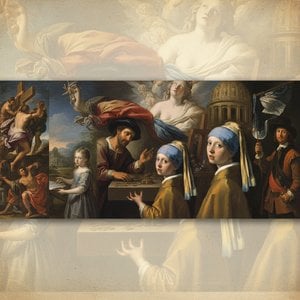
Andrea Belvedere: The Florentine Master of Still Life
Andrea Belvedere (1652 – Naples, 1732) stands as a singular figure in the Baroque landscape of Italy—a painter whose dedication to the genre of still life secured him an enduring legacy and cemented his place among the foremost artists of his era. Despite initial confusion regarding his birth year, scholarly research has solidified the belief that Belvedere emerged from Pavia around 1652, challenging earlier accounts attributed to Paolo Porpora’s influence. The discovery of his death certificate provided crucial evidence supporting this revised chronology.
Belvedere's artistic journey commenced in Pavia, where he honed his skills under the tutelage of Giuseppe Recco and absorbed stylistic nuances from Giovan Battista Ruoppolo—artists known for their dramatic lighting and vibrant vitality. However, Belvedere swiftly distanced himself from these overtly theatrical tendencies, prioritizing a more restrained aesthetic informed by Flemish masters like Abraham Brueghel and emphasizing meticulous observation rather than flamboyant ornamentation. This deliberate rejection of excessive Baroque exuberance distinguished him as an innovator within Naples’ artistic milieu. He sought inspiration in the works of Caravaggio, recognizing the power of chiaroscuro to convey emotion and drama—a technique he skillfully adapted to his own distinctive style.
His formative years in Naples witnessed a decline in the popularity of still life painting—a trend Belvedere successfully countered, becoming celebrated for his unparalleled ability to capture the subtle beauty of floral arrangements and animal specimens. He captivated younger artists with his originality, attracting pupils who would carry forward his distinctive approach. Notably, Belvedere’s collaboration with Luca Giordano at the Escorial Palace showcased his talent as a decorator and solidified his reputation as a master craftsman alongside fellow artist Giordano—a partnership that resulted in opulent interiors adorned with intricate frescoes and gilded embellishments.
Belvedere's artistic output spanned approximately twenty years, from around 1674 to 1694, during which he established himself in Spain—invited by King Charles II—where he continued his work at court until 1700. His return to Naples marked a pivotal moment, prompting him to abandon painting altogether and pursue a career in theater. Despite this shift away from visual art, Belvedere’s influence persisted through his pupils—gasparo lopez, baldassare de caro, tommaso realfonso, and nicola casissa—who embraced his stylistic principles and contributed to the flourishing artistic environment of Naples. His paintings, characterized by serene compositions and luminous colors, continue to inspire admiration for their understated elegance and profound sensitivity to natural beauty.
Among Belvedere’s celebrated works are “Flowers” (8Y3TA2) and “St James the Greater” (9XZ8ZM), demonstrating his mastery of tempera paint and meticulous attention to detail. These paintings exemplify his commitment to capturing natural beauty with remarkable precision—a hallmark of his artistic vision. His legacy extends beyond individual masterpieces; Belvedere’s contribution to the development of still life painting in Naples remains a testament to his enduring influence on subsequent generations of artists.