A Life Dedicated to Thought and the Subtle Art of Painting
Albert Rivaud, born in Nice, France, in 1876 and passing away in 1955, was a figure whose life embodied a fascinating intersection of philosophical inquiry and artistic expression. While primarily recognized as a distinguished French philosopher and classical scholar, Rivaud’s dedication to painting reveals a depth often hidden beneath the surface of academic pursuits. His journey began with a rigorous intellectual foundation; he ascended through the ranks of academia, appointed professor of philosophy at the University of Poitiers in 1908 before ultimately succeeding Léon Brunschvicg as professor at the prestigious Sorbonne in 1927. This commitment to higher learning wasn’t isolated from his artistic endeavors but rather informed them, shaping a unique perspective that permeated his work. Rivaud was also an active member of the influential Cercle Fustel de Coulanges, a testament to his engagement with intellectual currents of the time. However, his life took an unexpected turn during a tumultuous period in French history when he served as Minister of National Education under Philippe Pétain’s government from June 17th to July 12th, 1940—a role that undoubtedly cast a complex shadow over his later years.
The Philosophical Brush: Exploring Themes and Influences
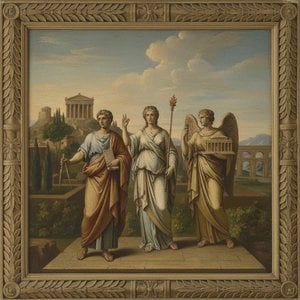
Rivaud's artistic output, though perhaps less widely celebrated than his philosophical contributions, is characterized by a distinctive blend of surrealist undertones and classical influences. He wasn’t merely applying paint to canvas; he was translating complex ideas into visual form. His paintings often explore symbolic themes—the human condition, the passage of time, the interplay between reality and perception—rendered with a delicate touch that belies their profound subject matter. While not strictly adhering to any single artistic movement, Rivaud’s work resonates with the spirit of Surrealism, particularly in its exploration of the subconscious and dreamlike imagery. However, his grounding in classical scholarship is equally apparent, manifesting in carefully composed scenes and a reverence for traditional techniques. It's as if he sought to reconcile the rational world of philosophy with the intuitive realm of artistic creation. The impact of artists like Gustave Moreau and Pierre Puvis de Chavannes can be subtly detected in his compositions, particularly in their use of symbolism and muted color palettes.
A Legacy Beyond Academia
Rivaud’s career as a painter unfolded alongside his academic responsibilities, making it difficult to categorize him neatly within the traditional art historical canon. He wasn't driven by commercial ambition or a desire for widespread recognition; instead, he pursued painting as a deeply personal form of expression—a means of grappling with existential questions and translating abstract concepts into tangible forms. His works are not characterized by dramatic flourishes or overt displays of technical virtuosity but rather by a quiet intensity and subtle symbolism. This introspective quality may explain why his paintings have remained relatively unknown outside of specialized circles, yet it also contributes to their enduring appeal for those who seek art that rewards careful contemplation.
Impactful Modern Works
The impact of Rivaud’s work lies not in its adherence to a specific style but in its unique synthesis of intellectual rigor and artistic sensitivity. He demonstrated how philosophical thought could be seamlessly integrated into the creative process, resulting in paintings that are both visually arresting and intellectually stimulating. His exploration of surrealist themes within a classical framework foreshadowed later developments in modern art, particularly the emergence of Symbolism and Abstract Expressionism. While his time as Minister of National Education undoubtedly complicates his legacy, it also underscores the broader context of his life—a period marked by political upheaval and profound societal change. Ultimately, Albert Rivaud stands as a testament to the power of interdisciplinary thinking and the enduring relevance of art that challenges conventional boundaries.