Albert Jurardus van Prooijen: A Master of Dutch Landscape Painting
Albert Jurardus van Prooijen (1834-1898) stands as a pivotal figure in the history of Dutch landscape painting, particularly during the formative years of Impressionism. Born in Groningen, Netherlands, he inherited artistic talent from his father, Johannes van Prooijen, a renowned decorative painter who instilled in Albert a deep appreciation for meticulous craftsmanship and visual storytelling.Early Training & Influences: At the tender age of thirteen, Albert enrolled at the Academie Minerva in Groningen, where he honed his skills under the tutelage of Jacob Bruggink and Jan Ensing. These formative influences exposed him to the burgeoning artistic currents of the time, notably Romanticism’s emphasis on sublime landscapes and emotional expression—a contrast to the prevailing academic style. The grandeur and drama of Romantic canvases served as a powerful catalyst for Albert's own artistic explorations.
Father's Legacy & Artistic Practice: Following in his father’s footsteps, Albert joined Johannes van Prooijen’s business, gaining invaluable experience in artistic production and commercial considerations. However, he swiftly transitioned towards independent artistic pursuits, actively participating in local exhibitions and securing the prestigious “Grote Koninklijke Medaille” for painting in 1853—a testament to his burgeoning reputation. This recognition underscored the importance of both artistic vision and entrepreneurial acumen within the artistic milieu of Groningen.
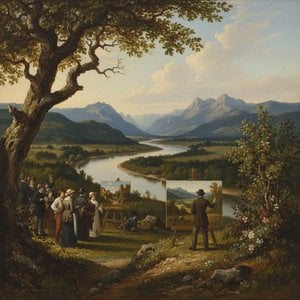
The Flowering of Impressionism: Van Prooijen’s work exemplifies the stylistic innovations of Impressionism. His celebrated canvas, “Rural Simplicity,” awarded by Pictura (the Groningen Art Society) in 1858, captures a serene Dutch countryside bathed in dappled sunlight—a hallmark of Impressionist technique characterized by loose brushstrokes and an emphasis on capturing fleeting moments of light and atmosphere. The painting’s luminous quality reflects the profound impact of Impressionism's revolutionary approach to depicting natural beauty.
Commissioned Artwork & Public Recognition: Notably, he undertook the ambitious project of documenting the imminent demolition of the Groene Weeshuis (Green Orphanage), Groningen’s historic orphanage. His watercolor series meticulously rendered both interior and exterior views, preserving a tangible piece of Groningen's heritage for posterity. Furthermore, his collaboration with lithographer Carel Christiaan Antony Last resulted in “Album der stad Groningen,” showcasing captivating cityscape drawings that cemented his position as a chronicler of urban life.
Later Years & Legacy: From 1864 to 1865, Albert served briefly as Headmaster of the Academie Minerva, following Egenberger’s resignation. Despite facing challenges related to personal conduct—according to Francesco Hermanus Bach, a friend of Egenberger's—Van Prooijen persevered in his artistic career, relocating to Amsterdam and dedicating himself primarily to landscape painting and river views. He died peacefully at the age of sixty-four, leaving behind a substantial body of work that continues to inspire admiration for its beauty and sensitivity. His landscapes—particularly those depicting tranquil waterways and pastoral scenes—remain treasured examples of Impressionist aesthetics and offer a poignant glimpse into the spirit of nineteenth-century Groningen.
A major retrospective was held at Fraeylemaborg in Slochteren in 1997, marking the centenary of his death and reaffirming Van Prooijen’s enduring significance within Dutch art history. His paintings are recognized for their masterful execution and evocative portrayal of the Dutch countryside.