Albert Henry Fullwood: Pioneer of Heidelberg Landscape and Witness to War
Albert Henry Fullwood (1863 – 1930) stands as a pivotal figure in Australian art history, inextricably linked to the Heidelberg School movement and profoundly impacted by his service as an official war artist during World War I. Born in Hockley, Birmingham, England, he emigrated to Sydney in 1883 seeking artistic opportunity and establishing himself as a lithographic draughtsman with John Sands Limited – a formative experience that instilled meticulous observation and technical skill. This early training would prove invaluable throughout his prolific career.
Early Life & Artistic Education: Fullwood’s formal artistic education began at evening classes at the Birmingham Institute of Art, followed by studies at the Birmingham School of Landscape Art at YMCA Needle Alley. These foundational experiences cultivated a deep appreciation for tonal painting and atmospheric perspective – techniques that would become hallmarks of his Heidelberg School style. He meticulously studied the interplay of light and shadow, mirroring the meticulous attention to detail evident in his later landscapes. This dedication to mastering fundamental artistic principles underpinned his entire oeuvre.
Arrival in Sydney & The Heidelberg School: Upon arriving in Sydney, Fullwood joined the Art Society of New South Wales and quickly gained employment with the picturesque atlas of Australia, undertaking extensive expeditions into Northern Territory. This journey fuelled his artistic vision and cemented his association with luminaries like Tom Roberts and Arthur Streeton – artists who established Sirius Cove as a collaborative studio space, fostering an environment of experimentation and stylistic innovation. The camaraderie amongst these painters was palpable, shaping not only their artistic output but also their personal lives. Sirius Cove became synonymous with the Heidelberg School’s distinctive approach to plein air painting—a deliberate rejection of academic conventions in favor of capturing the immediacy of nature.
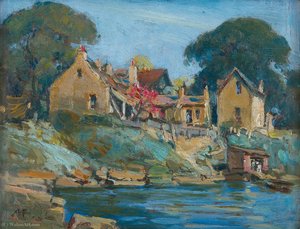
The Heidelberg Style: Paintings such as “Old Buildings, Kerosene Bay” and “McMahon’s Point, Sydney” exemplify this style's masterful use of light and color to convey mood and atmosphere—a deliberate departure from academic conventions. These canvases are more than just representations; they are imbued with a feeling for the landscape—a palpable sense of place and emotion. Fullwood skillfully employed atmospheric perspective, blurring distant objects into hazy hues to create an illusion of depth and distance – mirroring the techniques championed by Impressionists across Europe. His brushstrokes were loose yet purposeful, conveying texture and movement while simultaneously capturing the ethereal beauty of the Australian bush.
World War I Service & Artistic Legacy: Fullwood’s dedication to his craft extended beyond the studio walls when he enlisted in the Allied Art Corps during World War I. Serving as Sergeant in the Royal Army Medical Corps at Wandsworth Hospital and later as an Australian Official War Artist, he documented the realities of trench warfare with unflinching honesty and sensitivity. His paintings from the Valley of the Somme powerfully convey the psychological impact of combat on soldiers—a testament to his artistic empathy and commitment to portraying human experience. He captured the bleakness of the battlefield alongside moments of camaraderie and resilience – demonstrating that art could bear witness to both suffering and courage.
Later Career & Artistic Recognition: Returning to Sydney in 1920, Fullwood continued to produce stunning watercolor landscapes and etchings. He was a co-founder of the Australian Painter-Etchers’ Society, furthering the exploration of printmaking as an artistic medium. Throughout his life, Fullwood garnered considerable acclaim for his work, securing commissions from prominent patrons and exhibiting extensively in Europe—solidifying his position as one of Australia's foremost landscape artists and a courageous chronicler of wartime trauma. His legacy endures today, inspiring admiration for his artistic skill and unwavering commitment to capturing the essence of Australian identity through the lens of Impressionistic landscape painting.