Explore Paul Cézanne’s ‘Still Life with Water Jug’! A quintessential Post-Impressionist masterpiece showcasing innovative form & light. Discover its beauty & significance at the Tate.
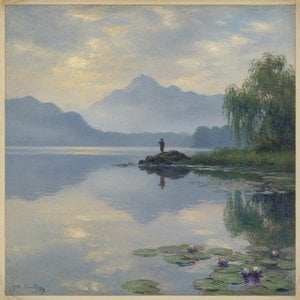
There is a profound, almost magnetic pull toward the water’s edge that transcends both culture and era. To gaze upon a still lake is to encounter a mirror for the soul, a place where the frantic rhythms of modern life dissolve into the gentle lap of ripples against the shore. In the realm of fine art, landscape painting has long functioned as more than mere documentation; it is an invitation to stillness. A lake, unlike the tempestuous ocean, offers a sense of contained beauty—a controlled landscape where the sky meets the earth in a soft, liquid embrace. This stability allows the viewer to linger, to explore the subtle details of a floating lily or the distant silhouette of a mountain, fostering a psychological state of calm.
This emotional resonance is deeply rooted in how we perceive nature’s quietest moments. When we bring scenes of lakes and ponds into our living spaces, we are not simply hanging a decoration; we are inviting a meditative presence into our homes. The water acts as a natural stabilizer for the eye, its horizontal planes providing a sense of groundedness that can transform even a high-energy room into a sanctuary of reflection.
Romantic Foundations: The Structured Grandeur of George Barret
Discover "Landscape With A Lake" by George Barret Sr., a serene Romantic landscape painting of rolling hills & tranquil waters. Explore its classical style & timeless beauty.
Before the Impressionists sought to dissolve the horizon, the Romantic painters established a language of landscape that emphasized the weight and dignity of the natural world. This era was defined by a reverence for the sublime, where the earth was depicted with a sense of permanence and monumental scale. George Barret the Elder, a significant figure in this tradition, utilized the medium of oil to create works that possessed a certain structural gravity. His landscapes often featured rolling hills and tranquil waters that felt anchored to the very bedrock of the earth.
The Romantic approach relied on a clear sense of composition, where every element—from the heavy clouds to the shadowed valleys—contributed to a larger narrative of nature's power. In works such as Landscape With A Lake, one finds a meticulous attention to the physical reality of the terrain. This era provided the essential groundwork for all that followed; it taught us how to look at the landscape not just as scenery, but as a vessel for profound emotion and historical weight.
Atmospheric Precision: The English Tradition and the Pursuit of Light
Thomas Waters: A Welsh Vision of the Landscape The world of 19th-century British art often focused on grand narratives – military campaigns, industrial progress, and aristocratic leisure. Yet, nestled within this landscape of ambition and power lay a...
As the nineteenth century progressed, the focus shifted from the monumental toward the atmospheric. A group of artists, particularly within the British tradition, began to obsess over the subtle variations in light and weather that could transform a familiar vista in an instant. Thomas Waters, born in Wales in 1814, embodied this dedication. He was not driven by the pursuit of fame but by an almost obsessive need to capture the essence of his native land—its rugged mountains and the ever-changing light upon them.
Unlike the broader strokes of later movements, Waters utilized a delicate, layered approach. As a master of watercolor, he built up color gradually through thin washes and subtle gradations to create an astonishingly luminous effect. His technique allowed him to render the texture of bark and the shimmer of water with remarkable precision. This pursuit of light was shared by his contemporaries, such as Frederick Waters Watts, who sought to capture the very soul of the English countryside. Watts’s work bridged the gap between rugged naturalism and a refined aestheticism, using light to suggest the infinite reaches of the horizon. These artists proved that the true subject of a landscape is often not the land itself, but the air that moves across it.
Giverny’s Legacy: Monet and the Dissolution of Form
Captivating Subject and Enchanting Atmosphere This exquisite impressionist masterpiece transports viewers to a tranquil water lily pond, where nature’s delicate beauty is captured in a harmonious balance of light and color. The scene centers around a...
The revolution arrived when Claude Monet and his contemporaries stepped out of the controlled confines of the studio and into the open air. They abandoned the somber, academic shadows of the past to embrace en plein air painting, seeking to record the precise sensation of a single moment before the light shifted forever. At Giverny, Monet’s fascination with his water lily pond became the focal point of his life's work. In his Water Lilies series, the boundary between sky and water begins to dissolve.
In works like The Water Lily Pond, Pink Harmony, we see the hallmark of Impressionism: loose, expressive brushstrokes that emphasize spontaneity and perception. The palette is no longer restricted to earth tones but explodes with lush greens, soft pinks, and purples. Monet’s late works, painted even as his vision challenged him, moved toward an almost abstract exploration of reflection and color. He did not merely paint flowers; he painted the way light breathes upon them. This movement transformed the canvas into a sensory experience, celebrating the transient beauty of the natural world and teaching us to find wonder in the ephemeral.
The Lens and the Brush: Capturing Atmosphere through Early Photography
Impressionist photography is a term occasionally used to describe certain pictorialist photographs from the late 19th and early 20th centuries that emphasize mood, atmosphere, and subjective vision over sharp detail and realism. While not directly al...
While the Impressionists were redefining the canvas, a parallel experimentation was occurring within the nascent medium of photography. This period saw the rise of "Impressionist photography," or Pictorialism, where photographers sought to move away from sharp, photographic realism toward a more subjective vision. They utilized soft focus, pinhole cameras, and darkroom manipulation to evoke mood and atmosphere rather than precise documentation.
George Davison’s 1889 photograph, The Onion Field, serves as a foundational example of this approach. By deliberately blurring detail, Davison created an effect reminiscent of tonal painting. This visual vocabulary—utilizing mist, glass, and layered surfaces to create ambiguity—echoed the concerns of painters like Edgar Degas, who used photography to research light play and oblique framing. This intersection of lens and brush demonstrates that the desire to capture the intangible is a universal impulse, shared across different mediums of art.
Curating Tranquility: Integrating Aquatic Landscapes into Modern Interiors
The Soul of the Water: Why Lake Landscapes Evoke Instant Serenity Landscape with a Lake and a Shepherd The Landscape with a Lake and a Shepherd is a stunning oil on canvas painting created by the renowned Scottish artist George Frederick Buchanan in ...
For the modern collector or interior designer, the inclusion of lake landscapes offers a unique opportunity to anchor a space with a sense of permanence and peace. Whether through a large-scale oil reproduction that mimics the impasto textures of Monet or a meticulously detailed watercolor in the tradition of the English masters, these works serve as windows into a more contemplative world.
Integrating such themes requires an understanding of how color and light interact with a room's architecture. A wide, multi-panel arrangement can transform a large wall into a continuous horizon, while a single, focused piece can act as a meditative centerpiece. Much like the historic halls of the Art Association of Richmond, which prioritize the influx of natural light to breathe life into its collections, a well-placed landscape allows the shifting daylight of a home to interact with the pigments on the canvas. In an age that often feels hurried and disconnected, returning to these scenes of water and light allows us to rediscover the poetry of the present moment.
At WahooArt.com, we specialize in bringing this history into the modern home through professional, hand-painted oil reproductions. Our artists, holding degrees from prestigious academies, employ the same layered techniques and respect for tradition found in the works of the masters. Whether you seek a custom "remix" of a classic or a bespoke commission from a personal photograph, our service ensures that every brushstroke contributes to a lasting legacy of beauty within your space.
Journey through art history's most serene lake landscapes. From Romantic vistas to light-drenched Impressionist waters, discover the stories behind these iconic masterpieces and find museum-quality, hand-painted oil reproductions for your private collection.
Esplora l'emozione del Realismo Romantico attraverso 10 capolavori senza tempo. Scopri la storia di maestri come Constable e Friedrich e lasciati ispirare da opere iconiche per il tuo arredamento. Trova riproduzioni d'arte di qualità museale su WahooArt.com.



 Still Life with Water Jug
 Landscape With A Lake
 Thomas Waters
 The Water Lily Pond, Pink Harmony
 Impressionist photography
 Serene Lake Scenes: Bringing the Tranquility of Water into Your Home through Impressionist Masterpieces