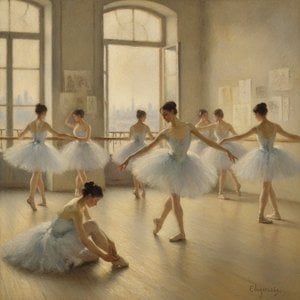
Introduction
To step into the world of Edgar Degas is to enter a realm where time seems to pause, yet movement never ceases. There is a profound, rhythmic pulse found within his canvases—a quiet tension between the grace of a fleeting gesture and the heavy reality of human effort. As we prepare to journey through his most significant works, we do not merely look at paintings; we witness the very heartbeat of late 19th-century Paris, captured by an artist who saw beauty not in the idealized, but in the authentic.
While history often nests Degas within the luminous circle of the Impressionists, he was a man of singular, defiant identity. A master of the studio rather than the open field, he eschewed the hazy sunlight of Monet to focus on the structured elegance of modern life. His gaze was that of a meticulous observer, finding profound narratives in the most unexpected corners: the disciplined strain of a ballerina mid-rehearsal, the weary slump of a laundress, or the intimate, quiet solitude of a woman at her toilette. Through his eyes, the mundane was elevated to the monumental.
These twenty-five masterpieces remain deeply resonant today because they speak to the universal human experience. Degas possessed an uncanny ability to capture movement in repose —the way a muscle tenses, the way light catches a silk ribbon, or how a crowd can feel both bustling and lonely. His unconventional compositions, often cropped with the daring eye of a photographer, continue to influence how we perceive perspective and intimacy in our own visual age.
In the following curation, we invite you to wander through this storied collection. From his iconic ballet scenes to his evocative studies of female form, each work serves as a window into a vanished era of Parisian splendor and grit. Prepare to encounter the precision, the passion, and the enduring legacy of an artist who taught us that true beauty lies in the honest portrayal of life in motion.
Dancers in Pink - Edgar Degas
 Dancers in Pink - Edgar Degas
While many perceive the ballet as a realm of pure ethereal grace, Edgar Degas often sought the grit behind the glamour, observing the dancers not as icons, but as working professionals. In Dancers in Pink , painted in 1885, he captures this duality with unparalleled mastery. The canvas is a whirlwind of movement, where the soft, swirling textures of pink tutus collide with the heavy, expressive impasto that defines his late period. Degas utilizes a sophisticated palette of warm reds and yellows, contrasted against shadowy, indistinct backgrounds to pull the viewer into the backstage atmosphere of the Paris Opera.
The technical brilliance lies in his ability to use broken brushstrokes to simulate the flickering light of the theater, creating a sense of fleeting, ephemeral beauty. This piece is far more than a mere depiction; it is an exploration of rhythm and stamina. For the discerning collector or interior designer, integrating such a dynamic work into a modern study or home office provides a profound sense of energy and disciplined creativity, fostering an environment of focused, sophisticated productivity.
Dancer with a bouquet of flowers (The Star of the ballet) - Edgar Degas
 Dancer with a bouquet of flowers (The Star of the ballet) - Edgar Degas
In Dancer with a bouquet of flowers (The Star of the ballet) by Edgar Degas, the soft, ethereal palette of pale pinks and creamy whites establishes a mood of delicate grace intertwined with a quiet, breathless tension. This mastery of light and color is precisely why this work stands as one of the top 25 artworks of Edgar Degas ; he does not merely paint a figure, but captures the very atmosphere of the Parisian stage. The subtle interplay between the dancer's luminous tutu and the muted, earthy greens of the background creates a sophisticated depth that feels both intimate and monumental.
For the discerning interior designer or collector, integrating this piece into a modern living space offers an unparalleled opportunity to curate emotional lighting. The painting’s warmth can anchor a room with soft, diffused light, while its palette of creams, pinks, and sage provides a serene yet dynamic focal point. Whether placed in a sun-drenched salon or a refined dining room, this masterpiece brings the timeless elegance of French Impressionism into a contemporary architectural context, evoking a sense of movement and prestige.
Miss Lola, au Cirque Fernando, NG L - Edgar Degas
 Miss Lola, au Cirque Fernando, NG L - Edgar Degas
In Miss Lola, au Cirque Fernando , Edgar Degas captures that breathtaking, heart-stopping moment where grace meets peril. There is a profound, universal tension in watching the acrobat suspended mid-air; she exists in a delicate equilibrium between soaring freedom and the terrifying pull of gravity. This masterpiece earns its place among the top 25 artworks of Edgar Degas through its masterful use of light and shadow, where warm golds and saturated oranges illuminate her shimmering costume against a backdrop of decaying, classical grandeur.
Degas does not merely paint a circus performer; he invites us into the visceral atmosphere of 19th-century Parisian nightlife, utilizing thick, expressive brushstrokes that lend a tactile, almost surreal energy to the scene. The composition, with its slightly distorted perspective and dramatic chiaroscuro, evokes a sense of wonder tinged with melancholy. At WahooArt, we honor this profound emotional depth through our hand-painted oil reproductions . Our artists meticulously recreate every impasto stroke and tonal nuance, allowing you to bring the theatrical brilliance and timeless movement of Degas into your own private collection with absolute authenticity.
Dancers at the Barre 1 - Edgar Degas
 Dancers at the Barre 1 - Edgar Degas
In Dancers at the Barre 1 , Edgar Degas invites us into a private, breathless moment of discipline and grace. There is a profound, quiet intimacy in watching these two ballerinas; they are not performing for an audience, but rather caught in the raw, repetitive beauty of practice. This piece earns its place among the top 25 artworks of Edgar Degas through its masterful use of pastel and charcoal, where soft, blurred outlines meet a vibrant, hazy wash of warm oranges and yellows. The composition captures that ephemeral tension between the physical strain of the dancer and the ethereal lightness of the art itself.
Degas’ ability to render movement through textured, almost impasto-like strokes creates a tactile experience that transcends time. At WahooArt.com, we honor this legacy through our hand-painted oil reproductions . Our master artists meticulously recreate every visible brushstroke and tonal depth found in Degas' original works, ensuring that the soul of this Impressionist masterpiece—its warmth, its light, and its movement—is preserved for your own collection. Whether as a focal point in a grand salon or a sophisticated accent in a modern study, this work brings the timeless elegance of the Paris ballet directly into your home.
Woman washing in the bath - Edgar Degas
 Woman washing in the bath - Edgar Degas
In Woman washing in the bath by Edgar Degas, a palette of muted blacks, earthy browns, and soft grays dominates the composition, establishing a mood of profound stillness and quiet prestige. This restrained color scheme is masterfully punctuated by subtle accents of orange and blue, a technique that earned this piece its rightful place among the top 25 artworks of Edgar Degas . The way these tones interact creates a sense of soft, diffused light, as if catching a fleeting moment of dawn within a private sanctuary.
For the discerning collector or interior designer, integrating this work into a modern living space offers an unparalleled opportunity to curate emotional depth. The artwork’s atmospheric neutrality and organic textures can anchor a room, providing a sophisticated focal point that complements contemporary minimalist or classical decor. By introducing these gentle, tonal variations, one can evoke a sense of serenity and introspection, transforming a dining room or lounge into a gallery-like retreat defined by grace and timelessness.
Nurse - Edgar Degas
 Nurse - Edgar Degas
In the quietude of Nurse by Edgar Degas, time seems to suspend itself, capturing a profound moment of solitary reflection that resonates with an eternal, soulful grace. This masterpiece earns its place among the top 25 artworks of Edgar Degas through its masterful ability to elevate a humble, private moment into a universal study of compassion and resilience. The composition draws the eye toward the nurse’s pensive face, illuminated by a soft, diffused light that emerges from a palette of warm ochres, deep browns, and muted golds.
Degas employs a rich, tactile technique, where visible, layered brushstrokes create an atmospheric depth that breathes life into the domestic setting. The interplay of shadow and warmth evokes a sense of intimacy and quiet strength, making the piece feel deeply human. For the discerning collector or interior designer, such a work brings a sophisticated layer of emotional intelligence to a modern space, offering a serene focal point that inspires contemplation and adds a timeless, dignified elegance to any curated collection.
The Collector of Prints - Edgar Degas
 The Collector of Prints - Edgar Degas
In The Collector of Prints by Edgar Degas, the mastery of light serves as the silent protagonist, orchestrating a profound sense of intimacy and quiet prestige. The scene is bathed in a soft, diffused illumination that appears to emanate from an unseen window, casting gentle shadows that dance across the scattered lithographs and the collector's contemplative face. This delicate play of chiaroscuro does more than merely reveal the textures of heavy dark fabrics and crisp paper; it creates a sanctuary of stillness, capturing the very soul of aesthetic obsession. It is this sophisticated command of light—the way it catches the edge of a porcelain vase or highlights the grain of a wooden bench—that secures this work's rightful place among the top 25 artworks of Edgar Degas .
For the discerning collector, a high-quality oil reproduction of this masterpiece brings an unparalleled layer of depth and luxury to a contemporary interior. The way the light seems to glow from within the canvas invites a sense of historical weight and intellectual calm, transforming a modern wall into a window onto 19th-century Parisian refinement.
Madame Théodore Gobillard (Yves Morisot, 1838–1893) - Edgar Degas
 Madame Théodore Gobillard (Yves Morisot, 1838–1893) - Edgar Degas
In Madame Théodore Gobillard , Edgar Degas achieves a rare, breathtaking stillness that stands in exquisite contrast to his more kinetic depictions of ballet dancers. There is a gaze in this 1869 masterpiece that follows you—not with judgment, but with understanding . As you stand before the canvas, you realize this isn’t merely a portrait; it is a mirror reflecting the quietude of the human soul.
The subject, Yves Morisot, is enveloped in a soft, luminous atmosphere where light filters through a window to dance upon her dark attire. Degas utilizes loose, expressive brushstrokes to capture the subtle interplay of shadow and radiance, creating a sense of palpable air within the room. For the discerning collector or interior designer, this work offers more than aesthetic beauty; it provides an emotional anchor. Its inclusion in our curated list of the top 25 artworks of Edgar Degas is a testament to its power to make the invisible visible. Imagine that serene, magnetic presence in your own space—not watching you, but reminding you : you are seen. You are part of the story.
The Dancing Class - Edgar Degas
 The Dancing Class - Edgar Degas
To step into Edgar Degas's The Dancing Class is to overhear the quiet, rhythmic breathing of a rehearsal in progress. There is a profound, human intimacy in this 1870 masterpiece; it captures not the glittering spectacle of the stage, but the raw, unvarnished dedication found in the shadows of a Parisian studio. Degas invites us into a world of warm ochres and muted browns, where the soft light catches the movement of dancers adjusting their slippers or stretching in moments of weary grace.
This work holds a prestigious place among the top 25 artworks of Edgar Degas because it transcends mere portraiture, offering a candid snapshot of discipline and fleeting beauty. It is a foundational pillar of his oeuvre, showcasing his revolutionary ability to find art in the everyday. At WahooArt, we honor this legacy through our hand-painted oil reproductions . Our master artists meticulously recreate every visible brushstroke and tonal depth, ensuring that the nostalgic atmosphere and soulful texture of Degas’s vision are preserved, allowing you to invite this timeless piece of Parisian history into your own private collection.
The Absinthe Drinker - Edgar Degas
 The Absinthe Drinker - Edgar Degas
In The Absinthe Drinker (1876), Edgar Degas transcends mere reportage to capture the profound psychological weight of the modern urban experience. This masterpiece stands as a cornerstone among the top 25 artworks of Edgar Degas , not merely for its depiction of Parisian café culture, but for its haunting exploration of human disconnection. Through a muted palette of ochres, creams, and somber earth tones, Degas renders two figures seated side by side, yet emotionally adrift in their own private worlds of introspection.
The visual language here is masterfully understated; the soft, diffused light and loose, expressive brushstrokes create a snapshot-like quality that feels startlingly contemporary. In an era increasingly defined by digital isolation, the themes of alienation and quiet melancholy found in this work resonate deeply within modern curated spaces. For the discerning collector or interior designer, possessing a hand-painted reproduction of this piece offers more than decor; it introduces a soulful, contemplative centerpiece that invites viewers to linger on the beautiful, tragic complexity of the human condition.
Ballet Rehearsal on Stage - Edgar Degas
 Ballet Rehearsal on Stage - Edgar Degas
In Ballet Rehearsal on Stage , Edgar Degas does not merely depict a scene; he composes a visual sonata of light and motion. To gaze upon this 1874 masterpiece is to feel the soft, atmospheric glow of the stage lights as they dance across the delicate white tutus of the performers. Degas uses light as a language, capturing the fleeting, ephemeral energy of a rehearsal in progress at the Musée d’Orsay .
The brilliance of this work lies in its profound sense of movement. Through masterful, loose brushstrokes, Degas invites you into the wings, offering an elevated perspective that makes the dancers' graceful gestures feel immediate and alive. The subtle interplay of shadows and the muted, sophisticated tones create a depth that transcends simple representation. It is a moment of quiet prestige captured in oil—a rhythmic arrangement of form and grace. This painting remains a cornerstone of the top 25 artworks of Edgar Degas because it does not just reflect the light of the Paris opera; it invents a luminous world that continues to breathe life into any collection.
Portrait of Rene-Hillaire De Gas - Edgar Degas
 Portrait of Rene-Hillaire De Gas - Edgar Degas
What story does the quiet, dignified atmosphere within Portrait of René-Hilaire De Gas by Edgar Degas tell us about the roots of his Realist vision? Painted in 1857, this profound work serves as a cornerstone among the top 25 artworks of Edgar Degas, capturing his grandfather not merely as a figure, but as an embodiment of contemplative strength. The scene is anchored by a sense of intellectual repose; the sitter rests in an upholstered armchair, his stern yet thoughtful gaze inviting us into a private moment of introspection. Degas’s meticulous rendering of textures—from the plush fabric to the subtle weight of the clothing—demonstrates a mastery of light and shadow that predates his later Impressionist fame.
In the realm of sophisticated interior design, such a piece offers more than mere decoration; it provides a curated escape into a bygone era of Parisian elegance. Integrating this portrait into a modern collection evokes a sense of historical depth and permanence. Whether you are drawn to the subtle symbolism of the violin resting at his feet or the masterful use of tonal range, this painting brings an air of academic excellence and soulful history to any prestigious home gallery.
Seated Woman Combing Her Hair - Edgar Degas
 Seated Woman Combing Her Hair - Edgar Degas
In Seated Woman Combing Her Hair , Edgar Degas does not merely depict a moment of grooming; he composes a silent sonata of light and intimacy. Completed around 1890, this pastel masterpiece transcends the mundane, inviting us into a private sanctuary where time seems to suspend itself. The artist does not simply paint light—he invents it, layering pigment with such meticulous precision that the soft, stray strands of hair appear to breathe upon the paper.
As you stand before this work, you feel the profound weight of the Belle Époque 's quietest moments. Degas utilizes the influence of Japonism to frame his subject through unconventional angles, creating a sense of modern spontaneity that remains strikingly contemporary. The woman, lost in her rhythmic ritual, embodies a delicate balance of strength and vulnerability. For the discerning collector, this piece is more than an artwork; it is a portal of inspiration, bringing the luminous, tactile soul of Parisian realism into the modern home.
Elena Carafa - Edgar Degas
 Elena Carafa - Edgar Degas
In the quietude of 1874, Edgar Degas captured a moment of profound stillness with Elena Carafa , a portrait where time seems to hold its breath. This masterpiece earns its place among the top 25 artworks of Edgar Degas through its masterful ability to transform a private moment of introspection into an eternal dialogue between the subject and the viewer. The painting breathes with a subtle, luminous energy; the deep, velvety textures of her black shawl contrast exquisitely with the soft, shimmering greens of her gown, suggesting a light that filters gently through a Parisian window.
Degas utilizes a sophisticated palette to evoke a sense of serene melancholy, where every brushstroke contributes to the weight of her thoughtful gaze. For the discerning collector or interior designer, Elena Carafa offers more than mere decoration; it brings an atmosphere of intellectual depth and quiet prestige to a modern space. Its harmonious composition and emotive power serve as a sophisticated anchor for any curated collection, embodying the very essence of refined, classical beauty reimagined for contemporary living.
Two Men - Edgar Degas
 Two Men - Edgar Degas
Step into the quiet, shadowed intimacy of 1865 with Edgar Degas’s Two Men , a work that feels less like a static painting and more like a captured breath within a private studio. In this evocative piece, Degas moves away from his famous ballet dancers to explore a profound, somber realism. The composition is masterfully asymmetrical; one figure sits in contemplative reserve, while the other engages the viewer with a startling, candid directness. The palette is a sophisticated arrangement of earthy ochres, deep browns, and muted grays, creating an atmosphere of heavy, thoughtful stillness.
Degas’s technique here is nothing short of visceral. His loose, expressive brushstrokes avoid the polished finish of academic tradition, instead offering a tactile richness that suggests the very movement of light across fabric and skin. For the discerning collector or interior designer, bringing a reproduction of this masterpiece into a contemporary space offers more than mere decoration; it introduces a sense of historical depth and intellectual gravity. The painting’s muted tones and quiet prestige serve as an anchor for a room, inspiring moments of deep reflection and timeless elegance.
Orchestra Musicians - Edgar Degas
 Orchestra Musicians - Edgar Degas
Step into the hushed, expectant atmosphere of a Parisian evening with Edgar Degas’s Orchestra Musicians . In this evocative 1874 masterpiece, the air seems to vibrate with the silent resonance of strings and the focused energy of performers. Degas, the master of capturing modern life, moves beyond the typical ballet stage to present a profound study of rhythm and concentration. The composition draws the eye through a sea of musicians—violins and cellos poised in mid-melody—creating a sense of depth that pulls the viewer directly into the orchestra pit.
The work is a triumph of texture and light; even in its monochromatic essence, one can almost feel the polished wood of the instruments and the concentrated stillness of the players. This piece stands as a cornerstone among the top 25 artworks of Edgar Degas because it captures the unseen labor behind the spectacle. For the discerning collector, integrating such a work into a contemporary interior offers more than mere decoration; it introduces a sophisticated layer of historical gravity and a meditative, rhythmic elegance that inspires quiet reflection and intellectual depth in any curated space.
In a Cafe, also called - Edgar Degas
 In a Cafe, also called - Edgar Degas
There is a profound, quiet intimacy in In a Café by Edgar Degas that transcends the centuries; it captures that universal, fleeting moment of connection found in the corner of a bustling city. As we explore the top 25 artworks of Edgar Degas , this piece stands out for its masterful use of a monochrome palette to heighten the drama of human interaction. Degas does not rely on vibrant Impressionist hues but instead uses light and shadow to dissect the subtle language of gesture—the way a hand rests near a wine glass or the tension in a seated posture.
This work earns its place among the master's greatest achievements through its unflinching realism and its ability to turn a simple Parisian evening into a timeless study of modern life. At WahooArt.com , we honor this legacy of precision through our hand-painted oil reproductions . Our artists meticulously recreate every controlled brushstroke and tonal depth, ensuring that the soulful, atmospheric essence of Degas’s vision is preserved in a museum-quality masterpiece designed to bring historical elegance into your private collection.
Race Horses at Longchamp - Edgar Degas
 Race Horses at Longchamp - Edgar Degas
In Race Horses at Longchamp , Edgar Degas does not merely depict a sporting event; he composes the very essence of motion. To gaze upon this 1874 masterpiece is to feel the rhythmic thrum of hooves against the turf and the electric pulse of Parisian high society. Degas treats light not as a static element, but as a living language, weaving it through the muted greens and earthy browns of the racecourse to create a shimmering, atmospheric haze.
The brilliance of this work lies in its refusal to settle on a single focal point. Instead, Degas utilizes dynamic diagonal lines and fragmented perspectives—hallmarks of his revolutionary approach—to guide your eye across the charging jockeys and the powerful, muscular forms of the horses. There is a profound tension between the Realist precision of the equine anatomy and the Impressionistic fluidity of the background. It is a captivating study of speed and fleeting moments, an invitation to bring the vibrant energy of the Belle Époque into your own curated space.
The Old Italian Woman - Edgar Degas
 The Old Italian Woman - Edgar Degas
In the quietude of The Old Italian Woman , Edgar Degas captures a profound moment of stillness, where time itself seems to pause amidst the whispers of history. This 1857 masterpiece stands as a cornerstone among the top 25 artworks of Edgar Degas because it reveals the artist’s foundational mastery of realism long before his celebrated explorations of movement and ballet. The painting is a symphony of muted ochres, creams, and deep browns, creating a palette that evokes the weathered texture of a life lived with resilience.
Degas employs a meticulous technique, using light to sculpt the elderly subject’s features, turning every wrinkle into a map of experience. The vibrant yellow shawl provides a striking contrast against her white attire, drawing the eye toward her gnarled hands and the contemplative weight of her presence. For the discerning collector or interior designer, this work offers more than mere decoration; it brings an aura of dignified sophistication and soulful calm to a modern space, serving as a timeless window into the beauty of human endurance.
The Ballet from "Robert le Diable" - Edgar Degas
 The Ballet from "Robert le Diable" - Edgar Degas
What story does the shadowy backstage environment in The Ballet from "Robert le Diable" by Edgar Degas tell? Rather than focusing on the grand spectacle of Meyerbeer’s famous opera, Degas invites us into the hushed, liminal space behind the curtain. Painted in 1871, this work stands as a cornerstone among the top 25 artworks of Edgar Degas because it eschews theatrical glamour for a profound, realist intimacy. Through a somber palette of deep browns, charcoal grays, and muted blacks, he captures the weary anticipation of dancers caught in moments of repose.
The atmosphere is thick with the scent of stage dust and the quiet tension of preparation. For the modern collector, this piece offers more than mere decoration; it provides a sophisticated escape into the historical soul of Paris. Integrating such a masterwork into a curated interior evokes a sense of timeless mystery and intellectual depth, allowing the subtle interplay of light and shadow to transform a contemporary space into a gallery of quiet, dramatic reflection.
Procession on a road near Florence (Cortège sur une route aux environs de Florence) - Edgar Degas
 Procession on a road near Florence (Cortège sur une route aux environs de Florence) - Edgar Degas
In Procession on a road near Florence (Cortège sur une route aux environs de Florence) , the light does not merely illuminate the landscape; it breathes life into the very lines of the pencil. Created in 1860, this delicate work serves as a profound window into Degas’s early mastery of draughtsmanship. As you gaze upon the hillside and the shimmering water in the distance, you feel the quiet prestige of a moment frozen in time. The artist composed the light to guide your eye through the rhythmic movement of thirteen figures, each captured with an intimate, observational grace.
There is a poetic soul in the way Degas renders the subtle textures of fabric and the delicate shading of faces amidst the procession. It is this ability to invent atmosphere through simple, precise strokes that secures its place among the top 25 artworks of Edgar Degas . This piece is more than a sketch; it is an invitation to experience the serenity of the Italian countryside, a portal of inspiration ready to bring a sense of historical depth and quiet movement into your personal collection.
Male Nude - Edgar Degas
 Male Nude - Edgar Degas
Acquiring a piece as profound as Male Nude by Edgar Degas represents more than an aesthetic choice; it is a deliberate investment in a legacy of unparalleled artistic mastery and refined taste. As one of the most enigmatic entries in our collection of the top 25 artworks of Edgar Degas, this 1856 study serves as a window into the artist's private struggle with form and light. The work possesses an extraordinary market significance, prized by connoisseurs for its layered history—literally painted over earlier sketches—which offers a rare glimpse into the evolution of nineteenth-century realism.
The palette is a somber, sophisticated arrangement of ochres, deep browns, and muted greys, evoking the weight of classical marble emerging from shadow. Degas utilizes loose, impressionistic brushstrokes to trace the musculature of the reclining figure, creating a tension between anatomical precision and atmospheric fluidity. For the discerning interior designer or collector, a high-quality oil reproduction of this masterpiece brings an undeniable sense of historical gravity and intellectual depth to modern luxury interiors, commanding the room with its quiet, sculptural authority.
Houses by the Seaside - Edgar Degas
 Houses by the Seaside - Edgar Degas
To encounter Houses by the Seaside is to step into a rare, sun-drenched moment of 19th-century tranquility, an exquisite jewel within the top 25 artworks of Edgar Degas . In this 1869 masterpiece, Degas transcends his reputation for capturing urban movement to offer us a profound study of coastal serenity. The work possesses a luminous, atmospheric quality, where soft blues and earthy browns coalesce to evoke the hazy, salt-kissed air of the French coastline.
What secures its place among the world's most significant compositions is Degas’s masterful use of texture; his loose, impressionistic strokes create a shimmering effect on the water that feels both spontaneous and deeply intentional. For the discerning collector or interior designer, this piece offers more than mere decoration; it provides a window into the bourgeois leisure of a bygone era. Its muted, sophisticated palette and sense of quiet contemplation make it an unparalleled choice for refined, modern luxury interiors, bringing a timeless, academic elegance and a sense of historical depth to any curated space.
Jockeys on Horseback before Distant Hills - Edgar Degas
 Jockeys on Horseback before Distant Hills - Edgar Degas
In Jockeys on Horseback before Distant Hills , Edgar Degas invites us into a breathless moment of suspended animation. The air feels thick with the quiet tension of the racecourse, where the rhythmic breathing of horses and the focused stillness of riders precede the thundering chaos of the gallop. Painted in 1884, this masterpiece captures the essence of French equestrian culture through a lens of profound realism. Degas utilizes a muted, earthy palette—rich ochres, deep greens, and soft blues—to render the rolling landscape and the textured details of worn leather saddles and kicked-up dust.
The composition is a masterclass in perspective, drawing the eye across the field toward the hazy, atmospheric hills. There is no grand heroism here, only the authentic, unvarnished beauty of movement and anticipation. For the discerning collector, bringing this work into a contemporary interior offers more than mere decoration; it introduces a sense of cinematic depth and historical prestige. Its understated elegance and rhythmic energy serve as a sophisticated focal point, inspiring a mood of quiet reflection and timeless vitality in any curated space.
Madame Deitz-Monin - Edgar Degas
 Madame Deitz-Monin - Edgar Degas
In the soft, luminous glow of 1879, Edgar Degas invites us into a quiet moment of Parisian elegance with Madame Deitz-Monin . This pastel masterpiece does more than capture a likeness; it freezes a breath of Victorian sophistication. As you gaze upon her, the artist’s masterful use of pastel creates a velvety texture that seems to radiate light from within, highlighting the delicate drape of her scarf and the exquisite detail of her feathered hat.
Degas employs an intimate, asymmetrical composition, placing Madame Deitz-Monin in a direct, soulful confrontation with the viewer. The subtle presence of figures in the background adds a layer of narrative depth, suggesting a world of movement just beyond the frame. For the discerning collector, this work offers more than mere decoration; its muted tones and psychological nuance bring a sense of quiet prestige and timeless reflection to any modern interior. It is a profound testament to Degas's ability to transform a fleeting glance into an enduring legacy of light and grace.
Conclusion
To wander through the world of Edgar Degas is to step into a private theater of human existence, where the curtain never truly falls. As we conclude this journey through his most profound works, we find that these masterpieces are far more than mere relics of 19th-century Paris; they are living presences that continue to breathe within our modern lives. Each composition—whether capturing the quiet exhaustion of a laundress or the fleeting, disciplined grace of a ballerina—serves as a bridge across centuries, connecting his meticulous observations with our own contemporary sensibilities.
There is a profound intimacy in Degas’s gaze, a way in which he invites us to witness the unvarnished truth of movement and emotion. When we bring these works into our homes, we are not simply decorating a wall; we are inviting a timeless conversation into our personal sanctuaries. His brushstrokes, preserved through our hand-painted oil reproductions , carry that same rhythmic energy, allowing the soul of the artist to resonate within the architecture of our daily lives. These paintings remind us that beauty is often found in the most transient moments—the tilt of a head, the adjustment of a tutu, or the stillness between breaths.
As the light fades on this retrospective, let us carry forward the wonder that Degas inspires. Whether you are drawn to the structural brilliance of his dancers or the soft, atmospheric depth of his portraits, we invite you to explore the full collection and find the piece that speaks to your own story. In every texture and every hue, may you find a fragment of that eternal human connection that art so beautifully sustains.