Two Young Women in a Landscape
Pierre-Auguste Renoir’s
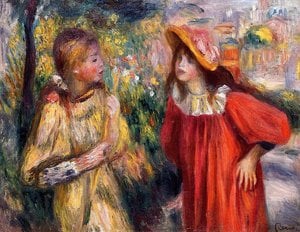
Two Young Women in a Landscape, created in 1916, is a quintessential example of Impressionist art. This beautiful oil on canvas painting measures 40 x 46 cm and is a testament to Renoir’s skill in capturing serene and peaceful scenes—a scene that embodies the very essence of summer's languid beauty. It transports us back to a time when artists sought to depict fleeting moments of experience rather than meticulously recreating reality.
The Painting's Composition
The painting depicts two young women enjoying each other’s company in a lush green field surrounded by trees. One woman sits on the grass while the other stands nearby, both holding umbrellas—a subtle detail that speaks volumes about the desire for protection and comfort amidst nature’s splendor. The atmosphere of the painting is tranquil, with the women seemingly lost in thought or simply appreciating each other's presence; Renoir expertly captures this contemplative mood through his masterful brushstrokes. Notice how the figures are positioned to create a harmonious balance within the composition—a deliberate choice reflecting Impressionist principles of visual equilibrium.
Impressionist Techniques
Renoir masterfully employs Impressionist techniques to create a sense of light and color. The brushstrokes are soft and delicate, capturing the fleeting effects of natural light—the dappled sunlight filtering through the foliage—with remarkable accuracy. These loose, visible strokes aren’t meant to obscure detail but rather to convey the vibrancy and dynamism of the moment itself. Renoir utilizes a palette dominated by muted greens and yellows, blended seamlessly together to evoke the warmth of the sun and the freshness of springtime air. This careful consideration of color contributes significantly to the painting's overall emotional impact—a feeling of serenity and optimism that lingers long after viewing it.
Artistic Influences
Renoir’s work was profoundly influenced by his contemporaries, including Claude Monet, who is famous for his
Weeping Willow and Water-Lily Pond. Both artists were key figures in the Impressionist movement, which sought to break away from traditional approaches to painting—rejecting academic conventions for a more subjective interpretation of visual experience. Monet’s exploration of light and color served as an inspiration for Renoir, encouraging him to prioritize capturing the sensory impressions of nature above all else.
Historical Context
The history of painting, as detailed on Wikipedia (
https://en.wikipedia.org/wiki/History_of_painting), shows that Impressionism was a significant departure from the representational and classical motifs that dominated earlier periods—a reaction against the rigid formalism of Neoclassicism and Romanticism. Renoir’s work, alongside that of other Impressionists, contributed to this shift towards more modern and abstract approaches—a movement driven by scientific discoveries about optics and color perception. It represented a bold assertion of artistic freedom and innovation, marking a pivotal moment in the evolution of Western art.
Portrait Painting Tradition
While
Two Young Women in a Landscape is not strictly a portrait painting, it does capture the essence of its subjects—suggesting Renoir’s desire to portray human emotion and experience with sensitivity and nuance. Portrait painting, as discussed on Wikipedia (
https://en.wikipedia.org/wiki/Portrait_painting), has a long history and has evolved over time to include various styles and mediums—from meticulous realism to expressive abstraction. Renoir’s approach aligns with the broader Impressionist preoccupation with capturing psychological states rather than merely reproducing physical likenesses.
Relevance in Modern Art
The influence of Renoir's work can be seen in later artists, such as Amedeo Modigliani, who was known for his elongated portraits—a stylistic departure from Renoir’s naturalistic style but nonetheless rooted in a shared commitment to conveying emotion and beauty. Modigliani’s elongated figures embody the modernist impulse toward simplification and abstraction—yet they retain a palpable sense of human presence. This demonstrates how Impressionist principles continue to resonate within contemporary artistic practice.
Conclusion
/art/list/?Filter=8EWQGL-Pierre-Auguste-Renoir-Two-Young-Women-in-a-Landscape by Pierre-Auguste Renoir is a captivating example of Impressionist art—a masterpiece that exemplifies the movement’s core values: spontaneity, observation, and an unwavering devotion to capturing the beauty of the natural world. For those interested in owning a reproduction of this iconic artwork, WahooArt offers high-quality, handmade oil paintings (
/art/list/?Filter=8EWQGL-Pierre-Auguste-Renoir-Two-Young-Women-in-a-Landscape).



 Anteprima in scala reale
 Passa alle stampe
 Condividi
 Condividi
 Dettagli

 Scarica
 Articoli simili
 Radiografia
 Slideshow
 Statistiche


 Leggi tutto






































 L'opzione vetro è disponibile solo per dimensioni inferiori a 110 cm