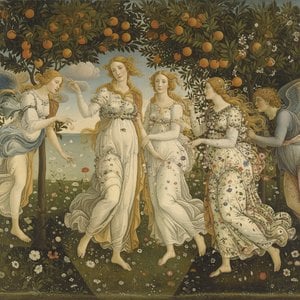
Calumny Of Apelles -
Sandro Botticelli’s *Calumny of Apelles*, painted around 1495, is a captivating and complex work that transcends simple visual appeal. It’s not merely a beautiful painting; it’s a profound meditation on reputation, slander, and the power of deceit – themes remarkably relevant even today.
Subject & Narrative: A Scene Unfolding
The artwork depicts a dramatic scene inspired by a story recounted by Pliny the Elder about the painter Apelles. A handsome youth is being subjected to vicious whispers and accusations by a darkly cloaked figure representing Calumny (false accusation). She’s flanked by two figures: one, Ignorance, with donkey ears, eagerly listens; the other, Suspicion, casts a wary glance. The central nude female figure, often interpreted as Truth or perhaps Venus, gestures upwards towards a regal figure on a pillar – likely representing King Alexander the Great, to whom Apelles was presenting his work. At the base of the composition kneels an aged man, presumably Apelles himself, in a posture of despair and supplication.
Style & Technique: Botticelli’s Signature Grace
- Renaissance Linearity: Botticelli masterfully employs elegant, flowing lines that define the figures and architectural elements. This linearity is a hallmark of his style, bridging the gap between Gothic grace and the emerging Renaissance emphasis on realism.
- Oil Painting & Detail: Executed in oil paints on canvas, the work showcases Botticelli’s meticulous attention to detail. The smooth rendering of skin contrasts with the textured drapery, creating a visually rich surface.
- Compositional Complexity: The composition is deliberately layered and intricate, drawing the viewer's eye through various focal points – from the accusing figure of Calumny to the pleading Apelles. The architectural setting, complete with arches and columns, adds depth and grandeur.
Historical Context & Inspiration
Botticelli created this painting during a turbulent period in Florence, marked by political instability and religious fervor led by Savonarola. The artwork is believed to be a veiled commentary on the slanderous attacks leveled against Botticelli himself and his patrons, particularly Lorenzo de’ Medici. The story of Apelles provided a classical framework for addressing contemporary concerns about reputation and justice.
Symbolism & Meaning: Unveiling Hidden Layers
- Calumny: The central figure embodies the destructive power of false accusations, depicted as a monstrous beauty who thrives on deceit.
- Truth/Venus: The nude female represents Truth attempting to reveal itself, but overshadowed by the darkness of Calumny. Her association with Venus also suggests the vulnerability of beauty and love to slander.
- Ignorance & Suspicion: These figures highlight the ease with which false narratives can take root in the minds of those who are uninformed or predisposed to doubt.
- Apelles’ Despair: The kneeling artist embodies the anguish and helplessness felt by those falsely accused, struggling to defend their honor.
Emotional Impact & Aesthetic Appeal
*Calumny* evokes a powerful sense of unease and moral contemplation. The dramatic lighting, contrasting shadows, and expressive gestures create an atmosphere of tension and drama. The painting’s enduring appeal lies in its ability to resonate with universal themes of betrayal, injustice, and the fragility of reputation. It's a work that invites viewers to reflect on the importance of truth, discernment, and the devastating consequences of unchecked slander.
This artwork is an exceptional addition to any collection, offering both aesthetic beauty and intellectual depth. Its complex narrative and masterful execution make it a compelling focal point for interior design, sparking conversation and inspiring contemplation.
Photo Description: --Overall Impression-- The artwork is a Renaissance-era oil painting depicting a scene of divine revelation and human interaction. It features a nude female figure, likely Venus or another goddess associated with beauty and love, standing prominently in the foreground. She gestures upwards towards a celestial being depicted on a pillar behind her. Below, a cloaked and aged man kneels in supplication before her. The composition is complex and layered, utilizing architectural elements like columns and arches to create depth and a sense of grandeur. The use of lines is primarily linear, defining the architecture and figures with sharp edges and precise details. Shapes are predominantly geometric – rectangles, squares, and circles – forming the structure of the scene. Textures appear smooth in areas, particularly on the skin of the female figure, while the drapery and architectural elements exhibit a more tactile quality due to the brushstrokes. Lighting is dramatic, emanating from an unseen source above and behind the central figures, casting strong shadows and highlighting key features. Perspective is employed to create a sense of depth, with receding architectural forms and diminishing size of objects in the distance. The color palette is dominated by warm earth tones – ochres, browns, and reds – contrasted with cooler blues and greens in the background. Symbolic elements include the nude figure representing beauty and desire, the celestial being symbolizing divine grace, and the kneeling man embodying humility and devotion. The style aligns with Renaissance painting techniques, characterized by realism, anatomical accuracy, and a focus on classical themes. The technique is evident in the meticulous brushwork and layering of paint to achieve depth and luminosity.
Size: Unknown
Date: Unknown
ARTIST INFORMATION:
==================
Artist: Sandro Botticelli
Birth Year: 1445
Death Year: 1510
Birth City: Florence
Birth Country: Italy
Biography:
Early Life and Florentine Beginnings
Sandro Botticelli, born Alessandro di Mariano di Vanni Filipepi around 1445 in Florence, Italy, emerged during a period of extraordinary cultural ferment—the Early Renaissance. His life was deeply rooted in the city’s artistic and social fabric; he never strayed far from his neighborhood of Ognissanti, a testament to both familial ties and the vibrant creative ecosystem that nurtured him. His father, Mariano di Vanni Filipepi, initially a goldsmith and later a tanner, provided an early exposure to craftsmanship and meticulous detail—qualities that would profoundly influence Botticelli’s artistic approach. Though initial reports suggested training as a goldsmith, he soon found his calling under the tutelage of Fra Filippo Lippi, a leading painter of the time. This apprenticeship proved pivotal, immersing him in the techniques and aesthetics of the Florentine school while also connecting him to influential patrons like the Medici family.
A St



 Anteprima in scala reale
 Passa alle stampe
 Condividi
 Condividi
 Dettagli

 Scarica
 Articoli simili
 Radiografia
 Slideshow
 Statistiche

 Leggi tutto






































 L'opzione vetro è disponibile solo per dimensioni inferiori a 110 cm