x

 Ordina la riproduzione Acquista download
 Invia
Invia
 Details
 Aggiungi ai preferiti
 Scarica
 Simili
 X-Ray
X-Ray
 Slideshow
 Acrylic On CanvasWallArtSurrealist Expressionism
 1927Early Modern
 25.0 x 36.0 cm
 Museo di Tel Aviv per le Arti
Stampa giclée o su tela di qualità museale, con produzione rapida e diverse opzioni di finitura.





























Scegli tra le nostre dimensioni predefinite, che rispettano le proporzioni originali dell'opera d'arte.

È possibile inserire dimensioni personalizzate per adattare l'opera a una cornice o a uno spazio specifico. Se la dimensione selezionata non corrisponde alle proporzioni dell'immagine originale, procederemo al ritaglio dell'opera o all'estensione dell'immagine con un bordo specchiato o a tinta unita. Un mockup digitale ti verrà inviato per approvazione prima dell'inizio della produzione.
Si prega di notare che l'anteprima a schermo non riflette il ritaglio o l'estensione effettivi. Solo il mockup mostrerà accuratamente la composizione finale.
Sebbene siano disponibili dimensioni personalizzate, si raccomanda di selezionare una dimensione dall'elenco predefinito per preservare le proporzioni originali.
Consegna in tutto il mondo () in 2 settimane invece delle normali 4/5 settimane. (2 Luglio)


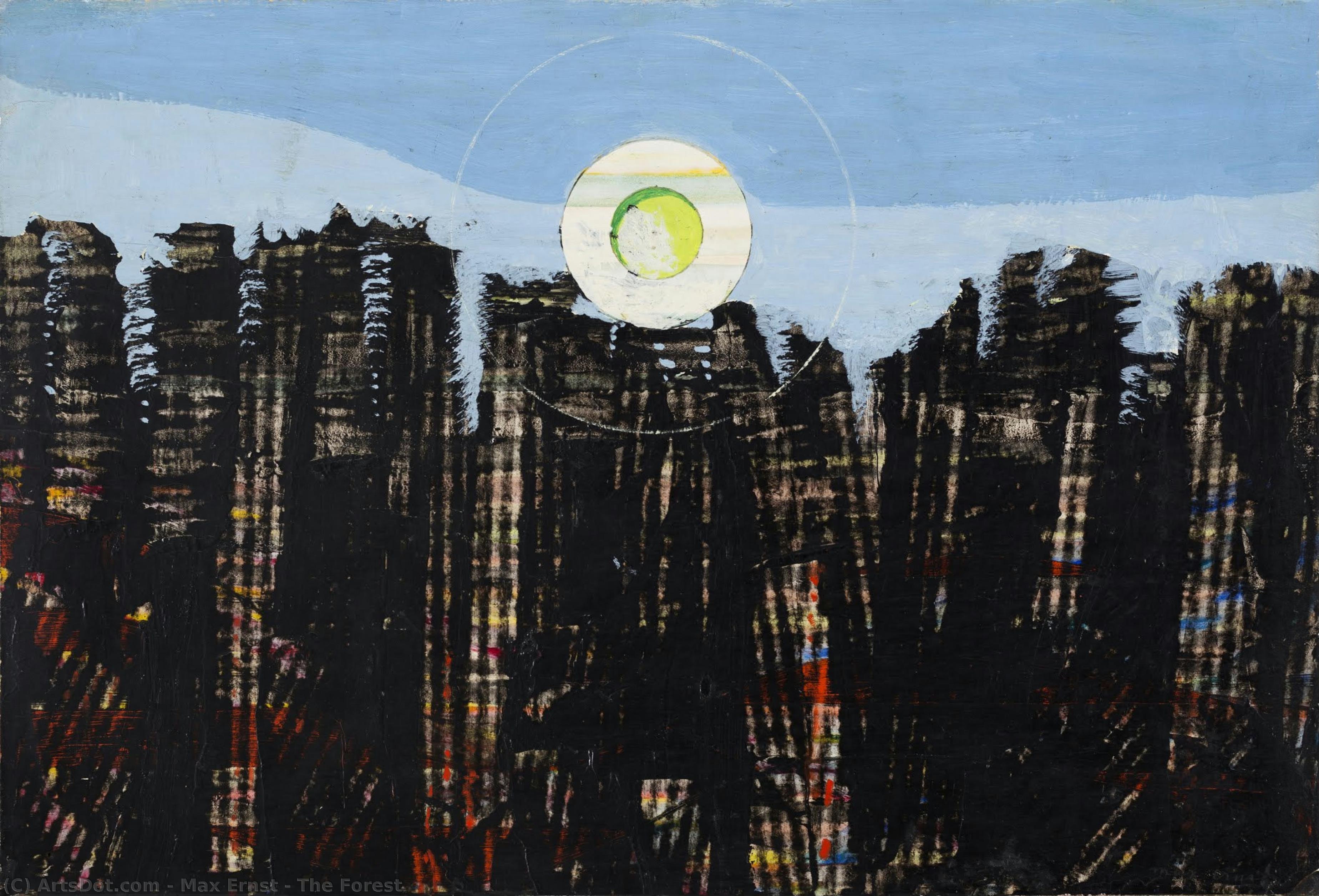
The Forest
Dimensioni riproduzione
Max Ernst's "The Forest," painted in 1927, isn’t merely a depiction of a landscape; it’s an immersion into the subconscious, a carefully constructed dreamscape rendered with the unsettling beauty characteristic of the artist’s early Surrealist explorations. This intimate canvas – measuring just 25 x 36 cm – holds within its borders a potent collision of natural and urban elements, inviting viewers to contemplate the anxieties and aspirations simmering beneath the surface of modern life. The painting immediately draws the eye upward to a luminous moon dominating the sky, casting an ethereal glow upon the sprawling cityscape below. Buildings rise from the darkness, not as symbols of progress or order, but as strangely distorted monoliths, hinting at a world both familiar and profoundly alien.
Ernst’s technique is deliberately evocative, employing a layered approach that anticipates techniques he would later refine in his collage work. He utilizes loose, expressive brushstrokes, building up the forms of trees and buildings with a sense of urgency and movement. The color palette leans heavily into cool blues and greens, punctuated by the stark white of the moon and the muted tones of the city lights – colors that contribute to the painting’s nocturnal atmosphere and imbue it with a feeling of quiet mystery. Notice how he doesn't meticulously render detail; instead, he favors suggestion and mood, allowing the viewer’s imagination to fill in the gaps.
Understanding “The Forest” requires acknowledging Max Ernst’s unique artistic trajectory. Born in Brühl, Germany, in 1891, Ernst wasn't a traditional painter; his path was forged through rigorous academic study – philosophy, art history, literature, psychology, and psychiatry at the University of Bonn. This intellectual grounding profoundly shaped his approach to art, moving him beyond mere representation towards exploring the realm of dreams, memory, and the irrational. His father, a teacher of the deaf, instilled in him a sensitivity to the world and a rebellious spirit – qualities that would become central to Ernst’s artistic vision. He was deeply influenced by thinkers like Freud and Jung, particularly their theories on the unconscious mind, which he sought to translate into visual form.
The year 1927 is crucial within this context. It represents a pivotal moment in Ernst's development as a Surrealist, a period marked by experimentation with automatism – a technique of spontaneous creation designed to bypass conscious control and tap directly into the subconscious. "The Forest," therefore, can be seen as a product of this process, a visual manifestation of his inner world.
The juxtaposition of the forest and the city is laden with symbolic weight. The forest, traditionally associated with nature, instinct, and the primal, stands in stark contrast to the rigid geometry and artificial light of the urban landscape. This isn’t a harmonious blend; rather, it's a tension – a suggestion that the encroachment of modernity threatens to overwhelm the natural world. The moon itself is a potent symbol, often linked to cycles, intuition, and the hidden realms of the unconscious. Its presence elevates the scene beyond a simple cityscape, transforming it into a dreamlike tableau.
Furthermore, consider the distorted forms of the buildings. They aren’t simply architectural structures; they seem to lean inward, almost collapsing under their own weight, mirroring perhaps a sense of unease or anxiety about the future. The trees, though present, are somewhat obscured by the city's glow, hinting at a diminishing connection with nature.
"The Forest" continues to resonate with viewers today because it taps into fundamental human experiences – the longing for escape, the anxieties of urban life, and the enduring power of the subconscious. WahooArt’s meticulously crafted hand-painted reproductions capture not only the visual details of Ernst's original but also its emotional depth and atmospheric quality. Each reproduction is created with the same attention to texture and color as the original, ensuring a faithful representation of this iconic Surrealist masterpiece. Whether you are an art collector seeking to expand your collection or an interior designer searching for a unique piece to elevate a space, a WahooArt reproduction of “The Forest” offers a captivating glimpse into the mind of one of 20th-century’s most visionary artists.


1891 - 1976 , Germania

Explore the evolution of cityscape painting from historical maps to Impressionist masterpieces. Discover artists like Caillebotte, Utrillo & Matsumoto Shunsuke. Find museum-quality reproductions at WahooArt.

Esplora i 10 capolavori del Surrealismo con WahooArt.com! Scopri le storie di Dalí, Magritte e altri maestri, il simbolismo nascosto e l'impatto di questo movimento artistico rivoluzionario. Quadri surrealisti per la tua casa: acquista stampe d'arte di alta qualità online. Scopri tutte le opere su W

Explore the rich history of forests in art! Discover Romantic masterpieces by Friedrich & Monet, Symbolist depths, and contemporary visions. Find inspiration & quality reproductions at WahooArt.
Esplora i 25 capolavori di Max Ernst, pioniere del Surrealismo. Scopri la storia, le tecniche e il simbolismo dietro ogni opera iconica. Trova riproduzioni arte su tela di alta qualità per decorare casa con WahooArt.com.

Esplora i 25 capolavori di Joan Miró, pittore surrealista catalano. Scopri la storia, il simbolismo e le tecniche dietro opere iconiche come 'La Fattoria'. Stampe d'arte e riproduzioni su WahooArt.com per arredare con stile.


Rimani aggiornato sulle ultime novità dell'arte, sulle offerte esclusive e sulle idee di decorazione.
Raccontaci del tuo progetto e i nostri esperti d'arte ti proporranno 3 suggerimenti artistici personalizzati.
Lascia che ci pensiamo noi: 3 opzioni su misura per te – Gratis!
 Condividi

 Scopri di più







 L'opzione vetro è disponibile solo per dimensioni inferiori a 110 cm