The Hammock (La Reve) – Gustave Courbet’s Embrace of Tranquility
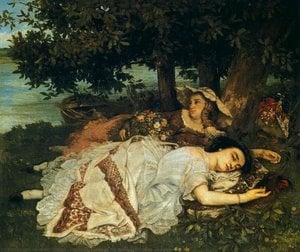
Gustave Courbet's “The Hammock,” completed in 1844, stands as a cornerstone of Realism and an enduring testament to the artist’s unwavering commitment to portraying life exactly as he perceived it. More than just a depiction of a simple domestic scene—a woman resting peacefully in a hammock amidst lush foliage—the painting embodies a profound philosophical stance: a rejection of Romantic idealism in favor of honest observation and unflinching representation.
A Snapshot of Rural Idyllic Life
The canvas captures a moment of serene leisure, transporting viewers to the tranquil countryside. A woman lies supine on her stomach within a hammock positioned centrally against a backdrop of towering trees—a deliberate choice by Courbet that harkens back to medieval iconography and elevates the commonplace into something sublime. Scattered apples punctuate the composition, adding splashes of color and reinforcing the painting’s connection to nature.
Technique and Style – The Troubador Influence
Courbet employed a masterful technique characterized by thick impasto—heavy application of paint—creating palpable texture that mimics the roughness of bark and foliage. This bold approach distinguishes “The Hammock” from the smoother surfaces favored by academic painters of his time. Influenced by Eugène Delacroix and Théodore Géricault, Courbet nevertheless forged his own path, prioritizing expressive brushwork over meticulous detail. The painting exemplifies the Troubador Style—a revival of medieval artistic conventions—demonstrating Courbet’s ambition to master its techniques while simultaneously conveying a mood of profound calm.
Symbolism and Emotional Resonance
Beyond its visual beauty, “The Hammock” resonates with deeper symbolic meanings. The hammock itself represents repose and vulnerability, mirroring the woman's posture—a deliberate allusion to depictions of Mary Magdalene in medieval art. Courbet’s masterful use of light and shadow enhances the painting’s emotional impact, creating an atmosphere of contemplative stillness. It invites contemplation on themes of peace, solitude, and the beauty of the natural world.
A Legacy Preserved – The Oskar Reinhart Collection
Currently housed in the Oskar Reinhart Foundation in Winterthur, Switzerland—specifically within the Kunst Museum Winterthur | Reinhart am Stadtgarten and the Oskar Reinhart Collection ‘am Roemerholz’—“The Hammock” continues to inspire admiration for its artistic integrity. Its inclusion in this prestigious collection underscores Courbet's enduring influence on art history and ensures that his masterpiece remains accessible to future generations.
Domande e risposte
Quale stato d'animo esprime "The Hammock (also known as La Reve)" di Gustave Courbet all'interno di Contemporary Realism?
"The Hammock (also known as La Reve)" trasmette un tono emotivo Serenità all'interno del movimento Contemporary Realism.
È possibile visualizzare "The Hammock (also known as La Reve)" di Gustave Courbet sotto diverse illuminazioni?
"The Hammock (also known as La Reve)" può essere esaminata strato dopo strato nella pagina Raggi X dell'opera, un visualizzatore ispirato al banco luminoso di un restauratore che offre undici letture ottiche dell'immagine.
"The Hammock (also known as La Reve)" è disponibile come stampa d'arte di alta qualità?
Per ordinare una stampa di "The Hammock (also known as La Reve)" di Gustave Courbet, ti basta cercarla nella sua pagina dedicata Stampa Fine Art: una stampa fine art su tela di cotone o carta canvas d'archivio.


 Anteprima in scala reale
 Invia
Invia Condividi
 Dettagli opera
 Guida
Guida

 Scarica
 Simili
 Radiografia
 Slideshow
 Domande e risposte
 Statistiche

 Espandi i dettagli
 Passa alle stampe





































 L'opzione vetro è disponibile solo per dimensioni inferiori a 110 cm