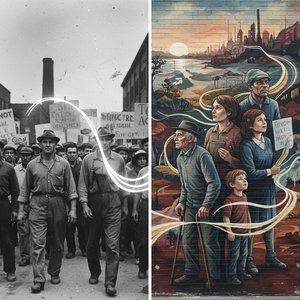
LaMar Baker: A Voice of the South
LaMar Baker (1908-1994) wasn’t a name widely recognized during his lifetime, yet his art—a potent blend of social realism and surrealist imagery—continues to resonate with profound significance. Born in Chattanooga, Tennessee, into a family grappling with the realities of poverty and racial injustice, Baker's early life instilled within him a deep empathy for the marginalized and a fierce desire to document their experiences. His journey as an artist wasn’t a straightforward ascent; it was forged through rigorous self-discipline, exposure to diverse artistic influences, and a commitment to using his craft as a tool for social commentary. Baker's work offers a stark yet beautiful portrayal of Southern life in the mid-20th century, capturing both its hardships and its enduring spirit.
Early training shaped Baker’s approach. He began his artistic education at the High Museum School in Atlanta under the guidance of Ben Shute, a prominent figure in American art education. This foundation provided him with essential skills but it was his relocation to New York City in 1935 that truly catalyzed his development. There, he enrolled at the prestigious Art Students League and found himself profoundly influenced by Harry Sternberg, a teacher known for championing social realism and encouraging artists to engage with pressing social issues. Crucially, Baker’s exposure to the work of masters like Thomas Hart Benton, Louis Lozowick, and particularly John McCrady—a New Orleans artist who depicted the lives of Black people in vivid detail—provided him with a crucial model for addressing racial inequality through his art. These influences combined to shape a distinctive artistic voice that would become synonymous with Baker’s oeuvre.
Thematic Concerns: Race, Mortality, and Southern Landscapes
Baker's work is fundamentally rooted in the social realities of the American South during a period of immense upheaval. He didn’t shy away from depicting the harsh realities faced by Black communities—the struggles with poverty, systemic racism, violence, and exploitation. His most famous series, “Cotton Field Saint,” powerfully illustrates this through a haunting image of a young boy kneeling in a cotton field, his face etched with sorrow and resignation. This piece, along with many others, serves as a poignant reminder of the human cost of economic hardship and racial discrimination. Beyond depictions of social injustice, Baker also explored themes of mortality and the passage of time. Works like “Necrophile,” a striking charcoal drawing depicting death and mourning, demonstrate his willingness to confront difficult subjects with unflinching honesty. Furthermore, he frequently captured the beauty and melancholy of Southern landscapes—rolling hills, dense forests, and winding rivers—often imbuing them with symbolic weight.
Technique and Style: Printmaking and Narrative Imagery
Baker’s artistic style was characterized by a distinctive blend of realism and surrealism. He primarily worked in printmaking – woodcuts, etchings, and lithographs – techniques that allowed him to create both detailed depictions of everyday life and evocative symbolic imagery. His prints are often densely layered with narrative elements, inviting viewers to contemplate the stories behind each scene. Baker’s use of line and shadow was particularly masterful, creating a sense of depth and atmosphere. He employed bold lines and dramatic contrasts to draw attention to key figures and details within his compositions. His work wasn't simply representational; it aimed to convey emotion and meaning through carefully considered visual choices. The influence of John McCrady is evident in Baker’s ability to imbue seemingly mundane scenes with a sense of profound human drama.
Legacy and Recognition
Despite facing challenges and often working outside the mainstream art world, LaMar Baker left an indelible mark on American art. His work gained recognition through exhibitions and awards, including a fellowship from the Julius Rosenwald Fund in 1942, which enabled him to travel throughout Mississippi and Louisiana documenting the lives of Black people in the rural South. Alain Locke, a prominent writer and civil rights advocate, praised Baker’s ability to “provide the American public with a new artistic frankness and social honesty.” Today, his work is increasingly recognized for its powerful social commentary and its unique blend of realism and surrealism. The Columbus Museum holds a significant collection of his prints, ensuring that his art continues to be studied and appreciated by future generations. LaMar Baker’s legacy lies not only in the beauty of his artwork but also in his courageous commitment to using his talent to shed light on the injustices faced by marginalized communities.
Kérdések és válaszok
Hány Lamar Baker alkotása tekinthető meg a katalógusban?
A Összes műalkotás oldalon Lamar Baker 23 műalkotás alkotását tekintheti meg.
Hol tekinthetném meg Lamar Baker összes művét?
Lamar Baker minden alkotása megtekinthető a ez a weboldal oldalán, az alkotó Összes műalkotás oldalán keresztül.
Mely Lamar Baker művei a legnézettebbek?
Lamar Baker számára elérhető egy Statisztikák oldal, amely statisztikákat mutat be a művész alkotmányairól a ez a weboldal felületén.